
Walking the floor of his potato and crisp factory near Oldtown, Co Dublin, Tom Keogh greets almost two dozen staff, on a first-name basis, going about their work as he passes by.
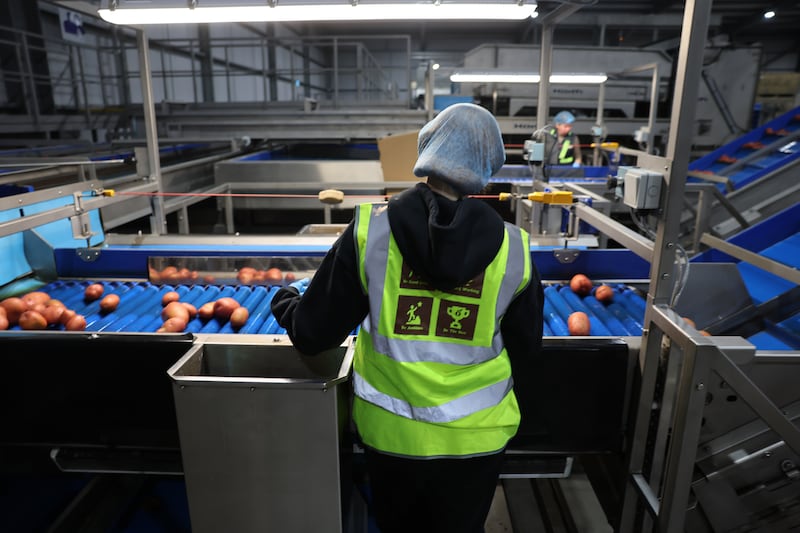
Most of the staff respond in kind, but two workers keep their eyes fixed on a stream of potatoes and crisps flowing in front of them on conveyor belts.
“Even after all the machinery has done its work, we still have human eyes on everything before it goes into a pack,” Keogh says.
Keogh’s facility is a mix of high tech and the human touch.
RM Block


In a large warehouse where potatoes are sorted, a bank of cameras takes 50 photos of each potato as they spin by and an automatic trapdoor activates if it doesn’t pass a quality test.
At the end of that process, there is a person on the lookout for unsuitable potatoes that managed to evade detection.
“The machines are just there to make the job for these people easier. I don’t think we’ll ever replace human eyes as a quality control.”
In a separate building nearby, where Keogh’s Crisps are cooked and sorted, it’s a similar scenario.
As thousands of crisps approach the end of a conveyor belt, a photo is taken of every single one. When a crisp falls off the conveyor belt, an automatic air jet individually pushes bad crisps from the production line as they are in suspension.
“And then there’s a set of human eyes again,” Keogh says. “We need humans at every stage of the process. In some cases, automation is not the right way. Human hand-on quality is really, really important.
“AI is helping in offices and I’ve had a lot of people come in and try to sell us AI products, but when you actually get into the weeds, all they’re selling are clever spreadsheets. AI is not adding massive value to manufacturing at our level just yet to a point that you would actually go ahead and invest in it.”
The Keogh family’s business is shying away from AI for now but have shown themselves to be adopters of new technology in the past when the time is right.
Keogh says his father Peter and uncle Tony were among the early adopters in the 1980s of ways to wash potatoes, which was almost “space age back then”, and invested in cold storage of their crops.
He adds they started polishing potatoes, which means the product is completely ready to cook, in 2004. “I saw a machine doing it while backpacking in New Zealand and we became the first in Europe to do it,” he explains.
The family farm in north county Dublin, which has close to 230 staff, now has three distinct divisions operating on site. The agricultural part of the business grows potatoes across 40 acres of land from Malahide as far as Dunshaughlin in Co Meath.
The packing unit near Oldtown, run by Tom’s brother Ross Keogh, sells Keogh’s branded bags of potatoes to large retailers, including Musgraves’s SuperValu and Centra, Aldi and BWG. The third business on site is Tom Keogh’s own snack food business, behind Keogh’s Crisps and popcorn, which he started in 2011.
“I remember going to the Bank of Ireland in Swords. Paddy Lonergan was the manager, and I went in to get a €50,000 loan off him. They said ‘no’ at the start, but eventually they came in and supported me. My business plan was to drive around Ireland in a van selling crisps at farmers markets.”
Giving a tour of his crisping house to The Irish Times, where five fryers now run seven days a week making his product, Keogh points to the corner of the room where it all began.
“This was an old potato store. When we were kids, we used to play on the straw on top of the potatoes in here. I rented this room off my dad and I bought a little fryer to get started. It’s hard to believe here we are and it’s completely different.”
When he was starting to scale, Tayto crisp owner Ray Coyle heard what Keogh was planning. Keogh thinks the orders of machinery tipped off the late businessman who had his own large production facility nearby in Ashbourne.
“Ray phoned me up and said, ‘I want to make them for you’, but I went and built a factory, because if Ray had made them, I never would have had that differentiation like O’Donnell’s. He made all the O’Donnell’s products, so it just would have been the same. Then Ray became a competitor and it was tough, really tough going up against Tayto.”
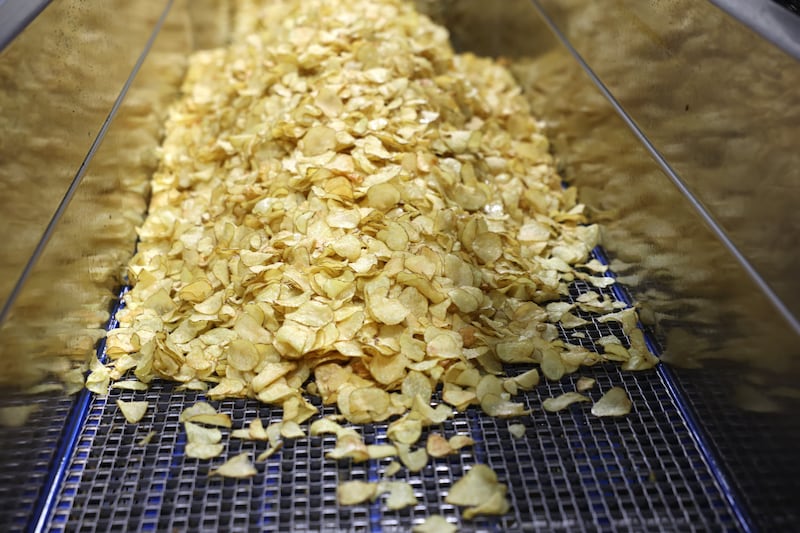
Keogh’s has gone from one small fryer to five large machines operating seven days a week, but the process hasn’t changed.
“Keogh’s Crisps have a certain bite that is our curve,” he says. “What the guys need to do here every day is just basically match the curve that I just started cooking to by chance 15 years ago.”
The process from potato to crisp takes nine minutes. Intricate machinery tracks the moisture in potatoes and manages the oil temperature in the cooking process to align with Keogh’s approach from 2011.
He points to a large screen on the factory wall that has the production plan for the day, which shows many orders for US retailers, including Costco. It also shows Keogh’s Shamrock & Sour Cream crisps being prepared for Emirates airline and stores in Dubai.
“All the Middle East business had dropped off in the past 10 weeks,” Keogh says. “We’re starting to get volumes back now, which is great to see.”
The ongoing conflict in the Middle East has caused issues for Keogh’s deliveries in the region in recent months. In March, a shipment bound for the United Arab Emirates was diverted to Mumbai in India.
“We were able to solve that because I’ve got great people in my business who come to me with a solution. Nobody will pick up the phone and say, ‘Oh God, Tom, we have a ship dropping containers off in India instead of Middle East.’
“They will say, ‘Tom, this is happening, but I think we can do this or this. What do you think?’ They call me with the solution, not the problem.”
Facing these sorts of dilemmas is a reminder to Keogh the business has scaled far beyond Ireland, where it has a 15 per cent market share. Close to 40 per cent of sales are now overseas, with the US making up 25 per cent of that total.
Keogh says sales in the US are growing fast, but it has been a tricky market to navigate since the beginning of 2025 when US president Donald Trump began threatening tariffs on imports.
“In April of 2025, we didn’t know what was going to happen, but what we can see has happened in the US is about a 20 per cent inflation in the cost of snack foods, in potato chips. That price increase in the market has more than offset the tariff increase.
“So the process has just completely raised the pricing over there. In America at the moment, food is very expensive.”
Last year, Keogh tried to keep up with the news on US tariffs as it developed, but the many twists and turns by Trump’s administration has made it very hard to judge the ongoing impact of tariffs.
“We didn’t know what the actual tariffs were until we received the first customs notes related to our products going through customs.
“So you might hear one thing in the media announced, but when you get your customs form through, the actual charge might be completely different than what was announced. Have we lost any sleep over it? No, we haven’t.”

Keogh finds himself at peace with the turbulence due to some sage advice his father passed on.
“What I have learned in my time in this business is that you don’t take harsh, quick reactions to anything like this. You need to look at the long-term view.
“My dad told me, ‘One year in five, the crop will come right and you’ll get paid’. That’s the type of environment I was brought up in, where you might lose money for a few years in a row, and I think that type of mentality around risk and cost management really works in businesses like this. It means we’re not turning around every six months telling customers, ‘We need a price increase’.”
He adds the company’s set-up as a family business has also helped it take a measured approach to the chaos in markets such as the US and Middle East.
“When you have that family ownership structure, you can make decisions like this. It’s not always about the bottom line or the percentages. It’s about the longer-term goal.
“The US is still a big market for us, but everything that happened has definitely made us take the blinkers off. We are dealing in 22 markets, 29 including ecommerce, and we’ve started to look further afield.”
The business plans to launch in Canada in the next two months and is hiring staff in the country to lead the expansion.
“I was in Canada in May to meet with distributors. That’s a big market. I think the Irish-Canadian link there is going to be a strong one, so I’m really excited about what’s going to happen in that market.”
Keogh’s business has developed far beyond that model he pitched in his first business plan of driving to farmers markets, and it has achieved his main vision.
He says the central goal all along has been to find a way to export potatoes, which he saw as a necessity due to decline in potato consumption among younger age groups in Ireland.
“I set this business up to be able to get potatoes exported outside of this country, and we’re doing that today. Now when you fly around the world, you see bags of crisps with Irish potatoes sitting in them. It’s fantastic for us and the 50 Irish potato growers we buy from.”
Exporting potatoes was Keogh’s initial vision, now he has a new one. He wants his family’s brand to be mentioned in the same breath as Irish-founded brands such as Guinness, Jameson and Kerrygold.
“That’s the vision now. If you look at any of the global Irish food and drink brands that have done this, like Guinness and Jameson, they had very differentiated, high-quality products that resonated with overseas consumers. Kerrygold, exactly the same thing.
“When you try them, you taste a difference. That’s the most important thing with food and drink, customers need to be able to taste a difference if an Irish brand is going to succeed in that marketplace, because we’re never going to compete on price here in this country.”
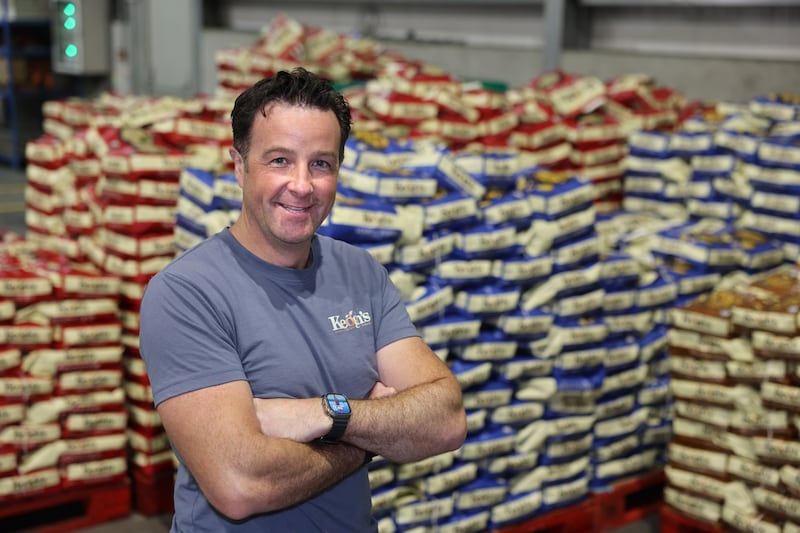
To achieve that, Keogh feels the business needs to stay in the family.
“One of the big strengths we have is customers can come in and meet the Keogh family and I can bring them around our factory. A customer can’t go to Walkers and meet Mr Walkers or Mr Tayto.
“This business is not something that’s going to be put on the market and sold to the highest bidder. This is a legacy business that, please God, someday I’ll be able to pass on to my kids.”
Keogh says he is also “enjoying it too much” to contemplate selling the business. He flits between being both eager and coy to talk about what he calls “two world firsts” Keogh’s will unveil later this year.
In recent weeks, machinery has been arriving at a new €10 million facility near Dublin Airport that will be used for its private label business and new products, he says.
“That is not focused on Keogh’s products at all. All going well, that will be operational in September and a number of new brands and companies will be created towards the end of the year.
“The snack foods market we operate in is just way too competitive. You need to be coming up with new stuff all the time because consumers are looking for new innovation all the time.”
CV
Name: Tom Keogh
Age: 46
Job: Founder and managing director at Keogh’s Farm
Family: Married to Eimear with two children, son Peter (10) jnr and daughter Heather (8).
Hobbies: Gym and sea swimming.
Something you might expect: He helps develop potato growing in Ethiopia through funding and knowledge sharing.
Something that may surprise: He went to popcorn school in Chicago before launching his Keogh’s popcorn line in 2018.


