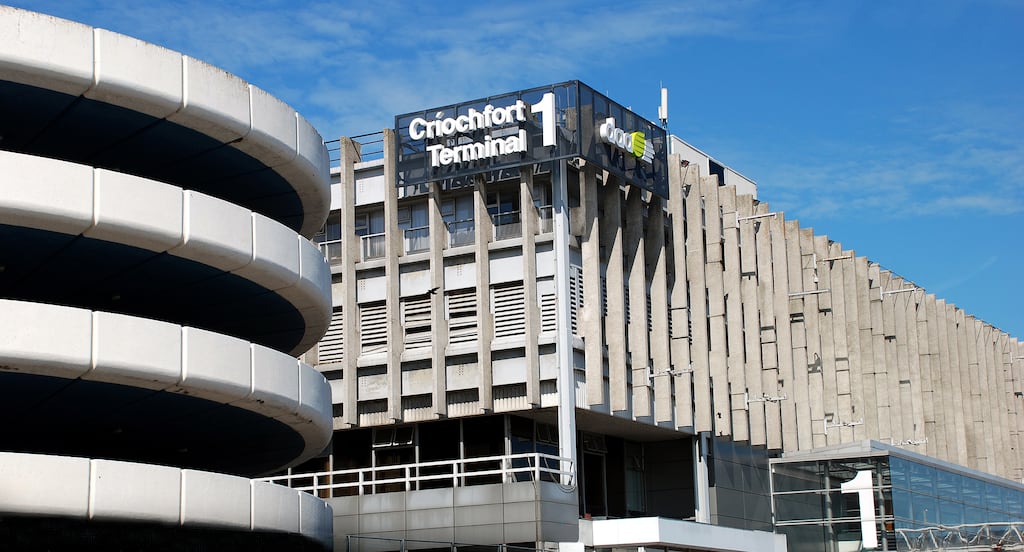
Airports operator DAA has warned of “material financial risk” from war in the Middle East, saying a prolonged conflict could have “adverse impacts” on sales and profits in the State-owned business.
Two months after US president Donald Trump’s attack on Iran ignited the worst oil shock for decades and turmoil throughout the Gulf region, the company behind Dublin and Cork airports said a significant escalation of the conflict “may pose a significant risk” to its international business.
DAA’s duty free arm Aer Rianta International has operations in Lebanese capital Beirut and also Abu Dhabi in the United Arab Emirates, Muscat in Oman and Manama, Bahrain. In addition, the DAA International consulting arm is in three Saudi Arabian locations: Jeddah, Red Sea and Riyadh.
“The group has material operations and investments across the Middle East,” DAA said on Thursday in its 2025 annual report.
RM Block


“While the group’s stores and concession operations in the region remain open, management has observed materially reduced passenger volumes at several locations.”
The 2025 report, published after the DAA’s agm with the departments of Transport and Public Expenditure, said it was “too early to assess any potential financial impact” of war on the carrying amounts of its regional assets.
“A prolonged conflict in the Middle East, where the group has significant operations, presents a material financial risk due to the potential disruption of trading conditions, reduced passenger activity, and resulting adverse impacts on revenue and profitability,” noted the report.
It went on to say widespread airspace closures and severe disruption across key hubs such as Abu Dhabi, Doha and Dubai were creating “significant uncertainty” for global connectivity and passenger demand, with implications for “core aviation business and our international operations”.
The company will pay a €66 million dividend to the Government after reporting €230 million post-tax profit in 2025, a year overshadowed by a long and bitter dispute between the DAA board and former chief executive Kenny Jacobs.
DAA reported €1.18 billion in revenues last year – compared with €1.11 billion in 2024 – and €401 million in earnings before interest, tax, depreciation and amortisation (Ebitda); 2024 Ebita was €394.63 million.
The number of passengers travelling through Dublin Airport rose 5 per cent to a record 36.4 million in 2025, the second successive year in which the annual 32 million cap was breached. However, enforcement of the cap is on hold pending litigation in the Irish and European courts.
“The most immediate short-term constraint, the 32 million annual passenger cap, has been recognised by Government and we welcome its commitment to address the cap by introducing legislation in 2026,” said Basil Geoghegan, outgoing DAA chairman.
Geoghegan will be succeeded in June by Gary Owens, the Dublin Bus chairman, who was previously chief executive of insurer Hibernian and financial services company IFG Ireland.
The DAA board is in flux right now, with several current and looming vacancies to be filled by Minister for Transport Darragh O’Brien. At present, the board is comprised of four worker directors, three non-executive directors appointed by the Minister and the non-executive chairmanship held by Geoghegan since 2018.
Data from the Stateboards.ie website show four DAA board seats appointed by the Minister are vacant. The terms of another two ministerial appointees expire in July and September.
DAA is under the day-to-day command of deputy chief executive Nick Cole, who took on the role in December as the board’s dispute with Jacobs escalated.

Jacobs left DAA in February after settling his High Court case against the company on confidential terms. The financial costs on DAA arising from the affair, which rumbled for most of 2025, are unlikely to be disclosed until the company’s 2026 annual report is published this time next year,
A process to appoint a permanent successor to Jacobs is under way, but is set to continue for some time yet. The DAA chief executive is an ex officio board member, but the deputy chief executive post does not take a board seat.


