
The classic postcard image of Galway city is one of tourists at the Spanish Arch and buskers on Shop Street.
For many Galway residents, however, a more fitting image of the city might be the gridlock on Quincentennial Bridge, the snail’s crawl down Lough Atalia or the sheer insanity of the Joyce Roundabout when school lets out on a Wednesday afternoon.
Galway city has been choked by traffic for more than 30 years. For much of that time, the promised construction of some sort of ring road has been offered as the solution.
An Coimisiún Pleanála is expected to publish its ruling on the latest planning application for the N6 Galway city ring road in January.
RM Block


There are few in Galway who believe that, however. A negative judgment from the planning authority would likely bring the project back to the drawing board, while a positive ruling would open the door to a High Court judicial review and, in time, input from the Court of Justice of the European Union.
High Court challenges to a previous grant of permission for the 18km ring road project, estimated in 2016 to cost €600 million, led to An Coimisiún Pleanála’s predecessor conceding its decision contained legal flaws, so the planning application should be considered afresh.
While this project takes its latest trip on the planning merry-go-round, other developments that could have a major impact on congestion in the city have remained on the back burner.
There is the much-vaunted BusConnects Galway project, which promises a complete redesign of the city’s bus network.
This project was last month shelved until 2027. The National Transport Authority (NTA) admitted to the Oireachtas Transport Committee that funding is an issue.
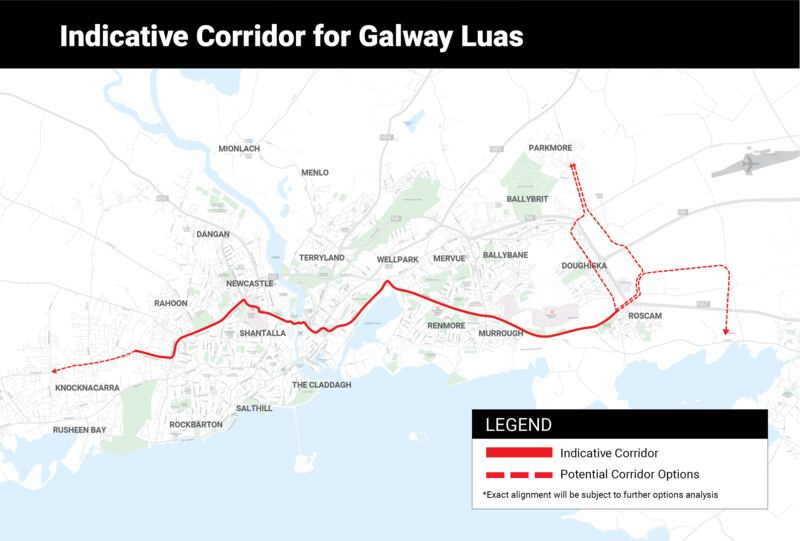
There is also the “Gluas”, or Galway Luas, a light rail project that is projected to remove some 13 million car journeys annually from Galway city, But, according to its main backers, the proposal is trapped in suspended animation until the Galway ring road is either built or scrapped.
There is the proposed new walking and cycling bridge over the river Corrib, which, aside from being a central part of the Clifden to Galway Greenway, will connect the University of Galway to the city. It will also open a new transport artery to the Corrib Causeway, the substantial social and affordable housing project being developed by the Land Development Agency and Galway City Council.
This proposed bridge, which has been allocated €5.5 million from the Government’s Urban Regeneration and Development Fund (URDF), was dealt a blow in November when the NTA said it could not cover the remaining cost of the development.
Much like Galway’s frustrated commuters, each of these possible developments is in gridlock awaiting the ring road project decision and any ensuing fallout.
“The issue isn’t funding, the issue is the courts,” said Social Democrats councillor for Galway City Alan Curran. He said it is “clear” someone will take a judicial review if permission is granted, and this would then “rumble through the High Court, the Supreme Court and go all the way to Europe.”
“If it is refused, what do we do then? Do we go back to the drawing board, do we reopen the design, which I think is probably inevitable. And then are we talking about another 10 years,” said Mr Curran, who is a long-time advocate for active travel.
He sees “no end in sight for this ring road, regardless of whether An Coimisiún Pleanála grant permission or refuse it”.
[ Imagine if Ireland could lay rail tracks as quickly as it builds roadsOpens in new window ]
A spokesperson for Galway City Council said the ring road is just one element of its “multimodal transport strategy” that aims to “reduce the reliance on private cars”.
Recent council moves in this direction include expanding parts of the bus network, the creation of new cycling and walking infrastructure in some areas and the redesign of two of the city’s roundabouts.
But after enduring decades of congestion, the people of Galway are hungry for a silver bullet. For many, that is the N6 Galway City Ring Road, which makes it politically challenging for any public representative to raise concerns about it.
Mr Curran is “not against the ring road”, but he believes it is a “1960s-style expressway”.
“There is no provision for a footpath. There is no provision for a cycleway. There is no provision for a bus lane on it,” he said.
He believes the drawn-out saga over the route has stymied progress that might otherwise be made in other areas.
One such option, the Gluas, has been a talking point since long before a ring road was ever spoken of in Galway.
First put forward by the engineering department of then-University College Galway in the 1960s, the project has gained momentum in recent years, with an NTA study identifying it as a cost effective option for the city.
Brendan Holland, who operates Holland’s newsagent in Eyre Square, has been campaigning for the Gluas for nearly 20 years.
While keen to point out his campaign group is not against the ring road, he believes the €1.4 billion the NTA estimates will be needed to develop the light rail system, could end up being less than the final cost of the ring road.
“Galway is the 56th worst city in the world when it comes to congestion and it is costing us millions,” he said.
“According to the Government’s Cost of Congestion Report, it is costing every man woman and child nearly €1,000 a year. It is costing money, it is costing people’s health; it has gone on and on and on,” he said.
“I am 50 years here in Eyre Square, I don’t want to be knocking our city, it is a fabulous city, but if this carries on it will be really detrimental to the image of Galway.”
Another recent setback is the NTA’s decision not to fund the remaining cost of the pedestrian and cycle bridge over the river Corrib, instead focusing on other active travel developments in the city.
A Galway City Council spokesperson said the local authority “remains committed to the development” and is “working to identify additional funding opportunities” to allow it to continue.
The NTA, however, said that, while it is “a project with merit”, it does not “represent a priority”. To co-fund the bridge, at an estimated cost of €10 million, “could put at risk the delivery of the core network across the wider city”, it said.
Mr Curran said he does not criticise the NTA “at all”, as it can only do so much with th money it is given.
“I would love that beautiful shiny bridge; it would be transformative for the area. For me, trying to get my kids to school in the morning, I think it might be more impactful to spend the money in the community.”
He said the city’s residents and workers have been landed with an unfortunate choice between the bridge and the ring road. “We can have one or the other, but we can’t have both.”


