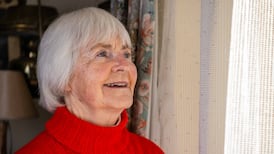
I am sitting in author Alice Taylor’s favourite part of her home. We’re facing each other in two armchairs beside the sunlit window of the front livingroom, which overlooks Main Street in Innishannon, Co Cork. At intervals, the sunlight is briefly blocked by the large lorries that travel through the village; commercial traffic that wasn’t here when she and her late husband, Gabriel, moved to Innishannon back in 1961.
There are window boxes on the outside of the window. “I always have my lunch out here,” Taylor says. “I love looking at my window boxes. They benefit people out there on the street, but they benefit me too. You feel there is a garden outside the window. I am right in the middle of the village and I love it.”
Wearing a bright orange jumper, Taylor herself glows like a flame in the sunlight. She is now 87, and has recently published a new book, Weathering Storms. Her hugely successful memoir of a rural Irish childhood, To School Through the Fields, was published in 1988. Ever since, she has continued to publish work reflecting on life in rural Ireland, and on topics such as grief, community, and faith. Weathering Storms is, astonishingly, her 33rd book.
Originally from a farm near Newmarket in North Cork, when Taylor and her husband moved to Innishannon, they ran the local post office. It’s now the Gala supermarket, and much extended. “At that time, there were four shops and three pubs, and no housing estate, and we all knew each other. We were very interconnected,” she recalls. “There was a blacksmith over in the forge at the other end of the village.”
RM Block


In 1965, they bought a corner property on Main Street for £2,700 – “a fortune in the 1960s” – and turned it into a guest house, extending it over time. “We started off with six or seven rooms and ended up with 17. It was a busy guest house. Tourism was booming at the time. It was before the Northern Troubles started.”
So how has the village changed since that time? “There is a huge hinterland of housing estates up behind the village. People didn’t have to make an effort long ago to preserve community. That’s the way it was. But now we have to make the effort for the people who come in. To make them feel part of the place.”
She talks about the importance of community. “Friendship and community is hugely important. I think it is a huge loss to Ireland that we got carried away with mobile phones and the internet, and we have forgotten how to talk to the fellah living next door. I have a mobile phone but it is in the press most of the time, out in the kitchen. I would use it if I went for a walk in the woods, or if I wanted to take photographs, but I think it is very important when you are out to interact with people. To acknowledge the presence of another human being, especially in villages and small towns. To say good morning and good evening, and to connect with people.
“I read in some paper last year that Ireland is one of the loneliest countries in the EU to live in. That’s a scary thing to think about. We were ‘Ireland of the Welcomes’, and now we are one of the loneliest countries to live in – how did that happen?"

Her husband, Gabriel, died 20 years ago. They had five children. She still talks to him, she says, and “members of my A-team”, every day. “When I have a dilemma, I call on my A-team.” Other close deceased relatives form part of the team that she chats away to in between her communications with the living, such as her daughter and grandchildren, who also live in the village.
Her faith, which has been a constant in her writing, remains a key part of her life. “I was reared in a very Catholic house. My mother was a rosary woman. She had great faith in the goodness of human nature. My mother’s philosophy was everyone is as good as they can be. My father loved nature, and wonder of creation. Creation and the divine creator was all intermingled.”
Taylor goes to 9.30am Mass on the weekdays it is celebrated in Innishannon, which is Monday and Wednesday. “It’s usually about 15, with the usual crowd. Some mornings you could have 20 or 30. Some mornings you’d only have 10.”
How did the church scandals in Ireland of recent years impact on her faith?
“I think I looked at this way. The staff – I mean the priests who were supposed to take care of the divine, messed up – but in a sense we allowed it to happen; we the lay people. In a way, the church became too powerful.”
She makes an analogy between the legacy of colonialism and the new holders of power over citizens in Ireland. “The control slipped from the British to the church. That was a terrible mistake. But when you look around the world, all power is corrupting. But in a way, your belief, your religion, is a very personal thing. You have to work it out for yourself.”
[ Alice Taylor: ‘At Christmas you’re closer to things you don’t understand’Opens in new window ]
As part of her daily routine, she tries to practice meditation for half an hour in the mornings.
“When I came to Innishannon, there were a lot of books in the house we were in. One of the books I picked off the bookshelf – and I’m talking now about 1960 or 1961 – was called The Magic Power of Your Mind. And there was a book about yoga too. I had never heard of yoga. And I didn’t know that much about the magic power of your mind. But I have been thinking ever since that your attitude is huge in your life. Inevitably you have grief, and things go wrong, but you have to pick yourself up and get going again.”
At one stage of the interview, Taylor makes tea, and brings out slices of apple cake on a tray, from an old family recipe. The apples used to always come from the tree in her garden, which fell in a storm, and which is the focus of her latest book. Now they come from a neighbour, and their bounty is laid out in a passageway off the kitchen. The apple cake, made with butter and eggs, is light and so delicious I later text my sister and tell her it is the best home baking I’ve had since our mother died.
I ask Taylor which of her many books is she the proudest of.
“The Gift of a Garden,” she says. There is a large garden at the rear of the house, full of nooks, and walkways, overgrown statues, trees, and flowers currently asleep.
“I am not a good gardener, and I know nothing about the names of plants. But I love gardening. I think it’s the farmer in me, really. I love working with the earth. The garden healed me when Gabriel died. I’d go out into the garden in the morning feeling bad, and after a couple of hours, I’d be better. There is therapy in working with the earth. There is more to gardening than flowers.”
She tries to spend some time in the garden every day. “I’ll walk around, and as soon as you go into the garden, jobs jump out at you, plants are saying, look at me! Look at me! So there are always things looking for my attention. I often spend longer in the garden than I planned to.”

Taylor’s current book took some two years to complete. “I wrote my first book with a pad and pencil and a rubber. I had no idea how to type,” she says. Taylor later taught herself to type from a commercial handbook, after her family gave her a computer as a gift. She uses a laptop now, a gift from her daughter. “I’m not a constant writer. When I start, then it’s all day every day. When I’m writing, I’m writing 100 per cent. And when I’m not writing, I’m still writing in my head.”
She regularly receives a number of letters and cards, particularly after the publication of a new book. “I reply to them all,” she says. They build up over time, and then she will sit down and clear the pile. “Often they are handwritten letters. If people take the time to write, you should have the common courtesy of replying. I am always intrigued about people’s reaction to what you write. People might say they found comfort in something I had written, as they did when I wrote a book about bereavement. Mainly women write the letters but some men do too.”
Taylor also has an art studio upstairs, where she paints farm animals and rural scenes. “Creativity is the greatest gift we have. Our creativity is baking, painting, flower arranging, gardening, writing.”
Now that she is approaching her 10th decade, what advice does she have for anyone still some decades behind?
“You slow down. You have no choice, You appreciate things you might have passed before without even looking at them. I love to stand and smell things in the garden. You stand and listen to the birds. When you read a book, you take it in more slowly. You absorb it. You appreciate the people around you more. It is very important to be grateful.”
She thinks for a while. “We have to make life around us as good as we can. Nobody else can do it for us. It is up to yourself. Life happens, things go wrong, but it is an awful lot to do with your attitude. Keep involved in your local community. Be less judgemental of everything, of people maybe mostly. Look for the good in people. Appreciate things. Don’t get preoccupied with your pains and aches.”
We drink more tea. “Take time to be kind,” she says. “Kindness brings back kindness. It takes time to be kind. It takes time to stop and talk to people. If somebody is going through a hard time, it takes time to sit down and write a letter or write a card. Never suppress a good impulse. Just do it. Stop questioning it, just do it.”
Weathering Storms by Alice Taylor with photography by Emma Byrne, is published by O’Brien Press. Taylor has also written the foreword to The Irish Farm in Colour by Michael B Barry and John O’Byrne (Gill Books)