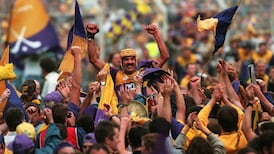
In the St Martin’s clubhouse there is a giant mural on the wall, a vivid tableau of local landmarks and wildlife and bloodstock and flowers and hurlers and footballers. At its centre, though not out of scale, George O’Connor is depicted in the image that defined his hurling life in the end: kneeling in the middle of Croke Park after the 1996 All-Ireland, his hands joined in prayer, head bowed slightly, a picture of incongruous stillness.
In his 17th season, that was his last match for Wexford. Throughout the 1980s and into the 1990s, every Wexford jersey he wore was infused with defiance. In that time, they lost a lot of big matches, half a dozen Leinster finals, five league finals, each one held against them like a court conviction. In the eyes of the public, though, O’Connor’s record was clean. For his virtuoso performances and his faithfulness to the fight, he was showered with admiration.
In the GAA, every hero is a local hero first and last. It is an unusual life of standing out and blending in. “If you’re in a county that only wins an odd All-Ireland,” he says, “there’s a kind of expectation on those individuals to walk correctly in life. And to perform in life.”

A little over 10 years ago O’Connor reached a reckoning about that, performing in life. Without any warnings that he understood, a tipping point crept up on him.
RM Block


He had left farming to become a full-time coach with the Leinster Council, and he played that game like losing was out of the question. He remembers one day coaching 1,153 young people and a day later coaching another five or six hundred. When he started, he conducted 30 weeklong courses in a row, Monday to Saturday. Kilkenny had beaten Wexford by 28 points in the Leinster championship. There was no time to waste.
Driving to a school in Curracloe one day in 2014 he blacked out behind the wheel. Miraculously he careered through a gate, rather than hitting the stone wall that ran for 80 yards on either side of it, and the car came to a halt on top of a ditch. All of his injuries were superficial.
The accident made him stop. “I thought I was bulletproof,” he says. When he looked for help, they reached for labels. He was diagnosed with anxiety, though it was more than that. “It’s like the electrical circuit in a house – the whole thing was overloaded.”
He didn’t know how long this had been building up or what had triggered it now. He took a breath. After a few months he thought he was feeling better and he tried to resume what used to be his normal life, but it was miles too soon. Nothing had been resolved.
For all of us there’s a wheel: mental, physical, emotional, spiritual and sexual ... They all need to be addressed
O’Connor’s search for help led to periods in residential care. The first time he was admitted to St John of God’s in Dublin he stayed four months. “I used to go up there for safety,” he says. “What was it like? Beautiful. Fantastic. People would think there’s a shame in going in there. There’s no shame – it’s the courage, the courage to look for help.
“People used to call me and call in to see me, but some people were unable to ring because they didn’t know what to say. Paudie Butler [the GAA’s national hurling director and close friend of O’Connor] found it difficult. He was so mournful because I was so close to him. He was nearly grieving. Here was someone that was fully alive, but, in his eyes, he couldn’t see the soul any more.”
It was four years before he started to feel better and there were periods during that time when he couldn’t see a way out.
“There were times when I’d have sooner gone to heaven than be where I was. I was nearly gone. It was a tug of war. Only for my beliefs – spirituality kept me alive. I remember one morning in particular was really, really tough. I didn’t think I’d get back into the house.
“The lads [two daughters and a son] were only young at the time and it was tough on them without their dad. I was just a shell. I couldn’t eat, I couldn’t sleep. I couldn’t watch television or read the papers. I couldn’t do anything. I was living on milk and eggs and coffee. No talk. I couldn’t lift an empty wheelbarrow I was that weak. I was just gone.
“When that happens it takes a bit of courage to say, ‘I need help.’ If I hadn’t got help I probably wouldn’t be speaking to you now. And my wife Ellen, I don’t have the words to describe how strong she was, to bring up the lads in those four years.”
It wouldn’t be pushed or pulled. O’Connor kept searching for something that would make a difference and all the while he depended on the goodness of others. He lived in the giant embrace of family and friends. Eventually things got better. He couldn’t say exactly how or when. There was no eureka moment.

“I did hear the old cliche, ‘Listen, will you cop on to yourself. Look at everything you have. You need a kick in the backside.’ Those lines do not work.”
Two of his greatest friends, Liam Griffin and Fr Jim Finn, encouraged him to return to the land. Paud and Michael O’Brien have a landscaping business, and they asked him to join them. By then O’Connor’s long frame was only carrying 70kg (11 stones), but he had found a path.
“I got my hands back in the land. The land is a healer. The land will give you a hell of a lot more than you could ever give back.
“I wouldn’t wish what I went through on anyone but, would you believe, I’d go through it again to get to where I am now. The gift I got was the gift of being present and I got the gift of letting go. The self-awareness I have now, I never had before – not even close to it. I know I’m no good to you or that young person over there if I don’t mind myself. I need to find that person in the mirror in the morning and say, ‘I’m with you today’. You’ve got to accept who you are. I’m not going to judge people. That’s what you get from four years of being in pure hell.”
O’Connor is invited into schools now to speak to young people. He says he has a “different tool box” depending on the ages of the students. The talks, though, are founded on his experience.
“What I do is life coaching. For all of us there’s a wheel: mental, physical, emotional, spiritual and sexual. That’s the wheel. They all need to be addressed, and they all need to be looked after. But you’re the only one to look after them. Your soul has no defence, only you.”
The GAA remained a constant in his life. His daughters, Katie and Ella, played camogie for Wexford and his son Barry was a Wexford minor. But when Barry was 19 he was offered a chance to try Australian Rules by the Sydney Swans and he seized it.
“We were delighted. Thrilled to bits. An opportunity like that, for a young fella, you have to take it. But only about one in 20 make it. He was with the Sydney Swans for three years and then he went to the Giants, the club next door, and he’s been a semi-professional with them.”
Barry hadn’t hurled for five years when St Martin’s wondered if he would play in last year’s county championship. St Martin’s won the county final, and he stayed until their interest in the Leinster championship had ended. This year he came home again.
“He’s so athletic and so fit and he’s actually quicker [than he used to be] as well,” says George. “He’s quite tall and he’s big and it’s not that easy to move an Australian Rules player off the ball. These guys get hit so hard over there, it doesn’t matter how hard you hit them you won’t put them off the ball. When he came back last year he wasn’t as proficient with the stick as he is this year. This year he spent a little bit more time playing hurling down in Sydney.”
St Martin’s didn’t win a senior title in George’s time. He made his championship debut as a gangly wing forward when they won the intermediate final in 1977; he was 17 and the corner forward playing inside him was 42. Different times. “The hurling was tough. Very tough. There was first time striking and overhead striking but God only knows where the hurley would end up. People came to matches to see the blood and thunder. Players survived it but it was too tough.”
In his career St Martin’s lost two senior finals. In 1994, they were beaten by Oulart-the-Ballagh, when both clubs were looking for their first title. The following morning Martin Storey from Oulart, and his wife, arrived at George’s door. “If you want to define sportsmanship and camaraderie and togetherness and respectfulness, whatever you want to call it, that was Martin Storey.”
After the 1996 All-Ireland final, O’Connor only played one more hurling game for St Martin’s. He was nearly 37 by then and the fingers on his catching hand had been broken 17 times. In 1999, when St Martin’s won their first Wexford title, they approached him before the semi-final to come out of retirement, but his “heart wasn’t in it”. That time had passed.

This weekend St Martin’s will contest their first Leinster final in Croke Park and in different ways he is immersed in it: his son and four of his nephews are in the squad and his brother John is part of the management team. The Wexford title they won this year was their fourth since 2017. A day like this had been coming. “There’s a golden period for every club – we’re in the golden period of our club.”
He looks well. Fit. Lean. There’s a lightness in his eyes and in his company, there’s a glow in his face. He is retired now but he has things to do; none of them a burden.
“I have unbelievable contentment,” he says.
He smiles.