Most of the time there is nothing more predictable in sport than the acceptance speech at any end-of-year awards. The winners invariably thank their coaches and family, pay a heartfelt tribute to all their rivals, then head swiftly towards the bar.
But Mondo Duplantis couldn’t let his moment pass without a little dig. Who could blame him? Sweden’s pole vault superstar had just won his third men’s athlete of the year award at the glitzy World Athletics headquarters in Monaco last Sunday night, utterly deserved after going unbeaten for a record second successive year and breaking another four world records.
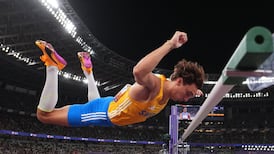
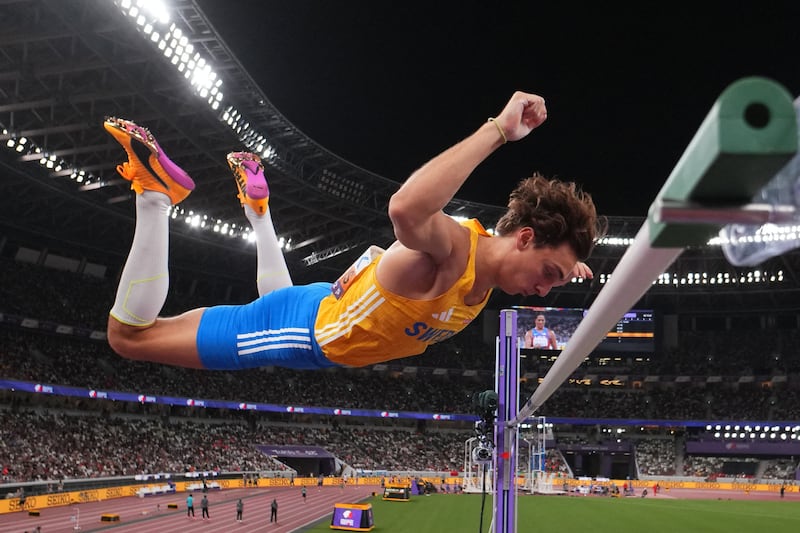
Just turned 26, Duplantis has now raised the world record bar 14 times in all, and he is far from finished yet. His latest mark on nascent greatness came at the World Championships in Tokyo in September, when after securing a third gold medal with a height of 6.15m, he went straight to the new world record height of 6.30m.
It was late in the night, Duplantis had been inside the hot field for hours, and no one inside the jam-packed stadium was going anywhere. After two near misses, he soared over 6.30m on his final attempt, breaking the only world record throughout the nine days of track, field and road competition (and earning himself a tidy $100,000 bonus).
Ian O’Riordan: Why Grand Slam Track is paying a high price for excluding field events
Jason Smyth: Ireland’s Paralympic legend on life after racing

Kate O’Connor’s father Michael wins 2025 Coaching Achievement Award from World Athletics

Dublin Marathon entry ballot creates some rage against the winning numbers

“It’s really important for me to win this award for the field eventers,” Duplantis said last weekend. “There was another tour that tried to exclude field events. That didn’t go so well, did it?”
That was clearly pointed in the direction of Grand Slam Track, the new super-elite competition dreamed up by Michael Johnson, the four-time Olympic champion and former 400m world record holder. Johnson promised an unprecedented prize purse of $12.6 million, with $100,000 for each event category champion, all aimed at capturing a younger fan base and growing the sport in between so-called Olympic cycles.
Johnson reckoned there was no room or need for any field events. The four-meeting series would instead focus on six performance categories, each combining two events, from short sprints to long distance. With a reported investment of $30m, Grand Slam Track also claimed to have sold a TV deal to around 180 countries.

By the time of the third meeting in Philadelphia at the end of May, Grand Slam Track was already unravelling, the programme shortened from three days to two. When the fourth meeting in Los Angeles was cancelled outright, suddenly a lot of people were left out of pocket, including the athletes.
Irish 1,500m record holder Andrew Coscoran earned himself $50,000 as the overall runner-up in the men’s long-distance events at the second meeting in Miami, then another $12,500 for his fourth-place finish in Philadelphia. Sharlene Mawdsley also earned $15,000 for her sixth-place finish in the long sprints category that weekend, but it’s still unclear if or when they’ll get all their money.
According to The Athletic, the sporting wing of The New York Times, Grand Slam Track has now sent letters to all its vendors asking them to accept 50 per cent of their total owed money to prevent the entire thing from going bankrupt. This was rejected by World Athletics for future licensing purposes, and they also told Grand Slam Track they must first settle their debts with the athletes before making any deal with its vendors.
An investigation by The Athletic also found Grand Slam Track had received only $13m in investment, not the €30m originally claimed. It currently owes over $10m. The lack of any field events wasn’t the only reason Grand Slam Track has failed so spectacularly, seemingly already facing financial ruin, but it surely didn’t help.

Duplantis is arguably the most in-demand athlete in the world right now. He’s the first field event athlete to win three men’s athlete of the year awards, and only the third to win three or more, joining Usain Bolt (who won six) and Hicham El Guerrouj (who also won three).
He also jested last Sunday about his uncanny knack of increasing his world record by one-centimetre increments at a time. That’s obviously to ensure he maximises his world record bonus for as long as he can. Duplantis was also frank in admitting many people watching athletics don’t necessarily care about the world record height. As long as they witness somebody breaking it.
How high can Duplantis go? He’s already billed as the star attraction for the London Diamond League next July, and there’s no doubt if he doesn’t break another world record in 2026, that constitutes an anticlimax. He has also talked about how his dad and coach Greg Duplantis made the call to use a stiffer pole for his third attempt at 6.30m in Tokyo, to optimise his elevation.
This requires a tremendous combination of strength, speed and agility, and Duplantis also explained how the catapult effect it creates is like “a pea on a plastic spoon that’s shooting across a cafeteria”.

His domination of a field event this year was only matched on the track by Sydney McLaughlin-Levrone, who duly won the women’s athlete of the year award. After making a sensational switch from the 400m flat to the 400m hurdles, it’s the second award for the US sprinter, who also won in 2022.
McLaughlin-Levrone is likewise undefeated in two seasons – or 24 races, to be exact – the 47.78 seconds she clocked when winning the 400m in Tokyo only bettered by the 47.60 run by Marita Koch from East Germany 40 years ago. And surely that is a record that has gone unbroken for an inordinate amount of time.
In the meantime, World Athletics have also realised field events aren’t to be messed with, abandoning plans to introduce a take-off zone for the long jump instead of the traditional board. The idea there was to reduce the number of foul jumps, before the athletes universally cried “no”.
Duplantis has proved field events are far from a just sideshow, although that realisation may come too late to save Grand Slam Track.