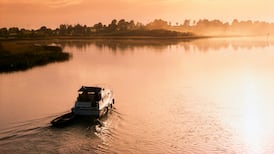
Last month, in the pages of the Nenagh Guardian, biologist Dan Minchin – the River Shannon’s sleuth of invasive and unwelcome organisms – revealed his latest find. On September 30th, he spotted a creature near the old Ballina-Killaloe bridge, whose name grabs attention: the demon shrimp.
Tiny? At barely an inch long, absolutely so, but this beast comes with an outsized reputation for being prolific and adaptable, thriving in conditions that would defeat more delicate species. With its distinctive appearance – a “striped Denis the Menace sweatshirt look”, as Dr Minchin put it – the shrimp grazes on fish eggs and insects and “even its own kind”.
The majestic Shannon needs the demon shrimp like it needs a hole in the head. Over the past few decades, the river has had to contend with an ever-lengthening roster of unwanted arrivals: Asian clams, zebra and quagga mussels, bloody-red shrimp, Himalayan balsam, giant hogweed, the crayfish plague, and chub. Now, a little demon. Native to the Black Sea – that geopolitical crossroads bordered by Turkey, Ukraine and Russia – the shrimp is kept in check by species it evolved alongside. But in new waters such as the Shannon, it may live up to its name, pushing out native crustaceans and destabilising the ecosystem they support.
The river, all 350km of it, is worn thin by the pressures we exert. It extends beyond the usual suspects: excess nitrogen and phosphorus, raw sewage, ammonia, heavy metals, and organic contaminants, and includes a cocktail of pharmaceuticals, microplastics, industrial discharges, everyday litter, and a growing number of unmonitored chemicals. It’s a punishing and reckless way to treat this magnificent river - a waterway vital not only for drinking water, industry, agriculture, recreation and energy, but for the countless species, in and out of the water, that depend on it to survive.
Let’s be ambitious for a plan to establish a real record of the majestic Shannon’s condition

An extraordinary find in the Irish Sea left experts gobsmacked

The golden plover’s numbers in Ireland have dwindled to a few isolated strongholds

A damp, soggy shed is frustratingly impractical but it has attracted visitors: snails

Ahead, the self-made challenges facing us are hardly modest: chaotic weather, heavier floods, warming waters and periodic droughts are all forecast, at the same time as we are planning to pump 300 million litres of water from it every day to serve Dublin’s drinking-water needs.
‘For all the river’s scale and importance, it suffers from a startling lack of long-term, comparable scientific data – the foundation needed to understand what’s there’
Flowing through 11 counties, the river’s fate is entrusted to a dizzying assortment of agencies, departments, task forces and policy frameworks. But how much do we know about the river itself? Yes, the Shannon has been studied; there’s plenty of data. But this information lives in silos, produced by different monitoring regimes and often incompatible sampling methods. What we’re left with is a fragmented portrait of a river we depend on, but do not fully grasp. For all the river’s scale and importance, it suffers from a startling lack of long-term, comparable scientific data – the foundation needed to understand what’s there, how the river is changing, and how we can protect it while using it for our needs. What’s missing is a single, coherent baseline: a unified snapshot of the entire river system, measured consistently and repeatable over time.
With this in mind, and working from the principle that you can’t manage what you don’t measure, Prof Fiona Regan of DCU’s Water Institute has an ambitious plan: the River Shannon Survey, a major scientific assessment repeated every four years to guide both development and environmental protection. By monitoring water quality, ecology and the rise of new, little-understood pollutants, this would establish an accurate record of the Shannon’s condition. Future surveys would build on the last, revealing shifts in the river’s health, flagging emerging problems early on and grounding policy decisions in clear, comparable evidence.
[ Algal bloom on Lough Derg prompts call for multi-agency investigationOpens in new window ]
Regan’s idea draws on the Danube Survey, widely regarded as the most comprehensive river-monitoring initiative in the world. Covering every country the Danube touches, the survey produces consistent, reliable data on water quality, biodiversity and pollution. When it began in 2001, it marked the first time the entire Danube and its tributaries had been assessed. By 2007, three floating laboratory boats had taken samples along 2,800km of the river. For policymakers, it offered something new: seeing the Danube not as a series of disconnected stretches or isolated data points, but as a single, dynamic, interconnected system.
Over the years, the Danube Survey has revealed pollution hotspots, identified rare species, and established a harmonised scientific baseline for future monitoring and, crucially, effective policymaking. Cutting-edge research technologies are used to test for emerging pollutants that go beyond EU requirements. The survey has also significantly expanded its citizen science component, involving locals, students and volunteers in understanding and protecting the river.
‘We can’t manage the Shannon with guesswork, fragmented data, siloed thinking or inconsistent oversight’
The Shannon system – the main river, tributaries, lakes and wetlands – exists as one. Pollution in one county can trigger algal blooms elsewhere; dredging can spark flash flooding downstream; water abstraction can dry out wetlands below. Without swift, agile management, even a tiny invader such as the demon shrimp can rapidly spread through the system, with unwanted and costly consequences.
We can’t manage the Shannon with guesswork, fragmented data, siloed thinking or inconsistent oversight. Rivers shift with the seasons, fluctuate over years, and evolve across centuries. A systematic, scientific survey would filter out the noise, reveal actual trends, flag emerging problems, show what works, stress test policies for climate resilience, and illuminate how the system – from source to sea – is interconnected.
If 14 EU and non-EU countries can come together every six years to understand the Danube – a 2,850km river spanning half the continent – surely Ireland can do the same for a far shorter river that begins and ends on a single island?
Every river has a story. Considering all that the Shannon gives us, we owe it to this magnificent waterway to understand that story entirely.