

For more than two years, the chief constable of the Police Service of Northern Ireland (PSNI), Jon Boutcher, has told a story of the mounting financial and recruitment crisis that has engulfed his force.
The scale of the challenges can be seen in a few startling numbers. In 2010, the PSNI received £903 million (€1 billion) from Northern Ireland’s Stormont government to carry out its duties. Fifteen years on, despite rampant inflation, it receives just shy of £930 million.
By comparison, An Garda Síochána received €1.5 billion in 2010. Today, it receives €2.48 billion from the Irish Exchequer. It’s a number that prompts unbridled envy from their Northern counterparts when the subject is raised between them.
In 2010, the National Health Service in Northern Ireland had a budget of £3.3 billion. Today, it is £8.4 billion. Stormont’s Education budget 15 years ago was £1.75 billion. Today, it is £3.3 billion.
RM Block


Sitting in his office at the PSNI’s headquarters in Knock, east Belfast, Boutcher leafs through numbers he presented recently to the House of Commons Northern Ireland Affairs Committee.
A lifelong Derby County FC supporter, the Englishman’s office is uncluttered, bar a series of neatly arranged photographs on the wall. So, too, is his desk.
“I spend as much time out of here as I can on the ground,” he tells The Irish Times in an interview.
His connection with Northern Ireland is now nearly a decade old, beginning in 2016 when he was put in charge of Operation Kenova alongside his work as chief constable of Bedfordshire, England..
The Kenova investigation brought Boutcher huge profile in Ireland. It investigated the activities of Stakeknife, the late Belfast man Freddie Scappaticci who was linked to at least 14 murders while working as a British army agent within the IRA during the Troubles.
Boutcher’s connection with Northern Ireland deepened even further in 2019 when he was given authority to investigate the Glenanne loyalist gang that killed scores of Catholics in the so-called “Murder Triangle” in Mid-Ulster.
In the years since, he has developed close ties with the families of many of those killed, including Eugene Reavey, whose three of his brothers were murdered by the Glenanne gang in 1976, and with families in Dublin who lost loved ones in the Dublin-Monaghan bombings of 1974.
Today, Boutcher’s focus is on the PSNI’s budget and how it has failed to keep up with the requirements of the North’s police force and has lagged behind other police forces in Britain.
“Pound for pound, we’re roughly where we were in 2010. And inflation has gone up close to 40 per cent. The figures speak for themselves,” Boutcher says.
“Compare us with all the forces in England and Wales – Scotland sits slightly differently – and we are the most underfunded police service on the island of Ireland or in the United Kingdom,” he says.
Simply put, Boutcher blames the outcome of the decision in 2010 to devolve control of policing and its budget to Northern Ireland’s politicians.
“Devolution has simply not worked for policing in Northern Ireland,” he says.
“We have lost out as a result of devolution. Choices have been made to support the education budget and the health budget.”
Policing, on other hand, has fallen way behind.
“I don’t think it’s seen as popular to fund the police; there’s no votes in funding the police here. Maybe that’s because it’s post-conflict,” Boutcher says.
However, he declines to offer his view on why Stormont parties, especially the Democratic Unionist Party (DUP) and Sinn Féin, are unwilling to fund the PSNI in line with other public bodies.
“That question is not for me, it is for those parties. What I’d say is I go to all of them and I get really positive answers privately. When it comes to making decisions around funding, that doesn’t transition into the decisions that need to be made,” he says.

However, there are other reasons, too, dating back to the Patten Commission a quarter of a century ago when the RUC was renamed as the PSNI, with significant numbers of Troubles-era officers retiring.
The grievances felt then by the Ulster Unionist Party and the DUP remain.
“Many people are very bruised by the way they felt the RUC was dealt with, with so many police officers murdered or left with life-changing injuries as a result of terrorism,” Boutcher says.
Despite its bigger budget – and very little reform because Stormont politicians cannot agree on it – Northern Ireland’s health service is struggling, but many of its problems end up having to be handled by police officers from the PSNI.
“The PSNI is neither resourced nor trained to deal with such issues and yet it seems we have become the frontline of mental health services,” Boutcher, a 40-year-old policing veteran, says.
Last year the force dealt with “39,000 calls of concern”.
“Many are people going through a crisis, or some type of chaos in their lives, and they’re calling us rather than getting support from services trained to support them,” he says.
“On average, we get 1,000 ambulance calls a month. Now, we will always go to people in distress, but those calls for concern from people going through a crisis of alcohol, or drug addiction, or mental health breakdowns, we are not here to deal with.
“We’re left holding the baby. I am very concerned when even grassroots organisations who previously [were] funded to look after people going through really difficult times in their lives are now not being funded anywhere near like they used to be.”
The pressures are clearly visible: the PSNI should have 952 officers in its neighbourhood teams. Today, there are 450.
The number of highly mobile tactical support groups has fallen from 13 to 11, reducing its ability to respond quickly to major incidents.
Non-emergency calls are taking far longer to be advertised, Boutcher says, leafing through the list he shared recently with the Commons Northern Ireland committee.
So-called major incident teams filled with detectives are supposed to have no more than six investigations under way at any one time, the United Kingdom’s College of Policing recommends. The PSNI’s average is 20 per team.
The numbers facing officers tasked with monitoring dangerous offenders are even worse.
“Each officer should manage no more than 50 violent or sexual our officers have caseloads of over 100 each,” he says.
During the interview, Boutcher offers example after example.
During the summer riots sparked after an alleged sexual assault in Ballymena, Co Antrim, there was much coverage of the number of officers sent on mutual aid to support the PSNI.
However, there was no coverage of a far more revealing illustration of the PSNI’s difficulties: the PSNI had to source mechanics from police forces in Britain to help keep its ageing vehicle fleet on the road.

The pressure on the vehicle fleet was worsened by the riots, but also by the challenges of policing 300 parades and 60 bonfires, with every single available officer in the force on duty.
One of Boutcher’s problems is he does not know when “the next Ballymena” will occur.
“Notwithstanding all the hard work by everybody, you never know when there may be an escalation in disorder,” he says.
The PSNI has 6,250 officers; it is widely accepted, including by politicians at Stormont, that it should have 7,500 officers, plus another 2,500 civilian staff. Today, 51 recruits are being brought in every month.
Now Boutcher is looking at bringing in outside experts to bolster his case for dealing with the effects of “chronic underfunding” by Stormont for day-to-day operations over years and by London for not meeting a £24 million annual bill for dealing with legacy cases.
The bill for dealing with civil cases, inquests and criminal investigation over the last 10 years has cost the PSNI £160 million.
“The resources to deal with legacy come from the budget provided to police Northern Ireland today, not the Troubles from the past,” he says, “There has never been any specific funding provided to the PSNI to manage and pay compensation relating to The Troubles.”
So far, he has received verbal support for his “workforce recovery plan” to bring the number of officers to 7,000 and civilians to 2,572, but verbal support does not equal money. For now, even current recruitment numbers are at risk.
“They have all had to accept, or they have all accepted that it’s justified. But they haven’t accepted where the money comes from, but that’s where the decisions come in for funding,” he says.
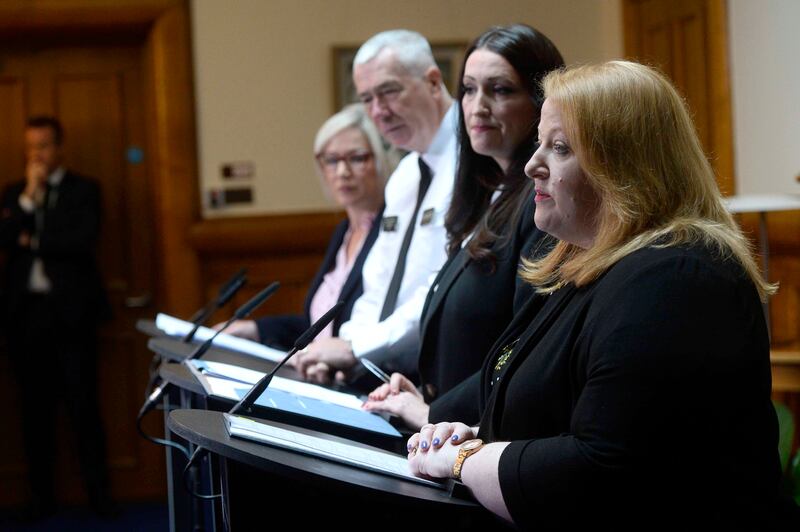
“I do understand the wickedly difficult issues facing the Northern Ireland Executive, but different choices have to be made to now fund the PSNI.”
Greater Manchester Police was “a failing force” five years ago, he says. Today, its numbers have risen from 6,300 to 8,300.
“Decisions were taken by the people who had the levers of power to arrest the decline,” he says.
Despite everything, Northern Ireland is one of the safest parts of the United Kingdom in which to live, with 50 people out of every 100,000 reporting being a victim of a crime annually compared to a UK average of 85.
However, the figures do not tell the full story.
“Crime has changed, but the way we monitor and record crime hasn’t changed in a very long time. Look at how we all live our lives. Crime is so much online,” the chief constable says..

The case of Alexander McCartney still troubles him, clearly. Described in court as “a disgusting child predator”, the 26-year-old “catfisher” from Newry, Co Dublin, was jailed in October 2024 for a minimum of 20 years on 185 charges of child sexual abuse and blackmail.
The “industrial nature” of the crimes by other people like McCartney, but who are not yet known about by the police, are not captured in the crime figures. “We’re still very much analogue rather than digital in how we understand crime,” Boutcher says.
Speaking to The Irish Times just hours after two officers were stabbed in Derry, Boutcher praises colleagues who daily perform “heroics” in the face of mounting challenges, including the ever-present threat from dissident republicans.
“But we have less and less capability to be a proactive police force. We’re a mainly a reactive organisation now – almost entirely reactive, in my view, because we have got such a diminished workforce, a dangerously low workforce,” he says.
Pressed about complaints made by the public along the Border about the near-disappearance of community policing, Boutcher does not even attempt to sugarcoat an answer.
“How do I answer that? I’ve got 40 per cent less people to do the job,” he says.
“Conversations that happened years ago about what neighbourhood policing would look like ... well, we can’t now resource such commitments.
“Whatever those pledges were, I can’t stand over them because I simply don’t have the people to do that. I wish I did.”


