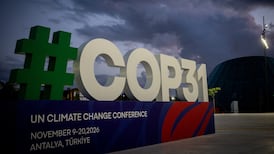
The collapse of the Cop31 talks in Turkey on Sunday was the latest in a series of setbacks for the global effort to address the climate emergency. The poor will pay the price.
A dead end in Antalya
By the time the Turkish and Australian joint presidents threw in the towel on reaching an agreement after a two-day extension of the talks in Antalya on Sunday, some of the delegates were already heading for the airport. It was the first such meeting since Copenhagen in 2009 that ended without a “cover text”, or final political declaration, but Minister for Climate Darragh O’Brien said on behalf of the European Union that the draft text was unacceptable.
“We will not endorse a decision that does not respond to the science, that disregards the implementation gap and that actually risks deepening the chasm between global commitments and the action required to correct the overshoot and bring 1.5 degrees back to within reach,” he said.
The EU and more than 100 other countries rejected the draft text in part because it included no reference to fossil fuels such as oil, gas and coal, which are the biggest drivers of man-made climate change.


But as Caroline O’Doherty outlines in a superb report from Antalya, the draft text was inadequate in many other ways, including in its failure to make a specific commitment to increasing financial help for poorer countries to deal with the climate crisis.
The EU was in the vanguard of resistance to demands for more substantial and predictable funding from richer countries to help poorer places adapt to extreme weather and rising temperatures and sea levels. But the Europeans made common cause with small and vulnerable states in rejecting the omission of a reference to fossil fuels.
The removal of any mention of oil, gas and coal was driven by the Like-Minded Developing States, a loose and shifting coalition including big emerging economies like China and India as well as producers of oil and gas like Saudi Arabia, Iran, Iraq and Venezuela. The group also includes poorer states like Bangladesh, Mali and Sudan that are vulnerable to the effects of climate change.
This group backs more concrete action on climate finance and more accessible funding for developing countries’ adaptation needs. But it opposes what it characterises as top-down targets, including timetables or roadmaps to transition from fossil fuels.
The collapse of Cop31 will be welcome in petrostates like Saudi Arabia and will cause no sleepless nights in countries like China and India, whose economies need huge, reliable supplies of energy, much of which comes from fossil fuels. China is in the unusual position of leading the world in electrification and developing renewable energy while producing more emissions than any other country.
The biggest losers from Antalya were, as so often, the poorest countries that have done least to create the climate crisis and are bearing its greatest impact.
Ghana’s environment minister, Zanetor Agyeman-Rawlings, who spoke on behalf of the African negotiators, said Cop31 represented a step backwards from the last meeting in the Brazilian city of Belém. She said world leaders would not have to face the consequences of their actions because they will be borne by future generations.
“The future will not ask leaders why they were silent. Farmers will be questioned about why their lands were turned to desert, and children who drink floodwater, as well as coastlines whose cities have disappeared,” she said.
Please let me know what you think and send me your comments, thoughts or suggestions for topics you would like to see covered to denis.globalbriefing@irishtimes.com