
I sat through a training session with work recently, and one of the key points has stayed with me. It was about client engagement and the danger of self-interest, where wanting an outcome so badly can distort your judgment.
You stop seeing the situation as it is and start seeing it as you need it to be. Protecting against that is about staying self-aware enough to catch yourself doing it, which can be tough.
Self-awareness is one of the more undervalued qualities a person can have in sport or in life. We, the media and the supporters, and I include myself in this, are in danger of wanting something out of Andy Farrell’s team that may not be there, rather than enjoying them for what they are today.

Irish rugby's state of the union down under
Ireland beat Japan 36-20 in Newcastle, Australia. Two from two, bonus points secured, top of the group heading into New Zealand on Saturday. Yet you would struggle to find anyone who came away satisfied. The performance was flat. The set piece misfired badly, and it was that, more than anything Japan conjured, that kept the Brave Blossoms in the contest.
‘It just felt like a perfect storm was building here’: Will Connors on Connacht move

Munster’s Clayton McMillan: ‘There were a few things that I would have had a strong opinion on’

Munster can call on Marnus van der Merwe as South African hooker recovers from calf injury

World Rugby is wasting its time if it thinks the US is an untapped goldmine

Ireland underperformed. Japan never really stretched the Irish defence. So here is where self-awareness must do some work. It would be easy, satisfying even, to reach for one of two ready-made narratives: either everything is fine because we won or everything is wrong because we didn’t win well. The answer sits somewhere in between.
[ Infectious joy of Ireland’s new quartet outshines laboured win over Japan ]
My first handful of international caps came in games that were tricky; awkward, disjointed displays on the kind of afternoon where you are simply trying to make a fist of it. That is the lot of a Test debutant, and it can be applied just as much to those trying to rediscover their international pedigree.
Look at Jacob Stockdale against Japan. Did the ball come? Not really. When a decent pass didn’t arrive, there was very little he could do. Ciarán Frawley will look at it as an opportunity missed. I had suggested he could be the ideal fit, but his lack of recent game time at 10 showed.
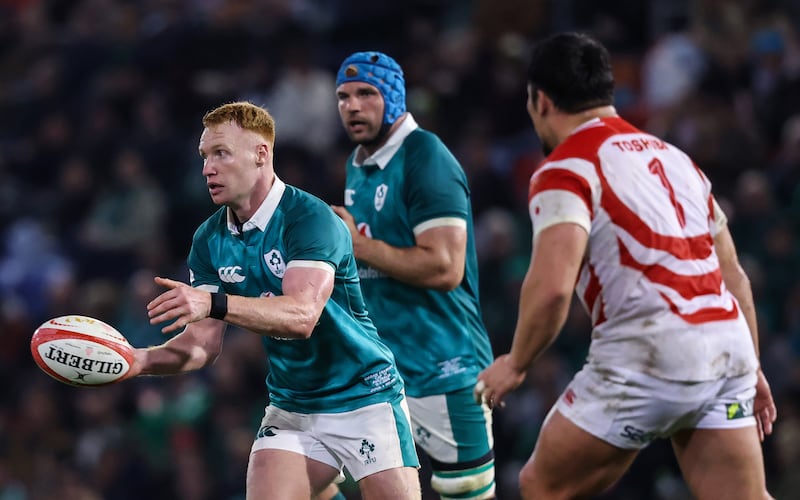
He was at the mercy of what was happening around him rather than being able to dictate. A stuttering set piece does not lend itself to a controlled afternoon for an outhalf. The irony is that Harry Byrne looked immediately comfortable on his introduction.
The sooner Frawley gets his teeth into the 10 jersey out west, the better. Importantly, he got a show of faith, but rather than being freed by it, you could see the desperation in how much he wanted to impress. The backing is there, so he has time to repay it over the next 12 months.
There were good individual performances scattered through the side, but the combinations didn’t fire. Those are different things, and that difference is important. The set piece is a huge issue. You cannot beat New Zealand with a malfunctioning lineout and a scrum that concedes penalties.
Japan competed and disrupted, but Ireland’s misthrows were punitive. The immediate task is not tactical sophistication; it is simply winning the ball. Crooked throws, timing, the mechanics are within Ireland’s control. No panic, just get it sorted. A lot of Ireland’s attack is built on its function.
There are a few truisms for critics. Ireland doesn’t have the playing population of some of our rivals. Farrell selects to win. Rotation, like the Japan match, is rare. Opportunities to impress are few and far between. Why? Because the success of Irish rugby is dependent on results, which drive revenue.
Ireland sits atop of the group on 10 points. Regardless of the result this weekend that has put them in a position to compete for the Nations Championship at the end of the year.
With that context, we should always be careful about the questions we ask, because we may not like or appreciate the answers. This tour is an exercise in the next-man-up philosophy and has showcased the depth we have and the glitches that can come with experimentation.

The New Zealand game is the ultimate benchmark. There are no excuses available, no heavy rotation, no rawness, no unfamiliarity to hide behind. The All Blacks are building something specific. Dave Rennie has handed the outhalf jersey to Ruben Love, a 25-year-old with barely a handful of caps, picked purely on form ahead of Beauden Barrett and Damian McKenzie.
Love’s instinct is to attack. It is a point of difference, and he is the meat in a Hurricanes sandwich with Cam Roigard and Jordie Barrett. Look at their back three and playmaking options – Love, McKenzie, the Barretts and Will Jordan – and you see four or five players capable of blowing a game open.
Stylistically, it is the type of examination Ireland finds hardest. We are a reasonably conservative side, orthodox in exits from our 22, conventional kick/run options in the middle third of the field and a largely structured game.
[ Ireland visit to All Blacks fortress could be start of something special ]
New Zealand are the opposite: high tempo, play to width, ball moved away from the breakdown at lightning speed. No one waits for Roigard. If he’s not there, someone else whips the ball away. The team is geared to move it away from the contact point, to keep it alive and let the picture form organically.
That is precisely the type of rugby with which we have struggled historically. Give us the heavy, upfront confrontation of South Africa, England or Argentina and, for whatever reason, aside from the occasional blip, we manage it well. Give us a team that plays at pace and keeps the ball alive, and we have often flattered to deceive.
We will want a performance, a positive result, despite coming off a long season and playing a fresher New Zealand group of players in their own backyard. We should want those things. But whatever comes, the scrutiny that follows must be proportionate to how the game was; not to what we wanted it to be.
If Ireland go close, that tells us something real. If they don’t, that tells us something too. Either way, the value is in reading it honestly. You would never bet against a Farrell side finding a performance from somewhere. They have made a habit of delivering the ones you don’t see coming.
The odds are stacked against them. That is exactly why it is worth watching carefully. For what it is, not what we want it to be.