
“Allow elite competitions the option of using the 20-minute red card if they choose to.” That’s an extract from World Rugby’s press release following their recent deliberations in Dublin.
So there it is, in black and white - confirmation that there is no universal agreement as to how to proceed with red card sanctions. Given the strongly held opposing views, an accord was probably never really on the cards. But now rugby union has truly arrived at a fork in the road.
When Brett Robinson took over the role of chair in World Rugby - with whatever agenda he might have had, my understanding is that he has now changed his focus to a different, very difficult priority: that all elite competitions must be aligned by having the same laws which are officiated in the same way.
Why is Leo Cullen leaving Leinster?
So, credit where it’s due, the chair knows that all unions must travel the same path. Anything else would be absurd. Add in the elite referees moving in and out of competitions, working to different laws, directives and southern hemisphere ‘innovations’ and we’re heading for two different games.
Rassie Erasmus rubbishes All Blacks’ head coach’s ‘walking around’ claims at scrums

Munster defend with their lives against Leinster to retain Interprovincial Championship title

Siya Kolisi fires up ferocious Springboks to hit back against All Blacks

Munster brace for ‘relentless’ Leinster in interpro final as they target back-to-back titles

It is no secret that the two hemispheres are completely at odds on the 20-minute red card, and also what type of dangerous play qualifies for a straight, permanent red issued by the referee. At present, ‘down south’ shoulder hits to an opponent’s head are treated liberally, all of these go to the bunker, and - if upgraded - the maximum punishment is the 20-minute red. In the ‘north’ there is general consensus that those hits, which clearly are highly dangerous, must receive the permanent red with no replacement allowed.
So, let’s consider these: Ruan Ackerman’s recent hit on Rónan Kelleher; James Ryan on South Africa’s Malcolm Marx in November; Dan Sheehan’s crash into Australia’s Tom Lynagh in the Lions third test. Perhaps World Rugby would tell us where these should properly sit in terms of on-pitch sanction - it would be a starting point to know their views. Maybe those in Australia and New Zealand could also provide an illuminating opinion.

Undoubtedly, we would hear some of the same old, worn-out excuses - the player got his timing, or his technique, wrong; that there was some sort of (invisible) attempt to grasp the opponent; that the victim’s head moved marginally. Sorry, these hold no water at all. A player arriving at speed into the breakdown, leading with a hard shoulder which smashes into the head of an opponent, must surely face the maximum sanction.
However, we will also hear arguments that permanently reducing a team to 14 is not fan-friendly, and hence it should only happen for the most heinous, egregious offences. These include biting, kicking, head-butting, testicle-twisting, but not the above mentioned hits. Why not? You’d be right to ask.
Given a choice, players might well prefer to be bitten rather than have their brain subjected to a horrendous battering; the true effects of which can be both invisible and unknown. How quickly we forget the many former elite players who now suffer from early dementia and probable chronic traumatic encephalopathy. Current players are also forced to retire when they’ve had too many brain injuries. The latest is right on our own doorstep, Munster’s Oli Jäger. We must wish him well.
The great, recently deceased, Fergus Slattery suffered for many years with horrible dementia. Speaking at his funeral, former Ireland and Lions fullback Hugo MacNeill tellingly said that he would not allow his young son to continue playing the game unless the authorities were on top of this issue.
While many parents are extremely concerned at the dangerous direction rugby has taken, MacNeill has also stressed that his son is well supervised at school and in club mini-rugby, and that it is vital every parent can be confident this will continue into the future. His words will give them food for lots of further thought.
“Player welfare is at the heart of everything that rugby does,” said Robinson in welcoming trial results which now see the reduction in tackle height in the community-amateur game. That same sentiment must be applied to this extremely problematic red card issue. Essentially, it must outweigh the fan-centric approach, which, dangerously and unwisely, sees the scales tilt completely in favour of spectacle over player safety.
Permanent red cards are not frequent, simply because they exist. They act as a deterrent, while the 20-minute red does not. In fact, it’s not unreasonable to suggest that key players risk being targeted. This issue could not be of higher importance - it is central to the future existence of the sport.
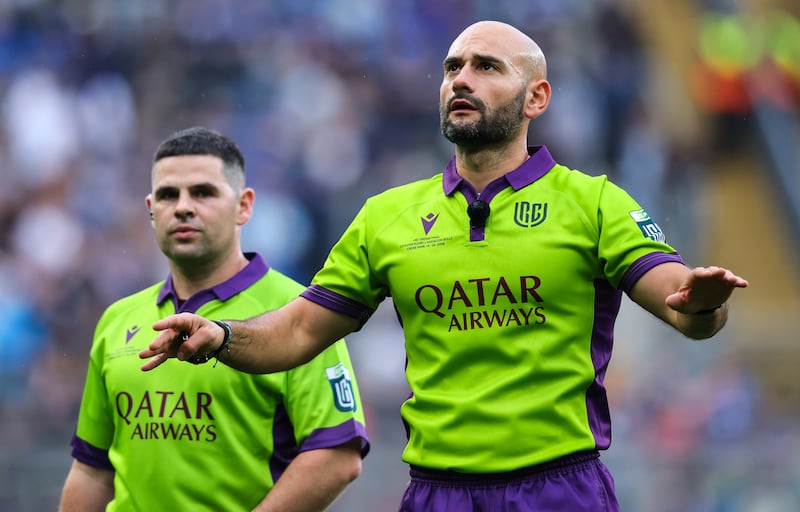
Very recently my car, scarily and suddenly, lost all power on the autoroute close to La Rochelle. In Croke Park, Leinster had no such problems, they kept their foot firmly to the floor. It was as complete a performance as we’ve seen from Leo Cullen’s men this season. Italian referee Andrea Piardi was firmly calm throughout, little backchat came from either team. Leinster were the better for it, they just got on with the job of dismantling the opposition. Piardi handed two correct yellow cards to the Bulls, but these had little bearing on the overwhelming result.
It was Piardi’s fourth successive URC final, underlining the poor results of the other participating unions in terms of elite referee development. Only Ireland’s Andy Brace is currently at the required level for the final, and his breakthrough dates back to 2017. Italian referees are coached by Ireland’s World Cup final referee Alain Rolland, and it seems as if the IRFU might have missed a trick there. The bottom line is that the quality of refereeing remains a nasty blot on the competition’s landscape. The URC board of directors cannot have failed to notice.