
In the run-in to Fine Gael’s ardfheis taking place in Cork this weekend, Tánaiste and the party’s leader Simon Harris was caught up in a tussle over the agenda for the meeting.
A motion – which had generated considerable commentary and media coverage, and some misgivings among TDs and Senators – was authored by a group of grassroots members and councillors, who argue that the party should cleave more closely to its centre-right roots.
The motion was entitled: “This ardfheis affirms that Fine Gael is a centre-right party, in the European Christian Democratic tradition, as expressed through our proud membership of the European People’s Party.”
It was not included on the original agenda – or clár – for the ardfheis decided by the party.
RM Block


Harris asked the party’s executive council – which signs off on the agenda – to reconsider its decision in light of strong views across the party. He indicated that it was a debate worth having.
However, it was not agreed at a meeting of the council on Tuesday. At a subsequent meeting the following day, it stuck to its original decision.
Allies of Harris say he ultimately agreed and didn’t push it further, nor overrule them.
But party sources have characterised the affair as “mad” and “bizarre”, saying it is “highly unusual” that a motion wasn’t put on the agenda after a request from the party leader.
[ Fine Gael motion to distinguish party from ‘woke left’ rejected for ardfheisOpens in new window ]
It is the latest internal melodrama for Fine Gael as it gathers for its ardfheis.
A much more meaningful date lands in just over a year, when Harris – if the agreed schedule is adhered to – will be preparing for his second stint as Taoiseach.
He is, according to a document published by the party this week, leader of a party which voters have kept in government for 15 years, but who also can see it as detached, managerial and unclear in its purpose.
In advance of a crucial year, can the Tánaiste arrest the drift in Fine Gael?
The immediate backdrop to the ardfheis is a bruising period where intrigue swirled over the Minister for Culture Patrick O’Donovan’s post-budget controversies, aggressive briefing against him from within and his subsequent illness.
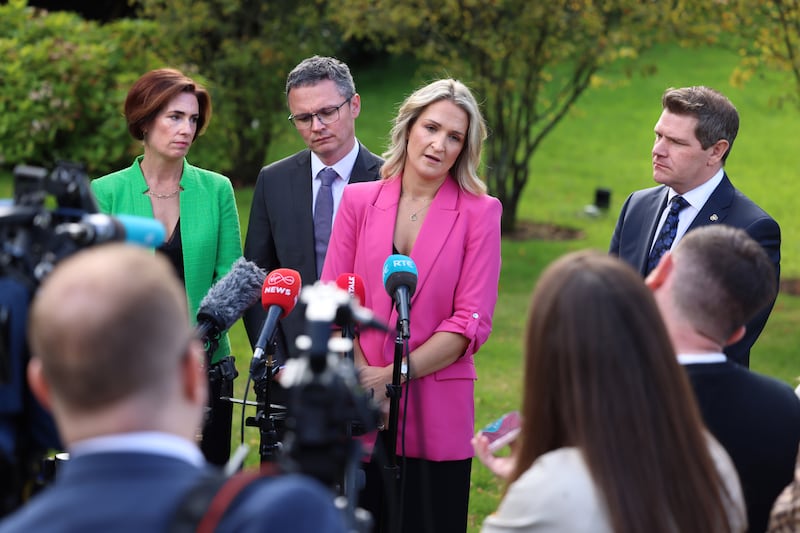
It has left some members puzzled, although that controversy has subsided for now. The private verdict from within the parliamentary party over its lasting impact ranges from effectively nil to casting a “cloud” over the ardfheis.
Some senior party figures rail against “manufactured drama, division and angst in full view of parts of the media”, but others say the degree to which Fine Gael has been discussing itself in public has been damaging.
Harris, for his part, acknowledged at his parliamentary party meeting last week that aspects of the melodrama could and should have been handled better.
Even amid intense scrutiny, the Tánaiste is unlikely to face much backbiting from within his parliamentary party.
[ Many people unsure of what Fine Gael stands for, party findsOpens in new window ]
It was partially cleared out by a slew of high-profile retirements before the 2024 general election, hampering its performance at the polls that day, but also ushering a new generation in.
One first-term backbencher says the presence of so many first-timers means TDs are less likely to whisper among themselves, arguing that many are in effect strangers to each other. Fomenting dissent is harder if there’s not a bedrock of mutual trust or a shared sense of dissatisfaction.
Another upshot of the clear-out is that Harris had plenty of patronage to spread around: of the crop of TDs who were re-elected in November 2024, only one is not a Minister.
TDs swear blind – even privately – that they are behind Harris. But nothing is static in politics. Insiders point out that Harris will have a reshuffle in a year, which will include appointing someone to the Department of Public Expenditure and Reform. Winners and losers will be created from then on.
Afflicted by being in government
The party may be fairly united, but paradoxically it meets in University College Cork amid a self-diagnosed sense of drift. This may be more problematic than a passing controversy or if a restive caucus emerges within its ranks.
Following the general election, Harris convened a commission for renewal, which reported this week, finding that many people “do not have a clear idea” of what Fine Gael is about.
Former minister for justice Charlie Flanagan was one of four of the report’s authors. He told The Irish Times last week that “the mood in the party is not great”.
“I accept that there is an identity issue in Fine Gael,” he says, agreeing that the party’s sense of itself – but perhaps more importantly, its resonance with voters – has been diluted through 15 years of participation in government.
Often governing with ideologically different partners, he says those coalitions have been closely marshalled by the strictures of agreed programmes for government.
“You do anything for an extended period of time, you get comfortable, get institutionalised, you drift,” says Minister of State Neale Richmond.
“It becomes harder the longer in government to separate the party from being an arm of government.”
In the past decade, the party’s polling and election performance has steadily declined. As for Harris, his “new energy” drove high personal and party popularity in 2024, before tracking speedily downwards.
Outside the Taoiseach’s office, Harris is constrained in his ability to shape priorities or set the agenda. His speech on Saturday night is expected to signpost where he will focus his energies as Taoiseach.
Law and order, and higher parental leave for those earning more, similar to reforms introduced for jobseekers, are expected to feature, along with promises of a more demanding culture around public expenditure.
Distinguishing between FG and FF
The slide in polling has coincided with a wider fracturing of the electoral landscape – what former Fine Gael minister turned pundit Ivan Yates calls “fragmentation and splintering on top of fragmentation”.
This, Yates says, has led the large parties to flock to a broad but poorly contoured centre ground.
The shelf life on this is finite, he believes, with his former party going through a “genuine identity crisis”.
“If you want to create a brand that stands for something it has to stand against something else,” says the former Wexford TD.
“Any time they get closer to making those choices and get clobbered by the people they’re potentially against, they back off.”
The commission for renewal report argued that Fine Gael should set a target of 25 per cent of the first preference vote in the next general election. (It won almost 21 per cent in the 2024 election.) The question is how to get there – and if a strategic shift is needed to do so.
Sarah Hynes, a Fine Gael member who authored the motion which was rejected last week, is adamant that the party is losing foot soldiers – and more importantly, voters.
Many, she argues, do not differentiate between Fianna Fáil and Fine Gael – and only vote for them grudgingly. These voters, she argues, may stay at home in the future or be lost as protest votes to parties further on the right.
The motion has resonated with grassroots, but had a more mixed reaction among some who are nervous of being branded as being on the right, or of the word “Christian” being associated with the party – or of losing the constructive ambiguity of being able to move left on policy if it wants.
TDs argue that it is a misreading of how broad the centre is in Irish politics, with most votes still gravitating towards parties that offer basically centrist solutions. In that context, nailing the party to an ideology that means “f**k all to people” would be folly, says one of the party’s TDs.
Hynes, who says she supports Harris and the leadership, is sanguine about it – noting that the motion has now enjoyed the “Barbara Streisand effect” – garnering far more attention and public discussion than if it had been allowed on to the clár.
As the party gathers in Cork, Yates predicts that, on its current trajectory, the party may slide to its core vote of 12 to 15 per cent, a scenario with no safe seats – something he also predicts could happen for Fianna Fáil.
“Catch all,” he counsels, “is catch nothing.”