
Humanity has always chased the promise of renewed youth. From ancient myths about the fountain of life to modern Silicon Valley regimes of supplements, sensors and self-tacking biohackers, the supposed elixir may change over time, but the desire for eternal youth remains the same.
Today it appears everywhere, and it is often split along gendered lines. For women, the pursuit tends to be aesthetic, shaped by a culture that treats ageing as a flaw to be corrected via Botox, fillers, or – increasingly among actresses barely in their mid-30s – a facelift. Men, meanwhile, are urged to optimise. An entire industry of podcasts, tech devices and protocols encourages them to track their biomarkers, adapt their sleep cycles, and follow elaborate nutritional codes. It’s a thriving market built on the belief the body, ageing, time itself can all be mastered and controlled with enough science, discipline and money.
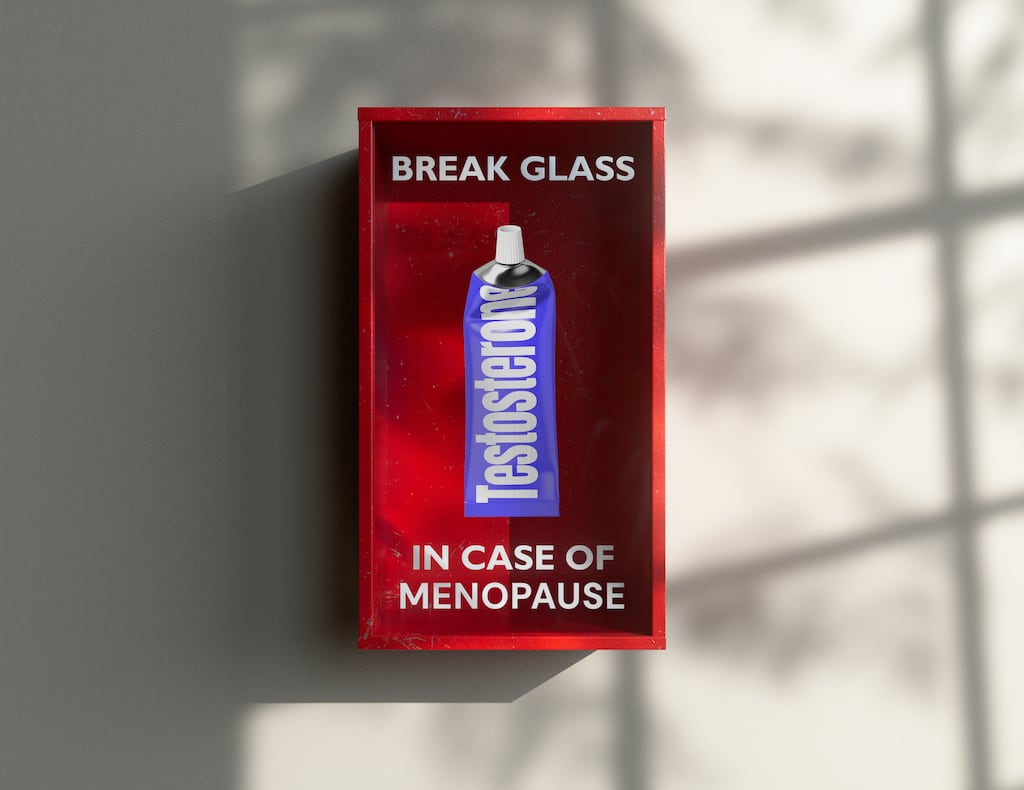
Into this landscape enters a new supposed miracle tonic for women: testosterone. It may be a hormone as old as time, but it’s being worshipped with a new fervour. Influencers and wellness clinics are peddling unregulated, high-dose testosterone to women, promising not just heightened libido but sharper focus, renewed purpose and a vitality dormant for years. Some of the stories sound almost mythic. Women describe bounding out of bed, lifting heavier weights, rediscovering sexual desire, and feeling newly energised at work and at home. In one recent New York Times piece, women described sex going from “How about never?” to six times a week; marriages transformed, energy levels electrified, all apparently down to testosterone.
The problem is, most of the claims about testosterone are simply not borne out by evidence. Step away from the viral testimonies and influencer marketing spiels and into the consulting rooms of clinicians who specialise in hormonal care, and the story of testosterone becomes far more measured, more grounded, more wary. This research-backed, evidence-based medical view is not anti-testosterone; it’s just anti-magic.
RM Block


What is testosterone?
Though long framed as the defining male hormone, testosterone is no more exclusively masculine than oestrogen is exclusively feminine; both circulate in all bodies, and both matter profoundly. “Testosterone is the third hormone that your ovaries make, along with oestrogen and progesterone,” explains Dr Caoimhe Hartley, the clinical lead in women’s medicine at the newly opened Blackrock Health Women’s Health Centre. “It has an impact on bone density, muscles, probably cognition and sexual function, and that is where libido comes in. All these hormones do multiple things; they are not isolated to one usefulness.”
What testosterone does not do is plummet dramatically at menopause, despite the common misconception. “There is no study that has shown any change over natural menopause,” says Prof Susan Davis, an endocrinologist at Monash University whose work has shaped global understanding of female testosterone. “Testosterone blood levels decline slowly from the age of about 20 through to the age of about 60,” she explains. Over those 40 years, she says, “on average, normal women will have about a 50 per cent decline.” Then, unexpectedly, levels start to creep up again from about 60. “It is changing with age, not menopause.”
This distinction matters because it reframes midlife experiences. Changes that women may experience in metabolism, energy and mood are often misattributed to a sudden drop in testosterone, when the real cause may be the cumulative effects of ageing, stress, workload and emotional demands.
But if testosterone drops over time and these emotional and embodied changes are experienced, a question naturally arises: does putting more testosterone into the body help?
For premenopausal women, the answer right now is simply: we do not know. Two trials have hinted at some possible benefits for women in their late 30s and early 40s, “but the studies are too small to have any degree of confidence”, Davis says. Another trial is planned, but for now, “there is no good evidence that giving premenopausal women testosterone will be beneficial”.
For postmenopausal women, the picture is clearer, though still limited.
“All the published studies show that the only evidence of benefit is for postmenopausal women who are bothered by low libido,” Davis says. Her own meta-analysis of 36 trials involving 8,480 women found consistent improvements in desire, arousal, orgasm and overall sexual satisfaction. Though more modest than the accounts of teenage boy-levels of sexual desire experienced in women on high doses, these research-backed improvements were meaningful. “The beneficial effects for postmenopausal women shown in our study extend beyond simply increasing the number of times a month they had sex,” she says. “Many women who are sexually active report dissatisfaction, so increasing the frequency of a positive sexual experience from never or occasionally to once or twice a month can improve self-image and reduce concerns and distress.”
Hartley sees the same patterns clinically. In Ireland, doctors can prescribe testosterone for women, but only off-label and only in carefully selected cases, such as postmenopausal women distressed by low libido. Because no female-specific product is licensed here, clinicians like Hartley rely on precisely titrated-down doses of male testosterone gels, monitored with blood tests to keep levels within a normal female range. She prescribes testosterone when low libido is causing distress, usually after menopause or after surgical removal of the ovaries. “It makes a bit of physiological sense,” she says of its use following surgical menopause, “but it is still for low libido and nothing else”.
Beyond this specific use for improving libido for older or postmenopausal women, the evidence around the benefits of testosterone therapy for women fades. “No benefits have been shown for cognition, bone mineral density, body composition, muscle strength or psychological wellbeing at physiological doses,” Davis says of the clinical trials to date. “There simply isn’t evidence.”

Menolicious: Mariella Frostrup & Belles Berry / Should all women be on HRT?
Placebo effect
If testosterone’s proven benefits are relatively modest, why do some women who’ve taken it sound as if they have been converted to a new faith?
Part of the answer is placebo. “There is a huge placebo effect, and everybody is in complete denial of this placebo effect,” Davis says. She points to a company that developed a testosterone gel for women and then ran two large trials of libido, each with 500 participants. “Testosterone improved libido, but not better than placebo,” she says. In her own 800-woman trial of a testosterone patch, published in the New England Journal of Medicine, women on testosterone had better sexual function than those on placebo. But when the team buried validated wellbeing questionnaires inside the study, they found no difference in general wellbeing at all.
Hartley encounters the anecdotal power of testosterone every day. “I have patients who will come back and say, ‘I went on testosterone and my brain fog improved’ – and I am not in their brain, I cannot tell them that they are wrong.” The problem is that individual stories, which are very real to the woman telling them, are not the same as evidence. “How do you remove all the other things that may have helped? How do we know it is not placebo?” Hartley asks. “That is why we do studies.”
But when women are looking for answers and hear one or two stories saying, ‘This transformed my life’, the effect is infectious. “It is human nature to want to believe it,” Hartley says.
Dangers of unregulated use
This gap between evidence and promise is sharpened by what happens outside regulated medical practice. In the US, an increasingly booming, unregulated industry of influencers and wellness clinics is offering female clients testosterone pellets and gels at doses that take women well beyond a normal female range for the hormone. At those levels, the side effects can be alarming: scalp hair loss, unwanted facial hair, acne, irritability, voice deepening, clitoral enlargement, and surges of arousal that disrupt daily life. Some of these side effects, like clitoral enlargement and voice changes, can be irreversible. Hartley notes that such dramatic changes “really should only occur if your testosterone level is bumped outside of a normal female range” – yet in unregulated settings, that boundary is routinely crossed.
In countries like the United Kingdom or Australia, women have access to a licensed female-specific testosterone cream that allows safe, standardised dosing. In countries like the US or Ireland, without such a product, the gap between evidence-based prescribing and unregulated hormonal experimentation is widening, leaving women vulnerable to treatments that promise transformation but bypass the safeguards of medical care.
“Knowing that this is an option that might help them, women are forced to use either compounded therapies or try microdose male options,” Davis says of countries without an approved product. “That is really where things go out the window, because it is very difficult to safely dose using very concentrated male formulations.”
In her view, “the best thing to protect women is a regulated product”, one tailored to female physiology. Hartley would welcome the UK’s new female-specific cream for similar reasons. It contains the same active ingredient as existing male gels, she notes, just at a concentration and formulation that makes it easier to apply in tiny doses.
Regulation, though, is not enough on its own – doctors need to understand the drug and how best to help their patients. For Hartley, the safeguard is information. “The more we have well-educated healthcare professionals at every level,” she says, “the more we are passing that on to women.” She wants GPs and specialists who are “well armed with information on what is evidence-based and what is rubbish”, so that they can help patients sift through hype and anecdote.
The real issues affecting women
Both Hartley and Davis think the fervour around testosterone says as much about the state of women’s lives as it does about the hormone itself.
“I think women are sick of their symptoms being dismissed,” Davis says. “And when someone says this will make you feel better, of course, they want to take it. I get that, and I think that is perfectly reasonable.”
Davis’s team has documented the decline in women’s quality of life at mid-age. Despite a huge amount of cultural discourse focusing on the so-called male loneliness epidemic, the documented mental health struggles of middle-aged women remain unacknowledged. “Women are suffering,” she says. “We have shown in our latest work that midlife wellbeing has gone down compared to 10 years ago. There is a real decline.” Davis explains the multitude of factors affecting women, noting: “This is the sandwich generation. Women trying to ‘have it all’: have children, take care of ageing parents, have work, have work-life balance, have financial stability. These are enormous pressures.”
Depression rates are high, distress is high, and time is scarce. Hartley is watching the same pressures play out in Irish consulting rooms. “You see how much women are carrying,” she says. “It is no wonder their libido is low or that they feel flat or foggy or depleted. That is not a pathology. It is life.”
Amid all the stresses affecting women, it thus becomes necessary to be careful of how we speak about women and low libido, in order not to pathologise a lack of desire that may be natural or due to a host of interlocking external factors, or to risk reinforcing damaging ideas about women owing their bodies and sexual availability to others.
Neither doctor wants to minimise the distress of women whose sexual desire has vanished. Both prescribe testosterone in carefully selected cases, understanding the stakes for relationships and for individual self-esteem.
“Our own research has shown that if women themselves personally have poor sexual wellbeing, that impacts them personally in their general wellbeing and their relationships,” Davis says. “So I prescribe testosterone for women with low libido. I am not anti-testosterone.”
But what does concern Davis and Hartley is how the issue of women’s libido is often medicalised or framed. Hartley notes how many women come in apologising, or framing their lack of desire as a personal failure or a dereliction of duty to their partners.
“Women come in saying, ‘Oh my God, my poor husband, my poor partner’,” says Hartley, who is always clear in redirecting them. “I say, ‘Your partner is not my patient’.” The real question is whether the woman herself is distressed. “It’s really important to not stick it on the list as something that has to be fixed. Low libido is not a disease,” says Hartley, who notes that it is a normal evolution for spontaneous sexual desire to reduce as you get older. ”That is universal. There is nothing wrong with you if that happens.”
Davis notes that often, low libido is a “multifactorial condition”, and she points out that the guidelines from the International Society for the Study of Women’s Sexual Health set out a process of care that requires clinicians to look first at depression, relationship dynamics, medications, trauma, pain and vaginal health before they “jump in saying testosterone is going to be the fix”.
The research gap
Underpinning all of this, both the hope and the caution, is a simple fact: there is not enough research into women’s health, which leaves us without the data that women deserve.
“The future, hopefully, is research,” Hartley says. Without larger, longer, better trials, she and her colleagues cannot give women the clear answers they want about benefits and risks.
Davis has spent four decades trying to generate that data and sounds, at times, weary. Getting funding is brutally hard, she says; she can spend “up to 30 per cent” of her working time writing grant applications. When money does come through, another hurdle appears. “Trying to get women to go into clinical trials is an absolute no,” she says. “They are all too busy, busy.” Her team is about to start two large new studies, one looking at testosterone’s effects on muscle and bone, the other at bone and sexual function, both including wellbeing questionnaires. She welcomes the increased interest but insists that until the trials report, the honest answer to many questions will remain “we do not know”.
That is not a comfortable message in a culture that wants a quick fix for midlife female exhaustion and desire. It is, however, the only message that treats women as adults and demands better for them in the long term.
So what should an Irish woman do, sifting through a wave of hyped-up Instagram adverts about testosterone pellets and listicles of anecdotes about life-changing results?
“Keep expectations realistic,” Davis says. If you are going to try testosterone, she urges, treat it as a time-limited trial, not a new identity. Do not try to treat bone loss, muscle fatigue or life itself with testosterone. “Testosterone is not the answer for life.”
Hartley, for her part, hopes women will come in to talk, not arrive convinced that there is only one solution. “If they are symptomatic, if they have low libido and it is bothering them, and they want to have a discussion with their GP about it, do that,” she says. But she also wants them to hear something that often gets lost in the hype: “You are not broken.”
She’s right. There is nothing inherently wrong about wanting sex less as you age. There is also nothing shameful about wanting more. But there is something deeply shameful about a society that devalues women; refuses to invest in research about their physical or emotional wellbeing; pathologises them for ageing and constantly tells them that they are not enough, only to try then make money selling them an unsafe, unregulated “cure”.
Women deserve acceptance, accurate information and autonomy, not another marketplace built on their insecurity.