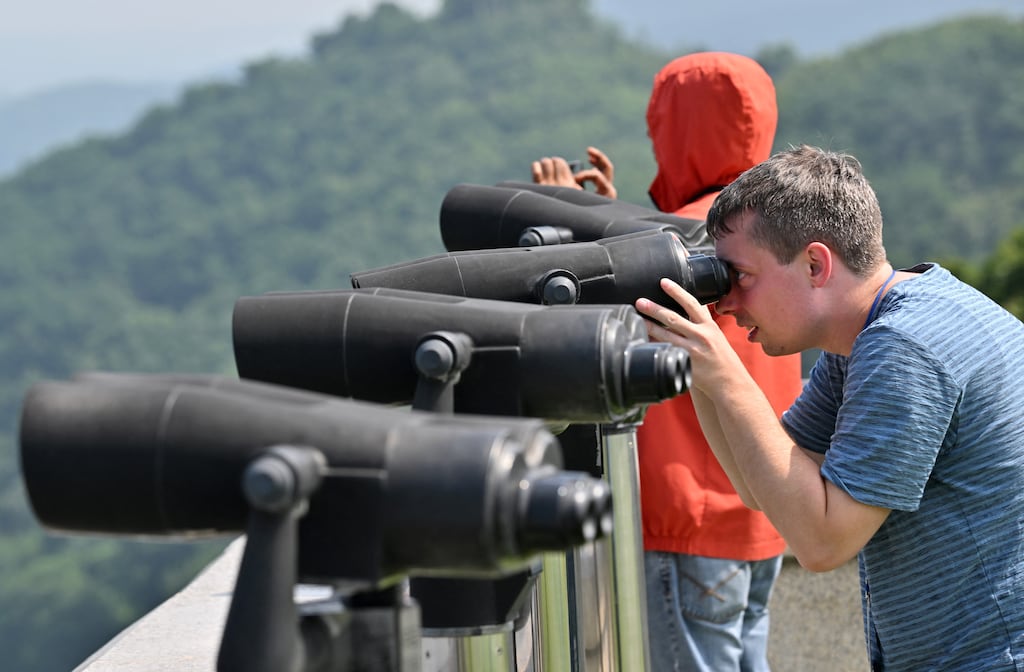


European commentators are comparing this week’s meeting between Xi Jinping, Donald Trump and Vladimir Putin to the 1945 Yalta conference between Franklin D Roosevelt, Joseph Stalin and Winston Churchill. The echo is louder in Asia.
Korea fears a second Yalta
When it became clear last week that an unprecedented, trilateral meeting between the leaders of the United States, China and Russia would go ahead in Shenzhen on Thursday, South Korea raised the alarm.
“I explicitly told my Chinese counterpart that the US-China-Russia summit should not become another Yalta Conference,” a senior South Korean foreign ministry official told reporters in Beijing.
“We have made it clear not only to the United States but also to China that our national interests concerning Korean Peninsula issues must not be compromised.”
Fight to make climate polluters pay for crushing poor countries at Cop31

‘I will not stop telling the truth’: António Guterres issues parting climate warning

Hundreds of thousands march in cities across France in latest round of protests

Dodging bikes, cars and culture wars on London’s newly ‘pedestrianised’ Oxford Street

Opposition People Power Party representative Na Kyung-won echoed that anxiety on Monday, warning that Seoul was at risk of being excluded from negotiations that could reshape the security landscape of the peninsula.
“A second Yalta conference, in which our very survival becomes a bargaining chip among major powers, is becoming a reality,” she wrote on social media.
When Roosevelt, Churchill and Stalin met in the Crimean port of Yalta in February 1945, the war in Europe was almost over and they set about agreeing a postwar global order. This saw the three leaders formalising spheres of influence and determining the fate of smaller countries without consulting them.
They agreed to dismember Germany into US, British, French and Soviet military zones and to shift the borders of Poland westwards. And although they promised free and fair elections in liberated countries, the agreement included no enforcement mechanism so the Soviet Union was allowed to determine the political future of the parts of Europe its armies occupied.
A secret protocol agreed that after Germany’s surrender, Moscow would join the war against Japan in return for a number of territorial concessions at China’s expense. And the leaders agreed informally to place Korea under international trusteeship rather than restoring the independence it had enjoyed for 500 years before the Japanese occupation in 1905.
In August 1945, Soviet forces accepted Japan’s surrender in Korea north of the 38th parallel while US forces did so south of the line, dividing the peninsula into two occupation zones that subsequently hardened into two separate states. What the South Koreans fear now is that when Trump, Xi and Putin meet in Shenzhen on Thursday they will agree a common approach to North Korea without consulting Seoul.
Beijing has an alliance with North Korea dating back to the Korean War in the 1950s, when China fought alongside the Soviet Union in support of the new communist state. Recent years have seen a deepening of the strategic partnership between Moscow and Pyongyang with North Korean soldiers deployed with Russian troops on the frontline of the war against Ukraine.
Trump met North Korea’s leader, Kim Jong-un, a number of times during his first term in the White House but their negotiations collapsed at a summit in Hanoi in 2019. Kim has shown little interest in reviving talks, although Trump said this week that he was open to a meeting while he is in Asia.
At the heart of Seoul’s anxiety is the prospect of the US, Russia and China discussing North Korea’s nuclear status and the future of the peninsula without consulting South Korea’s government. These fears were heightened by a visit to Moscow this week by Jo Yong-won, one of Kim’s closest aides, and one to Beijing earlier this month by Kim Song-nam, another senior North Korean official responsible for international affairs.
The signs are that Xi, Trump and Putin will not discuss Korea at this week’s meeting, which is not expected to go too deeply into any policy specifics. But if the three leaders agree in Shenzhen to hold regular trilateral meetings, Seoul might have more to fear in the future.
Please let me know what you think and send me your comments, thoughts or suggestions for topics you would like to see covered to denis.globalbriefing@irishtimes.com