
I spent a magical evening in the middle of Leitrim once, waiting for a cup. It was a day after they had upended Mayo in the 1994 Connacht final, winning the title for the first time in 67 years. Delirium must be spontaneous, which makes it resistant to something as buttoned-up and po-faced as a schedule. Leitrim let it roll.
Cloone had a loose appointment with the cup for 8.30pm, but no arrangement was binding. If mobile phones existed, they had no influence over the cup’s frazzled diary. The public pay phone next to the lounge in Creegan’s Bar was the nerve centre for updates, though information was scarce. By the time somebody made contact with one of the county selectors he had given up on promises.
The tantalising wait continued. Nobody was at a loose end. A replay of the match from the day before was being played on repeat in the pub. A singsong flared up. The throat of one reveller was so sore from the shenanigans of the night before that he resorted to dipping a choc ice into his glass of brandy, to smooth its passage.
The beauty of homecomings back then was their freewheeling nature. Receptions were liable to be organised on the hoof. When Clare won the Munster hurling final a year later – for the first time since 1932 – Anthony Daly was hustled on to the roof of a bus shelter in Clarecastle hours after the game because they didn’t have time to concoct a stage.
All you read is love: The books about Mayo’s All-Ireland win that just had to be written

Eamon O’Shea’s Ireland panel coming together for ‘throwback’ hurling-shinty international

Éamonn Fitzmaurice return gives Galway fresh hope of ending Sam Maguire drought

Mark Zuckerberg’s few coins thrown to the GAA should not fool us

The cup was filled with a cocktail of Guinness and champagne – the internationally recognised nectar of champions – and handed back to the captain.
It is so much different now. Like everything else in modern sport, homecomings are beholden to a process, an offshoot of the high-performance mentality.
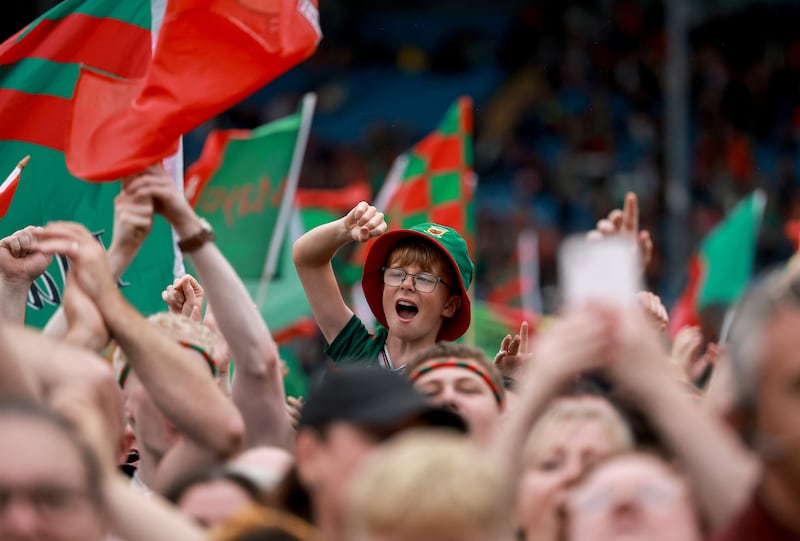
When the Mayo players were delivered into the rapturous embrace of their people in Castlebar last Monday, the homecoming in MacHale Park was organised like an outdoor concert. There was an abundance of stewards and just enough barriers and not an ounce of jostling or congestion, despite the presence of up to 40,000 people.
Bits and pieces of alfresco drinking were not an intrusion on anybody. It was designed for families to witness something they would never forget. Children of all ages amused themselves on the pitch. Parents felt at ease arriving with kids in prams. It was a modern-day marriage of delirium and decorum.
That takes planning, naturally. In one of the years that Mayo lost to Dublin in an All-Ireland final, plans for the Mayo victory homecoming were leaked in advance of the game, which turned into another source of vilification and embarrassment when that outcome didn’t materialise. But what were they supposed to do? Last week’s homecoming in Castlebar wasn’t dreamt up on Monday morning. There must always be an element of quiet assumption.
In other places, assumption operates on a different frequency. Ten days before the 1982 All-Ireland football final, there was a heated debate at a Kerry county board meeting about whether their five-in-a-row heroes should be greeted in Killarney first, or in Tralee.
“After all, it’s the capital of the county and there are five Tralee men on the team,” said the John Mitchels’ delegate, who was also a member of the Tralee Urban Council. “I am expressing the view of the elected people of Tralee.”
Mercifully, Séamus Darby’s last-minute goal spared them any further conflict on the matter.
Over the years, though, homecomings for losing teams have often caused the greatest ructions. There was commotion in Cork last year when a homecoming for the hurlers was scrapped after their second-half collapse against Tipperary and there was an opposite reaction in 2007 when a reception went ahead for the Cork footballers despite their 10-point destruction by Kerry the day before.
Billy Morgan, Cork football’s greatest agitator and spiritual leader, was manager of the team that year and he insisted that the players should be accorded the dignity of a homecoming. According to a report in the following day’s Irish Examiner, “hundreds” turned up on the South Mall to greet them. When it came to the footballers, the Cork public never had any conscience about desertion.
In those situations, it must be gruelling for the players. In 1992, after Donegal beat Dublin in one of the greatest modern-day shocks, the Dubs went ahead with the plans they had made to honour champions.
The players were paraded through town in an open-top bus as people going about their daily business gawped at this curiosity snaking through the city centre on its way to a Lord Mayor’s reception at the Mansion House.
Gay Mitchell was the Lord Mayor of Dublin at the time, and he thought it might be nice to draw the curtains and leave in some light. “Let us not forget,” said Mitchell, “there are 30 other counties that would change places with Dublin this weekend.”
The Dublin captain Tommy Carr was in no mood for trite consolations though. “Nobody wants to change places with losers,” he said in answer to the lord mayor. “The feeling of losing is not comparable to anything else.”
Some homecoming traditions have stood the test of time. Crossing boundary rivers has always mattered. When Waterford won the Munster hurling final in 2002, for the first time in 39 years, they got off the team bus at Youghal Bridge and walked the cup over the Blackwater. In MacHale Park last Monday, news that the team had crossed the Shannon was greeted with a cheer. They had already crossed the Rubicon.
Somehow, bonfires have survived the regulatory strictness of the health and safety police. The Mayo team was greeted by a controlled blaze in Ballinrobe on Friday and in Tooreen on Thursday and in other places on their magic carpet ride.
There was a bonfire in Cloone too, 32 years ago. It started around 9pm and was still blazing when the team arrived about 2.20am. Declan Darcy stepped off the bus with the cup and was immediately swept off his feet and carried shoulder high to the stage.
The Cloone club chairman tried to bring some formality to proceedings, but it had gone way beyond that. One man carrying a banner asked for a pint and poured it over himself. Nobody paid any heed.
The team left at about quarter to three in the morning. They had three more stops to make. Imagine.