

The American republic is 250 years old today. On this auspicious anniversary, the story of Alexander Hamilton, the birth of the dollar and the emergence of what would become the economic behemoth that is the American republic is worth retelling because the story of America is the story of money.
Once they’d figured out the constitutional basis of the US, the most significant move undertaken by the founding fathers was to create a new currency. The American revolutionaries passed the Coinage Act on April 2nd, 1792, under the direction of Alexander Hamilton, the smartest economic mind of all the rebels.
Romantics like Thomas Jefferson possessed an almost elegiac view of America, where the new republic would be rural and isolated, uncorrupted by money, markets and finance. In contrast, Hamilton, always the modernist, saw a capitalist US, competing with the Europeans in industry, commerce and trade.
As the first Treasury Secretary of the US, Hamilton had no time for the nostalgic sentimentality of Jefferson, Sam Adams and James Madison. In the early 1790s, he saw that hyperinflation was hijacking the French Revolution, which was morphing from a thoughtful, bourgeois uprising to a murderous, guillotine-fuelled, Jacobin blood-fest.
Budget 2027: Measures put public finances on worse trajectory, State watchdog warns

Drumcree is theatre of the absurd, straight from Monty Python’s Ministry of Silly Walks

Ireland v Israel was no ordinary match assignment. Irish journalists were watched and filmed

Niamh O’Brien, Irish dancer and wife of Michael Flatley, dies aged 52

Hamilton knew America needed a sound currency to avoid making the mistake of the French revolutionaries and that is why he anchored the new American financial system to a solid currency via the Coinage Act. The dollar would be tied to silver and this move changed the course of American money and American history. It’s almost impossible to imagine the United States of America without the dollar. Indeed, from the perspective of the 21st century, it’s impossible to imagine the world without the dollar.
Once the dollar was established by Hamilton, the Americans – revealing their love of money and profit so regularly commented on by European visitors – displayed an uncanny ability to form companies and take a risk. This created an economic excitement that enticed Europeans to leave the old world and have a go in the new one. Capital as well as talent flowed into America.
While Europe became engulfed in the Napoleonic wars of the early 19th century, America, in splendid isolation, with a functioning banking system and a stable currency, got down to the business of making money. A capitalist republic, red in tooth and claw, America of the early 1800s was an economy on steroids.
Alexis de Tocqueville observed in 1831: “As one digs deeper into the national character of the Americans, one sees that they have sought the value of everything in this world only in the answer to this single question: how much money it will bring in.”
For Europeans, America offered the promise of the self-made man. Like the millions of our own countrymen and women who left Ireland for America, this promise of money must have been unbelievably seductive and Hamilton, himself once a poor migrant, appreciated this.
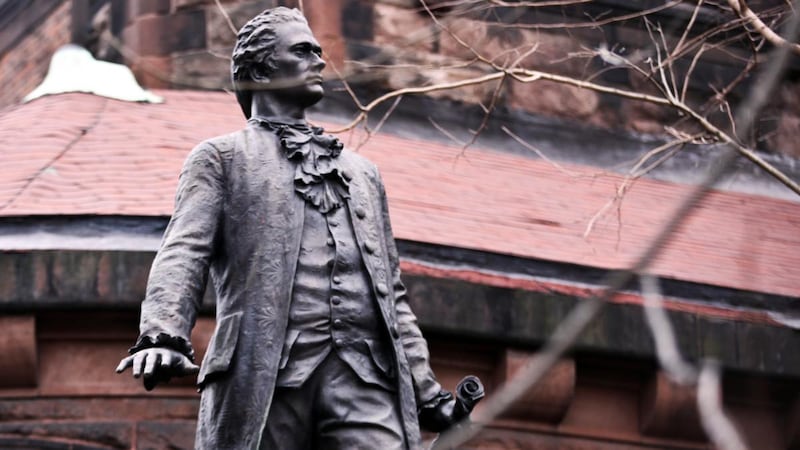
Hamilton’s own story is the American Dream incarnate. Born on the Caribbean island of Nevis and abandoned by his Scottish trader father, he became an orphan at the age of 11 when his Huguenot mother died. The originally French-speaking Hamilton was supported by local friends, who spotted signs of his early promise, paying for him to go to college in New York. Unlike many of the well-to-do federalists, he had been born poor, but his intellect and bravery on the battlefield (he fought alongside Washington and played a critical role at the Battle of Yorktown) enabled him to climb the heights of American revolutionary power.
After every revolution, there must be a period of stabilisation where the gains of the revolution are consolidated and made concrete. The late 1780s in America were the consolidation years. Central to political stability was getting the new constitution ratified and, crucial to monetary stability was the establishment of a credible currency. Hamilton was at the heart of both campaigns.
Hamilton the fighter re-emerged as Hamilton the orator and writer. He took it upon himself to get the fledgling American constitution ratified by the various states. In 1787, he set about getting the people on the side of the new constitution with a series of articles which would become known as the Federalist Papers. So great was the power of the press in this age of the political pamphlet that Hamilton’s reasoning won over public opinion. In fact, he accomplished that task with such brilliance that a huge boat, the Federal Ship Hamilton, was pulled through the city by delighted New Yorkers in July 1788 and proposals were presented to have New York City renamed Hamiltoniana.
Hamilton understood that talk of human rights and the pursuit of happiness was all very well, but something tangible was required to hold the United States together. Without some binding organisational tool, the republic and its competing states might unravel. Hamilton’s tool would be money. And central to the legitimacy of the new federal republic would be a new currency.
Throughout history, going right back to Alexander the Great, money has symbolised something bigger than mere exchange. Money is political power and across Alexander’s vast empire, his subjects knew who the boss was when they saw his face on the coins. To this day, money symbolises the nation, as is the case with sterling, or a greater supranational political project, as with the euro.
[ Alan Greenspan was so able and yet so blindOpens in new window ]
Under Hamilton’s influence, the founders of the American republic appreciated that the currency would be emblematic of the new country and a new beginning. Because money is tangible, and we use it every day, it serves as a gelling agent for other institutions, such as the tax system, which further bolsters the state.
For a nation the size of the American republic, money created an allegiance to the new country in a more mundane and yet powerful way than a constitution. While the constitution may have been the creed, money was America’s sacrament – or you might say, as de Tocqueville was to observe a few years later, that money was the religion of the new republic.
This weekend, when Americans are celebrating the greats like George Washington, Benjamin Franklin and Thomas Jefferson, don’t forget the greatest of them all, the monetary genius, Alexander Hamilton.


