

As we retreat for Christmas, and hopefully pile up with books and other art, it’s a good time to take stock of a year in Irish culture. What struck me this year is how Irish art makers are increasingly pulling their avant-garde intentions into the mainstream.
Boundaries are being pushed, and the results are drawing from Irish identities and our past.
One of the best Irish songs of the year was a cover, Lankum’s astonishing rendering of The Specials’ Ghost Town, accompanied by a stunning music video directed by Leonn Ward, with Robbie Ryan as the director of photography, and also featuring the captivating Oona Doherty. All Tarkovsky and Wicklow, no one does invigorating menace nor ecstatic doom like Lankum.
There was Maria Somerville’s perfect album, Luster, released on 4AD in April. Another Galway artist, Dove Ellis, released his debut album, Blizzard in early December, a captivating collection of songs recalling the tenderness and prowess of Jeff Buckley.
Roma coach lashes out at Evan Ferguson: ‘You need more to be a centre forward than being tall’

Woman arrested on suspicion of murder of toddler Daniel Aruebose

Civil servants say targeted bursaries for teachers must be considered to boost supply

After the Bondi attack: ‘We would love to feel some love from Ireland,’ says Rabbi

There were ghosts in the album of the year, CMAT’s Euro-Country, the trauma of the Great Recession pulled into its title track’s blistering lyrics, waving formative economic trauma as both banner and funereal shroud.
There were ghosts all over the book I enjoyed most this year – although actually from autumn 2024 – Maurice J Casey’s Hotel Lux: An Intimate History of Communism’s Forgotten Radicals – which follows Irish woman May O’Callaghan and her friends living in Moscow’s Comintern’s version of the Chelsea Hotel. Memory, persistence, and the pursuit of art were also qualities of Sinéad O’Shea’s Blue Road: The Edna O’Brien Story. Once again, O’Shea took on something big and told the story her way, as is the case with all of her work.
What links all of these things? There is both a hauntology – how cultural memory haunts the present, and how the presence of lost futures remains – and a hunting going on. The hunt is for depth; the hauntology is how the spectres from our social and cultural past persist in the present.
It’s in RÓIS’s synth-laden keening during one of the most captivating live performances of the year at the National Concert Hall, during a festival called Haunted Dancehall. It’s in Lullahush’s merge of electronica and trad on his captivating record, Ithaca.
The things heard and not heard, seen and unseen, were present in Irish theatre too, especially in two plays where deafness was core; Dead Centre’s wildly innovative Deaf Republic, and Shane O’Reilly’s boldly ambitious Her Father’s Voice, which flipped from a domestic drama to experimental film to opera. And there it was again, in one character’s frantic search for their hearing aids in Carys D Coburn’s brilliant BÁN at the Abbey, a reworking of Lorca’s The House of Bernarda Alba, steered by one of the most talented young directors around, Claire O’Reilly.
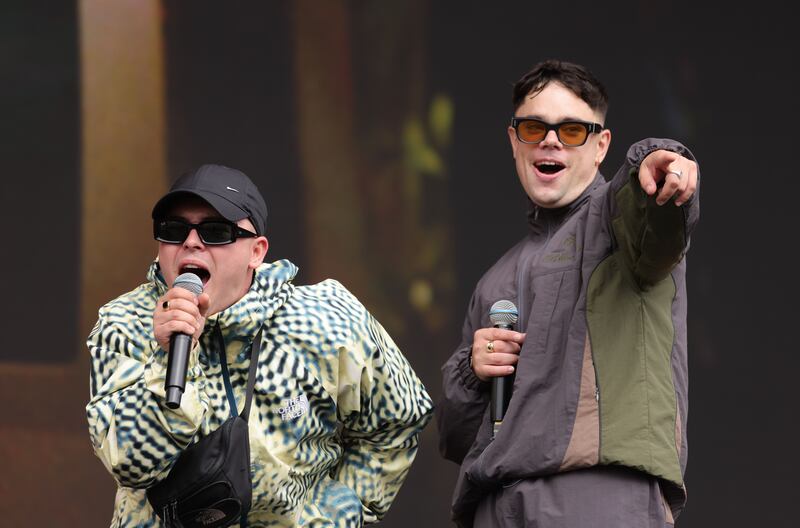
The past was the context for Kneecap’s pursuits this year too, as they recalled the treatment of Irish people in British courts. They didn’t just emerge victorious, but became one of the biggest figures globally in music, culture, and in artist-led solidarity with the Palestinian people, all while lighting up festival stages and conjuring one of the most exciting live performances of the year at Electric Picnic.
It makes sense then, that RTÉ’s right and proper boycott of the 2026 Eurovision was a highlight for the broadcaster this year. The continued inclusion of Israel in a competition celebrating a particularly jubilant form of song isn’t just wrong, it’s grotesque.
There are many other things to mention; the ongoing ascent of Irish creative talent in fashion and design; the Grammy nominations for Fontaines DC and Jordan Adetunji; Fred Again’s remix of Dundalk artist Reggie’s Talk of the Town becoming a town, county, practically national, anthem. There’s Edwina Guckian’s The Devil’s in the Dance Hall live series and Pea Dineen’s Raising Her Voice show, which lit up Dublin’s Fringe. There was the wonder of Mainie Jellett and Evie Hone’s work at the National Gallery; Eimear Walshe’s Romantic Ireland national tour; the work of uileann piper Muireann Ní Shé. Ghostly too, the emotional shimmering of MOIO’s pop melodies, and the outrageous fun of rappers Curtisy, Lil Skag, and Rory Sweeney’s album – another haunted work – Old Earth.
But what stays with me is a piece of filmmaking, the two-part documentary adaptation of Manchán Magan’s Listen to the Land Speak. Magan’s death shook Ireland this year. But his work and impact remains. His search for meaning and deep ancestral knowledge will continue to resonate. So will his mission which implored us to go within and learn, savour, and renew the past – and excavate all the clues our natural world, landscape, language and mythology offer to us.
Magan asked that we reimagine ourselves beyond the constraints of rote histories, narrow nationalism, colonialism, and Catholicism.
His legacy is one that demands attention and asks us to do things with intention, all while remembering the richness of the past, and bringing it into the present. The connection to that, and lust for a re-emergence into something more meaningful is what we should all meditate on as what we call a year ends. Yesterday was grianstad, the winter solstice, a moment that instructs us all to note that brighter hours are coming.


