
One of the professional hats I wear is wedding florist, a job that touches very satisfyingly on my love of plants. It also requires a boffinish interest in what the industry likes to call “floral mechanics”, from working out how to create contemporary arrangements that won’t wilt on a searing hot summer’s day, to making large-scale gravity-defying floral installations. In many ways it’s not unlike being a set designer, with the complication that you’re working with materials that are both fragile and naturally ephemeral.
Professional floristry aside, those very same good floral mechanics are the secret behind successfully creating a beautifully lush, long-lasting arrangement for your Christmas table. Likewise, they’re key if you’d love to make a giant swag of seasonal foliage to drape along your mantelpiece, or a leafy Christmas garland to festoon your front doorway or staircase. With all this in mind, I’d like to share some clever tricks of the trade.
The first is that chicken wire netting is your friend and the most useful, adaptable, versatile piece of kit. Just make sure it’s of a relatively fine gauge using wire soft and pliable enough to easily shape it with your hands.
You can, for example, use lightly scrunched-up balls of it in vases, buckets, bowls and jars filled with water as an easy, eco-friendly, infinitely reusable way of firmly securing stems in position rather than resorting to the environmental nasty that is floral foam.


Chicken wire can also be easily moulded into a wide variety of shapes to serve as the floral mechanics for seasonal swags or garlands of fresh foliage. To decorate a staircase, for example, make a long, narrow, slightly scrunched sausage of it to fit along the length of the banisters (twist the cut edges of your wire sausage together or secure them with some cable ties). Then fix a narrow strip of protective cloth along the banisters (hessian or an old towel torn into lengths works well) before securing the chicken wire sausage in place on top of it with cable ties or string. Once fastened in position, gently poke stems of a selection of resilient evergreen foliage through the voids in the wire to hold them in place, layering them densely to create a lush effect and conceal the wire. Add some longer lengths to trail down and add further interest.
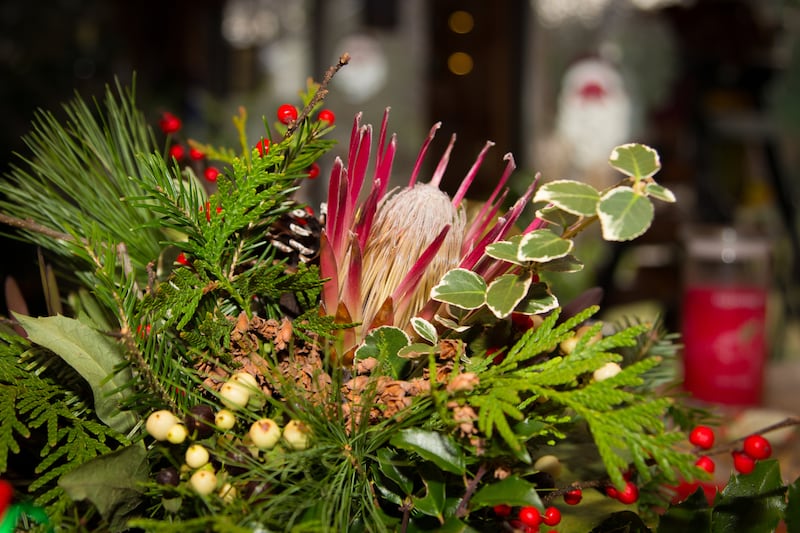
Bay laurel, box, wild seeded ivy, trailing ivy, Portuguese laurel and rosemary along with some stems of any of the resilient evergreen shrubs listed in last week’s column will all work well here, as will any offcuts or trimmings from your Christmas tree. To keep it looking fresh, lightly spritz with fresh water once a day.
If you want to use fresh flowers in a garland like this, you’ll need to prevent them from wilting by placing the base of their stems in individual plastic flower tubes filled with water (these are reusable), before tucking the latter into the wire, making sure they’re concealed well among the foliage.
A really lush, leafy, slightly trailing mantelpiece arrangement is another Christmas classic, but one that can also be challenging to create, the reason being that it’s naturally very one-sided with the weight of flowers and foliage. As a result it can naturally topple forward unless some sort of concealed counterweight is used as part of the mechanics.
I typically use a broken line of several low, rectangular, waterproof containers to make these kinds of arrangements, placing scrunched-up chicken wire inside them. Window boxes or even a few rectangular cake tins can all be easily recruited for this purpose.
To prevent the containers from toppling forwards, either place bricks in them or use cable ties or lengths of wire to securely fasten a few bricks as counterweights to the back of them where they won’t be seen. Just make sure to do this first before inserting any foliage or flowers. Some nicely trailing foliage placed to the front can then be used to help conceal the containers themselves if required. Alternatively, use some small trailing ivy plants, tucking the pots in at an angle to conceal them.
To add extra height and support to this kind of very lush Christmas mantelpiece arrangement (or if your rectangular containers aren’t waterproof), simply pop some individual vases filled with water into the latter. Again, make sure to use lots of seasonal, evergreen foliage and ornamental seed heads to give a sense of leafy abundance. Some gently fading hydrangea flowers will also make a great addition. Just make sure to place the stems in water to keep these thirsty blooms from wilting.
As for impactful arrangements for the Christmas table that won’t hog valuable space but still add plenty of magic, I like to use individual metal flower frogs or kenzans placed in small, shallow, dainty bowls, fixed securely in place with some waterproof floral putty (if you can’t source this, try a little Blu Tack instead).
This kind of floral mechanic lends itself very well to a pared-back style suggestive of Ikebana, with the focus on the individual beauty of a small amount of sculptural plant material. You could use some arching stems of wild rosehips, for example, or silvery lunaria, or the faded seed heads of wild teasels, or some simple, slender birch or alder twigs. Alternatively, try burgundy-coloured calla lilies, hyacinths or paperwhite daffodils. Some artfully placed figs (slice them neatly in half to reveal their colourful flesh), pomegranates, plums or cape gooseberries placed nearby will add vivid flashes of colour and a nicely contemporary touch.
Last but not least, bear in mind that moss is also the Christmas flower arranger’s friend in many ways. Squashed inside chicken wire, you can use it as a moisture-retentive, nature-friendly alternative to floral foam, for example, or use it to easily conceal any ugly floral mechanics. I also like using it as miniature mossy islands encircling a series of small table arrangements, where it acts as the perfectly pillowy, very Christmassy, emerald-green foil.
This week in the garden
If you’re leaving dahlias in the ground over winter, then it’s crucial to protect their fleshy underground tubers from subzero temperatures that can damage or kill them. Use a loppers or sharp secateurs to cut the faded stems down to ground level, then chop them up as a rough mulch before adding an insulating layer of fallen autumn leaves, home-made compost or old bracken.
Keep spot-weeding borders and flower beds as long as the ground isn’t frozen or waterlogged. Look out for troublesome perennial weeds such as creeping buttercup, scutch, ground elder and willowherb that will continue to form dense root systems underground throughout winter. For a useful guide to common garden weeds, see gardenorganic.org.uk
Dates for your diary
Sustainable Christmas Market, National Botanic Gardens Glasnevin, Dublin 9; today (Saturday, December 13th) and tomorrow (Sunday, December 14th), 10am-4pm. Fifty stalls selling a wide range of crafts, artwork, seasonal treats and other Christmas gifts, admission free. botanicgardens.ie