

The term “digital nation” means very different things to Ireland and Tuvalu.
For Ireland it means having a large IT sector, embracing AI and pursuing a deliberate policy of digitising everyday transactions in the home, school, business and public services in the name of progress.
For Tuvalu, it’s a desperate attempt to keep itself in existence via the online virtual world when all traces of the physical country disappear beneath the rising sea.
These two countries, with such different experiences of modern life, are partnering up to cohost the second International Conference on the Just Transition away from Fossil Fuels next July.
RM Block


The handover from Colombia and the Netherlands, who shared the task of hosting the inaugural conference last April, took place on the fringes of the United Nations General Assembly in New York at the end of September.
Details of next year’s event are scant, with the complex logistics, official agenda, side events programme and assignment of duties yet to be worked out.
But the UN gathering in New York provided abundant context for the challenges the conference aims to address, namely getting countries to stop using climate-destroying fossil fuels fast and forever.
During a high-level session, world leaders or their representatives delivered statements on sea level rise and its consequences, ending by formally approving the UN Declaration on Sea Level Rise.
The document was two years in negotiation and begins with a solemn shared message.
“We are deeply concerned about sea level rise,” it states. “Sea level rise is not a distant scenario but a real and lived experience for many.
“Rising sea levels are primarily driven by ocean warming and melting ice sheets and glaciers, and we note with concern this phenomenon is accelerating.”
To put the phenomenon in figures, the background report for the declaration says the seas globally rose by an average of 4.75mm per year from 2012-2025 – more than six centimetres in just over a decade.
But it was 5mm in 2023 and 5.9mm in 2024 so the rate is increasing as climate change intensifies.
In 2023 the Intergovernmental Panel on Climate Change, comprising the world’s top scientists, warned levels could rise by 20-29cm by 2050, and by 50cm to a metre by the end of the century.
But, it says, since then, further studies have warned of much more dramatic increases, particularly if tipping points are reached such as the collapse of the Greenland and West Antarctic ice sheets.
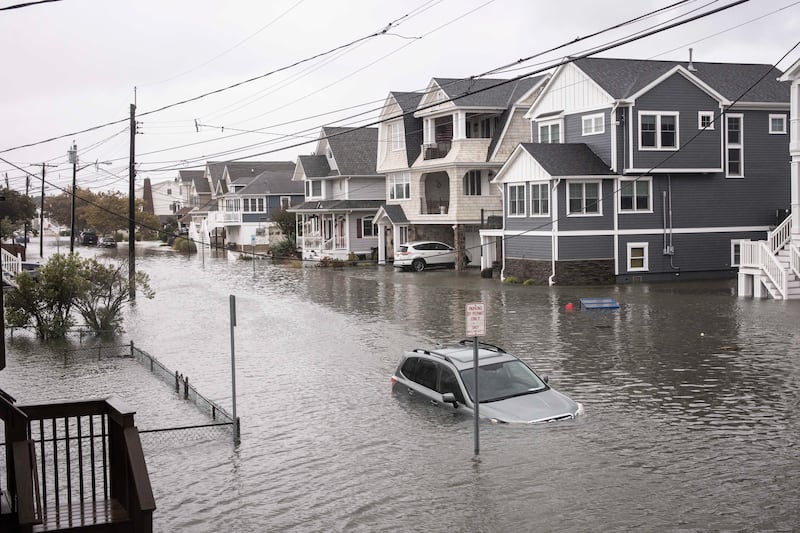
Either way, the backgrounder concludes, almost 770 million coastal dwellers – a tenth of the world’s population – are directly at risk.
These are a diverse group of people – beachside billionaires in California, small farmers in Co Wexford, fishing communities in Bangladesh, bankers in Manhattan, rice-growers in Vietnam and the citizens of some of the smallest, low-lying Pacific islands.
Tuvaluans are among them, fighting a fierce battle against the encroaching seas in a tiny archipelago where the highest point rises no more than 4.6m.
[ Ireland and Tuvalu to cohost international climate conference next JulyOpens in new window ]
The four-page declaration agreed by world leaders last month commits in quite a vague way to doing whatever is possible “to safeguard long-term habitability, livelihoods and critical infrastructure” in such places.
“We emphasise the need for strengthened partnerships and co-operation to mobilise and provide financial, technical and policy support to address sea level rise for developing countries, particularly Sids (small island developing states) and LDCs (least developed countries),” it says.
“We call for scaled-up finance to localise action on sea-level rise.”
That is a call they are making to themselves so it would be of greater significance if they actually pledged to scale up finance.
The declaration gets a bit more specific when addressing the issue of “nature-based solutions and ecosystem-based approaches”.
“Restoration and protection of mangroves, coral reefs, coastal wetlands, kelp forests and seagrass meadows can strengthen resilience while providing ecosystem services and co-benefits,” it says.
It also makes some sensible points about planning and development in coastal areas.
There is something for Ireland to learn from this, the tendency of developers being to trumpet the virtues of coastal living as all sea views and no storms while too often public representatives make zoning decisions based on what has not happened to date rather that what is projected to occur.
“We recognise the need to integrate sea-level-rise projections into the planning, design, implementation and maintenance of critical coastal infrastructure to ensure their resilience,” the declaration states.
It includes as critical coastal infrastructure, “ports, energy, transport, water systems, healthcare facilities, telecommunications, digital infrastructure, and coastal protection measures including land reclamation and elevation”.
But not everything that will be stolen by the sea is visible or tangible.
For the past two years, negotiators grappled with the existential question of whether a country can exist as a legal entity if it doesn’t have physical form and its people have had to leave.
They concluded, and the declaration backs this, that it can and, in most cases, should.
“Once a State is established, the disappearance of one of its constituent elements would not necessarily entail the loss of its statehood,” it says.
“We affirm the presumption in favour of continued statehood and in this respect we underscore the continuity of statehood in the face of sea level rise, as well as sovereignty, sovereign rights and responsibilities, and membership of the United Nations of such states, consistent with international law.
“We call for international support for states facing land territory changes due to sea level rise to continue to maintain institutional functions.”
Marine territories will also be respected even if the country they once surrounded, or part of it, is gone.
“Once established in accordance with UNCLOS (the United Nations Convention on the Law of the Seas), we affirm that states can accordingly maintain their maritime zones in the face of physical changes resulting from sea level rise,” the declaration says.
“We encourage the provision of relevant technical support to assist states to finalise their baselines under UNCLOS.”
Beyond territory, infrastructure and legal status are the characteristics that make a country unique and the declaration addresses these too.
“Sea level rise impacts culture and cultural heritage, including the loss of access to physical sites, living heritage, traditional lands, burial grounds, underwater cultural heritage, archaeological and sacred sites, and culturally significant coastal landscapes,” it says.
“Protection, preservation and documentation of cultural heritage is a priority, including through digitisation.”
This is a project Tuvalu has already embarked upon, with the aim of capturing, preserving and recreating the essence of island life, past and present, for when it has no physical future.
The project is only in its infancy and needs international help – finance and expertise.
Ireland may be able to assist. We certainly have a big enough, brash enough IT sector to pitch in on both fronts.
We will know more when the formalities of the Transition Away Conference are finalised how prominently the quest features on the agenda.

Tuvalu may end up assisting Ireland too over the course of the partnership between the two countries, by prompting some reassessment of attitudes.
The Climate Change Advisory Council warned last week, for the umpteenth time, that Ireland is not taking sufficiently seriously the coastal change we are seeing with climate change – and will see much more of.
Low-lying areas will be lost to sea level rise, higher coastal lands will crumble to worsening erosion and large, often densely populated, areas will be subject to more severe, more frequent storm surges and flooding.
Ireland still has time to prepare for much of this. By contrast, Tuvalu’s Digital Nation website opens with the statement: “Rising sea levels will swallow Tuvalu in a matter of decades.”
It’s a startling forecast that puts the UN declaration and the Transition Away Conference pledges in context. At the moment, they are just words on digital paper but making their commitments real might just allow Tuvalu to exist as more than a digital memory.


