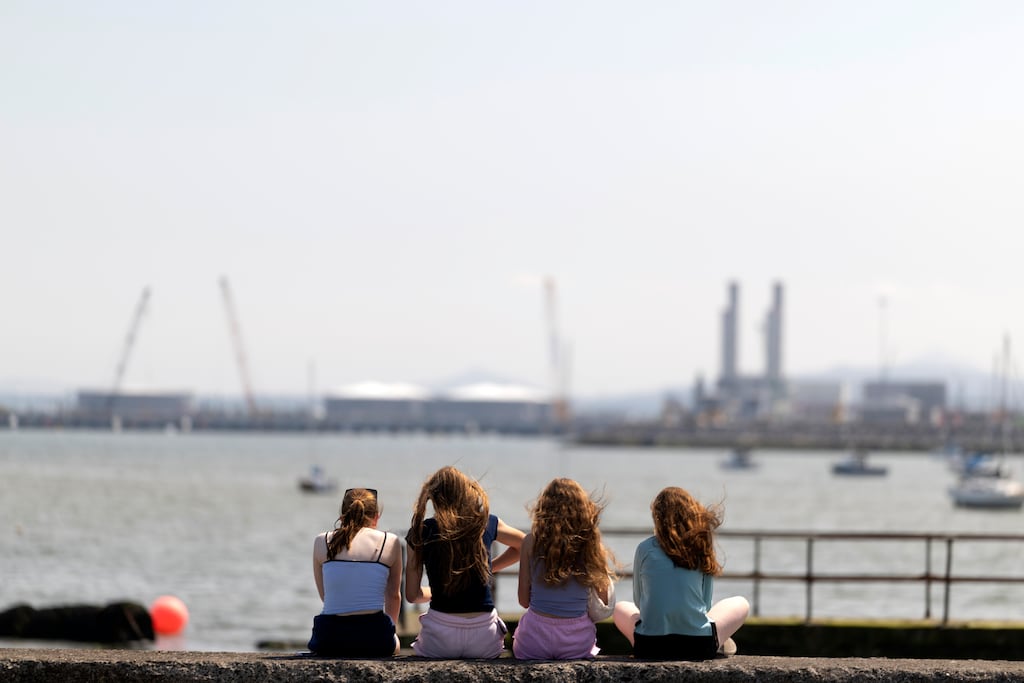

Dublin shimmered all weekend with the kind of light that drapes over the city a dozen or so days a year if you’re lucky, and rarely in a streak. “It’s been like this for a week,” my friend tells me on the drive back to her house from the airport. That’s love, I suppose. That’s a 20-year friendship; there are few gestures more eloquent than collecting someone from the airport. You only brave the inconvenience of it, the irritation of the parking and the traffic and the dull procedural wait because the anticipation of someone you care about walking through the door at Arrivals after so long somehow renders these bothers worth it. So yes, really, that’s love, and what a feeling to be the someone anticipated. You only get so many of those moments in one lifetime.
It was my first homecoming in two years, my first time in Dublin since leaving Australia for London three months ago. The sun does have a way of bleaching the world clean; yellowing everything over with an irresistible sentimentality. It can make a visit home dangerous, that amnesiac light. It can erase all awareness of why you ever left and stoke a yearning that almost makes you forget the frictions that drove you from home in the first place. There is nothing as frictionless as arriving back in Dublin on a cheerily sunny summer day, to find the air smelling of cut grass and the sea, and good friends waiting for you with smiling faces.
What followed was a weekend that was a portal into a past Dublin – the one I lived in with these very friends, when we first met, green as peeled twigs, and shared a university house, and none of us were yet the selves that we would solidify into later. It was the sort of weekend you don’t often get in your 30s, because nobody has time.
[ Laura Kennedy: In Australia, my heart is broken for want of a spice bagOpens in new window ]
There are children and sick or ageing parents, and demanding jobs. Reams of obligations rob you of the space needed to guiltlessly spend a weekend with friends sitting by the sea eating dangerously tilting whippy ice creams from a van with questionable hygiene, or bunched around a table playing board games. We are at the age now when every hour could arguably be claimed by someone else who feels entitled to it, and who really might be. Obligation outweighs enthusiasm, and the range of choice available feels constricted. We are at the age when life can, if you let it, feel less fun than it used to.


Two of the four of us had emigrated since we all lived together all those years ago, and the other two had married each other and stayed in Dublin, their permanence providing a route back home. One of us has lived in New York for years now. I would travel home from London, and before that Australia, and now, again, London. Our friends’ dining table with the board games is a lighthouse we always find our way back to. You drop your bag in the hall and the relationship resumes as though nobody has been leading siloed lives in disparate places, and your insides rearrange and relax, and you meet parts of yourself and of them that you worried might be gone, and that, too, is love.
Dublin would be perfect, you might think, if only there was more in the way of healthcare and housing and school places, and a light rail to the airport so your friends don’t feel obligated to come and get you
This is the danger when Dublin shimmers. The joy of homecoming is not an illusion – but that yellow light flattens the reality of a city that every Dubliner knows is hard to live in. It can fool you. A nostalgic sunny weekend in Dublin could have you thinking about what you miss. It can have you noticing how naturally your feet start to match the rhythm of those around you when you walk down the street. It feels familiar without all the resistance offered up by everyday living, commuting and engaging with public systems and services. Because Dublin would be perfect, you might think, if only there was more in the way of healthcare and housing and school places, and a light rail to the airport so your friends don’t feel obligated to come and get you, waiting with their bright faces to welcome you home.
In Canberra, the Australian capital, over the last year or more, the famously bad public bus system has been transferring over from their equivalent of a Leap card system to being able to tap your card or phone directly, like almost every other capital city in what is broadly considered a developed country. The process was bungled. For months, some buses just had to be free, costing the taxpayer heavily, because the changeover would otherwise have taken buses off the road. It occurs to me to ask my friend Niall – the one who’s back from New York for a visit and has been spending time travelling Ireland for a few weeks now – as we wait for the number 11 bus. “You can just tap on now, right? You don’t still have to use a Leap card, surely.”
“Yeah I’m pretty sure,” said Niall.
“You never know when you come home,” I say.
“You never do,” he says.
We look at each other meaningfully, and I imagine we’re both considering that very Irish dissonance. So advanced in some ways and arbitrarily stuck in others. So keen to emulate our European neighbours yet not necessarily as bureaucratically efficient.
We get on the number 11 bus, and it turns out you do need a Leap card. Or cash. We have a couple of small bank notes, but it’s coins only. And because it’s Dublin and we’re clearly two idiots with suitcases, the driver is lovely and he tells us to sit down and don’t worry about it, you’ll know for next time, and sure with the weather like this who’d be getting stressed about the small stuff anyway. Only at home is it like this. Only here.