
For a few heady weeks in August 2024, the Democratic Party enjoyed the warm gusts of resurgence generated by its Chicago convention revolving around the theme of ‘joy’. Among the key speakers that week was Hakeem Jeffries, then House minority leader, who closed with a rap-inflected prose poem – “meet the moment on Monday/take it to ‘em on Tuesday” – before turning to the scriptural with “until joy, joy comes in the morning”.
It was Jeffries at his most natural – and distinct from the measured, sometimes halting remarks of his House chamber style. It drew strong applause and reinforced the unassailable rise of a New Yorker who was at once deeply influenced by and at a remove from the burgeoning 80s rap scene in the Crown Heights locale. “Old Brooklyn”, he clarified in an interview. “Before gentrification.”
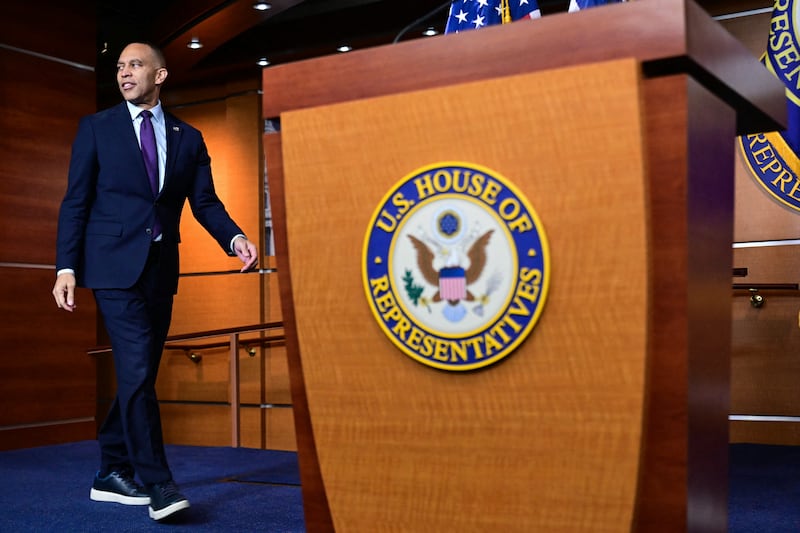
Over two years on from that moment, Jeffries has weathered the turbulence of that traumatic election, and an onslaught of criticism about his leadership during the firestorm of measures invoked by president Donald Trump upon his return to office, to become, on Wednesday, the first black speaker-elect of the House of Congress. The caucus vote was a formality, with Jeffries advancing on a 251-11 secret ballet to take the gavel at the next US Congress in January.
“We are gonna work together to find the highest common denominator in order to make life better for the American people,” he said in a press conference in the Capitol afterwards.
RM Block


“The overwhelming majority of people within the caucus have spoken, clearly and decisively, from all corners of the caucus. And I am humbled by that. But while we run to win, we win to govern and we govern to get big things done.”
But it wasn’t quite from all corners. The nine Democrats who voted against Jeffries (there were two abstentions) included representatives-elect Claire Valdez and Dariliza Avila Chevalier, both New Yorkers and both propelled to Congress by the democratic-socialist insurgency movement. They are two of seven incoming representatives who voted against Jeffries, whom they see as part of the prevailing congressional establishment – and therefore part of the status quo that Jeffries himself announced as unacceptable.
“Our job is to fight Maga extremism, not each other,” Jeffries said, speaking around the dissent, “and to get big things done for the American people and that is what we are going to accomplish together beginning on January 3rd”.
Jeffries has been a member of Congress since 2012 – anointed as the ‘Brooklyn Barack’ by the Washington Post that year – and his ascent through the party’s congressional ranks has been sure-footed while dividing opinion as to who and what he represents.
Both he and Senate leader Chuck Schumer frustrated and infuriated many Democratic voters for what appeared like an almost pathological passivity in the chambers during the move-fast-and-break-things era of the second Trump term.
Advocates for Jeffries argue that strategy, patience, and persistence has always been his chief qualities. Nor is he incapable of biting back: responding to the AI image reposted on president Trump’s account depicting Michelle and Barack Obama as apes, Jeffries fired out an angry video that included the line “F**k Donald Trump.” It was his most impolitic moment – and many Democrats wish there were more such moments.
Responding to his official nomination on Wednesday, former Trump press secretary Karoline Leavitt described Jeffries as “the most far-left progressive speaker of the House this country has ever seen”, and reminded viewers of Fox that he had described Stephen Miller, the new White House chief of staff, as a “reckless extremist with blood on his hands” whose role in the Government must be “eradicated like a tumour”.
But within the progressive left of the Democratic Party, Jeffries is inextricably linked with the pro-AIPAC (American Israel Public Affairs Committee) legacy of the Biden administration.
“I don’t hate him,” said Charlemagne Tha God, host of the influential Breakfast Club radio show, in 2025. “I just don’t think he stands for anything. I call him AIPAC Shakur. Hakeem is a puppet. Hakeem’s not doing anything if Chuck Schumer don’t tell him to do it. Simple as that.”
Jeffries’ private meeting Jared Kushner, the son-in-law of president Trump who has a double role as a peace envoy and private equity broker, drew strong criticism from prominent voices within the Democratic commentarial. He later explained it as a discussion about the cost-of-living crisis and vowed, in a video, that the caucus would “hold every single member of the Trump cartel accountable”.
One of Jeffries’ prevailing tasks as speaker will be marshalling the Democrats’ strong majority to make the Trump Government answerable for the decisions taken over the first two years while enacting legislation to deliver the cost-of-living, housing and health-relief measures that drove the midterm voting revolt.
“We collectively know as House Democrats that life is way too expensive here in the United States of United States,” he said on Wednesday.
“There are far too many people in this country who are working hard, playing by the rules, but they can’t thrive and they can barely survive. That’s not acceptable here in this great country – the wealthiest country in the history of the world. We know the American people are struggling; we know millions are drowning in this failed republican economy and House Democrats are committed to turning things around. Our message to the American people struggling in this failed economy: we hear you, we see you, we feel you.”
But addressing an inflation and cost-of-living crisis that has defied both the Biden and Trump administrations – even before the Iran war imbroglio – will be a difficult task for the new Congress majority. Trump’s early post-election promises to work with the Democrats soon flipped into a flaunting of his power to veto legislation.
Mike Johnson, the exiting House speaker (and republican House leader), described Jeffries as a “friend” but offered this succinct message on Wednesday afternoon: “Good luck. He’s gonna have a hard time keeping his conference together. That’s my prediction.”
But Jeffries will command a sweeping majority, unlike the razor- thin margins Johnson dealt with. Using his collaborative and strategic skills to keep the Democrats’ left and centrists on the same page will be the next test. For now, the election of the first black politician to the role of House speaker is another historic breakthrough for the United States.
“I feel vindicated,” said James Clyburn, the veteran South Carolina representative who had invoked Civil Rights activist John Lewis in his nominating speech.
“I feel redeemed. John was one who never lost faith in the pursuit. And I think this was another step towards a more perfect union, and it means that those of us who kept the faith have been vindicated.”