Although a dominant cultural force since the 1950s, American television only hit its true, glorious peak in the final decade of the 20th century. Among the gems to introduce cinematic ambition, sweeping storylines and renegade perspective to the small screen was The Simpsons. Nominally a cartoon that began as a short on the fledgling Fox channel, it invited the country to at once laugh at its vanities and flaws and examine its familial and civic institutions with an affecting and caustic touch.
The show was in its third season when, on September 26th, 1991, it broadcast Mr Lisa Goes To Washington, in which Lisa, the hyper-bright, idealistic daughter, earns her family a trip to the capital, where she will compete in the national finals of an essay contest on the theme of patriotism.
As with many of those early-season episodes, the flecks of genius are to be found in the casual asides. The judges mark Lisa’s regional essay out of 10 under the categories of Clarity, Organisation and “Jingoism”. Outside the White House, the perpetual protesters reflect the sanguinity of the coming decade (the 1990s are now held up as some lost idyll), holding up placards reading “Things Are Fine”, “No Complaints Here”, “One Happy Camper”.
But Lisa, on a dawn visit to the memorial of one of her heroines, stumbles on a secret meeting in which her local congressman takes a bribe from a lobbyist to permit the chopping down of the Springfield forest. In tears, she visits the Lincoln Memorial to seek counsel – “Honest Abe, he’ll show me the way” – only to find it crowded with other citizens pestering the great man with their own petty concerns. Disillusioned, she rips up her essay entry and scandalises both Homer and Washington’s political set by reading aloud – in the Kennedy Centre – an accusatory polemic titled Cesspool on the Potomac.
RM Block


That half‐hour of television, aired 35 years ago, remains a deft reflection of the nagging sense that in US politics, the themes and scandals never really change, only the names and faces. Summer in Washington thickens into a syrupy and bug-laden haze. Walking is reduced to snail’s pace along the National Mall, where visitors take photographs in front of the monuments and then refuge in the cool of the museums.
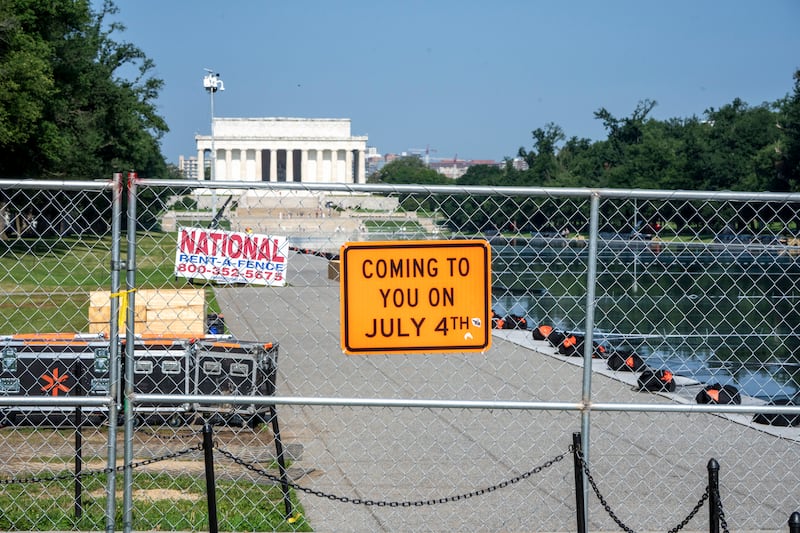
For the past month, the state of the reflecting pool, directly in front of the Lincoln Memorial, has been held up by Trump’s critics as an apt symbol of a befouled presidency. The administration’s commissioned upgrade, painting the pool’s base an “American-flag blue”, had promised a lagoon of crystal clarity. It briefly was. But over the past month, the water became discoloured with heavy algae, clumps of the blue sealing paint and even dead ducklings, rendering the place a calamity.
Trump has blamed criminal vandalism for the despoiling. The commentariat and Democrats have labelled it a perfect metaphor and in keeping with other disastrous vanity projects: the travesty of the UFC night at the White House; the East Wing a rubble-strewn building site; the Kennedy Center nameplate covered in tarpaulin and operating a zombie programme; the desolate sight of Trump’s Great American State Fair, which has attracted a cruel lack of interest from the general public, leaving Fox News hosts, broadcasting on site, suffering the humiliation of claiming the venue was crowded even though the screen showed an empty fairground.

From the left, the laughter and taunting have been ceaseless, deepening Trump’s paranoia that the mainstream media is incapable of fair reporting. He could point to other renewal projects in the city, such as the Columbus fountain outside Union Station and the cascades at Meridian Hill, which are both sparkling and working now for the first time in many years.
But through ineptitude and catastrophic timing, the reflecting pool will be fenced off as Americans consider who they are and what their country means 250 years into the grand experiment.
While Trump’s daily whims and pronouncements dominate the never-ending news cycle, the US supreme court issued a series of term-ending judgments which delivered mixed news to the administration’s project to chart a radical conservative “America First” agenda.
It ruled against Trump’s executive order, preserving the 150-year-old rule on birthright citizenship. It upheld his executive order banning transgender athletes from competing in girls’ and women’s sports – on a state-by-state basis. It declined to take judgment on Trump’s appeal against the 2023 civil judgment, which found him liable for sexual abuse and defamation against E Jean Carroll.
And last week, the supreme court overturned a circuit court ruling that has far-reaching impacts for future asylum seekers. The lower court had found that “an alien” may apply for asylum while standing on the Mexico side of the border and encountering a United States official. The supreme court rejected that interpretation.

Sonia Sotomayor, one of the three liberal judges on the court, took issue with that very aspect in her acerbic dissent.
She invoked the infamous case of the MS St Louis, an ocean liner carrying 937 passengers seeking refuge from Nazi Germany in May 1939. The boat was refused entry by Cuba and Canada and when it sought entry in the United States, the public mood, battered after the Great Depression, was not sympathetic towards the plight of arriving immigrants. The St Louis returned to Europe with its passengers.
“Tragically, over 500 of the refugees that had attempted to flee were trapped in Western Europe under German control, and over 250 of them died during the Holocaust,” Sotomayor wrote.

On the same day, the supreme court ruled to effectively end temporary protected status to Haitians and Syrians by 6-3. Writing her dissent to that ruling, judge Elena Kagan took issue with the majority’s contention about the nature of the comments Trump had directed towards those communities during his election campaign and since returning to office.
“The references – of filth, disease and primitiveness – are shot through with racial stereotypes and tropes. It is hard to imagine the statements being made today of any White community. No very ‘sensitive inquiry’ is needed to see them for what they are; judges, as we often say, are ‘not required to exhibit a naivete from which ordinary citizens are free’."
These, then, are the tensions concerning race, ethnicity and nativism dividing the highest court in the land even as the United States reaches 250 years old. They echo the same arguments played out in much cruder language on partisan networks and podcasts and social media. Among those celebrating the temporary protected status reversal was Megyn Kelly, the former ABC and Fox anchor who now fronts her own show that airs on YouTube. She had a gleeful message for the Haitian communities.

“Go home. Get out. We know our country is better than yours. That’s because we filled it, with our work ethics and our culture and our values. You being here only dilutes it for us. We don’t want you. Go back to f**kin Haiti.”
Kelly’s screed was widely denounced as rancid. But it revived one of the lowest moments of the 2024 election campaign, when Trump, in his presidential debate with Kamala Harris, repeated the lie about a specific Haitian community in Ohio.
“In Springfield, they’re eating the dogs.” (Not the fictive Springfield of The Simpsons). “They’re eating the pets.” When the moderator told the former president that a Springfield official had reported that there was no evidence of this, Trump replied: “I saw a guy say it on TV.”
Just this week, Republican congressman Mike Turner, who represents the constituents in that part of Ohio, rejected those allegations as “completely untrue”.
The conspiracies and accusations and counteraccusations and the noise of two political factions who have long stopped hearing one another have left many Americans feeling numb and psychologically battered. This marquee July 4th coincides with a World Cup tournament that has begun to enchant the country. Despite dire and sometimes dumb forecasts, the tournament has turned into what it always turns into: a carnival of human spontaneity and joy and exquisite sporting melodrama. It pairs people from countries in stadiums for a few hours of intense, unforgettable shared experience. Frequently, the tournament pits former colonies against their old European conquerors. It seems apt that the World Cup should take place here, in the United States, at the very moment that it celebrates, or marks, its transformation from colony to independent nation, to empire and self-appointed pilot light for democracy.
The ease with which the United States has hosted this mega-tournament is a tiny example of its supreme wealth, privilege and power. Everything was already built: the stadiums were in place. The US can host gargantuan events like this in their sleep. The atmosphere at the matches has been wonderful. The arrival of supporters from around the world has helped to remind addled Americans that their country remains, in many respects, a glory. In scale and geographical splendour, it is breathtaking. The feel of America now is of a nation looking back at the spellbinding arc of its 20th-century accomplishment and wondering: where now?
All the great American cities were built with the faith or conceit of planners who were convinced – who knew – that their metropolis would thrive and expand forever. Thus, cities like Detroit and the necklace of handsome midwest cities are trying to figure out how to reinhabit and revive their heartlands.

Immigration was the theme which Trump successfully prosecuted in returning to power. The other was the cost-of-living crisis and the implicit betrayal of the American Dream, the pursuit of happiness: the eternal upward trajectory. Like the Biden administration, Trump’s cabinet has seemed powerless to arrest the crisis. Its lurch into tariff-warfare and impulsive war with Iran has exacerbated the problem. Many of the generation of Americans under 30, born either side of the 9/11 attacks, have experienced nothing but a turbulent or dystopian version of the American Dream story, with Donald John Trump as their bedtime reader-in-chief.
In San Francisco, headquarters to artificial intelligence leaders Anthropic and OpenAI, tech workers earning up to $200,000 (€175,000) per year have this week told The New York Times that they are worried they can no longer afford to live in that city. If that’s the case, then something within the capitalist orthodoxies has gone badly wrong. Relocating to those underpopulated gems like Milwaukee or the small cities necklacing Lake Michigan, with all of the breweries and none of the traffic, may be one solution – it’s hardly a coincidence that the US census bureau reported that the midwest is “the only region where all states gained population from July 2024 to July 2025”.
A slew of polls interrogating Americans about their feelings regarding the country and the Dream have been released over the past few days. They point to a deeply conflicted and anxious electorate almost two years into Trump’s promise of a new golden age. To take just one: the Rainey Center shows a sharp split in the 41 per cent who feel their lives have improved: some 77 per cent of the Silent Generation and 51 per cent of the Baby Boomers hold that sentiment: the numbers for Millennials and Generation Z climb no higher than the mid-30s. There is no data on Generation X, who presumably just hung up the phone. Sixty-two per cent of those polled believe that the dream-promise has become less attainable over the last decade: a full 36 per cent feel it is out of reach. Only 16 per cent of people believe the so-called AI revolution will make it easier to achieve their idealised American life. Economic, inflationary and the seemingly hopelessly poisoned political climate are listed as the chief concerns.
But! Polls are polls and are devised to guide respondents down certain paths. The United States remains, at street level, a dynamic and, on a superficial level at least, a country filled with pleasant, optimistic and frequently kind people. There is laughter! The best of the place has been on show over the course of the World Cup. Quite by accident, the arrival of the football tournament has super-enforced the truth that the story of the United States, at 250 years, is an operatic, multicentury saga of immigration. Megyn Kelly, who has often referenced her Italian and Irish grandfathers, is a blazing immigrant success story. Her version of America as a nation of immigrants is limited to a certain kind of immigrant. Her grandparents, she has said, “desperately wanted to assimilate.”
“But if they didn’t, you know, then you’d have some guy with an Irish brogue eating a lot of meat and potatoes and drinking a lot. Like, that was the most significant downside to the Irish not potentially assimilating. It’s a very different story when you’re talking about immigrants from Uganda who are Muslim at a minimum and potentially radicalised Muslims.”
That fear of otherness and the return of openly nativist rhetoric and, within the Trump administration, policy, will become the dominating theme of the two-year cycle leading to the next presidential election.

Donald Trump is an immigrant story, too, one of flamboyant and brazen excess. But although he has dominated the horizon from East to West for a decade, he is not the United States. He is a uniquely American story: a singular version of the dream. Through a combination of unorthodox rogue charisma, his animal sense of mass dissatisfaction out there in the heartland, his uncanny ability to connect with them and a Democratic Party that had become fuzzy and hectoring in its messaging, Trump has become one of the most consequential American figures of the past 250 years. He has reinvented or subverted the perceived understandings of how to establish oneself as a politician. He has completed the circle, which started with the Nixon-Kennedy televised debate in 1960, treating electioneering as ultimately a screen show: a game of soundbites and images.
His ultimate compliment? He/she is “from central casting”. Trump moves through the American subconscious as an Orca moves through a body of water. The support cast, from Stephen Miller, nativist-propagandist-in-chief, to vice president JD Vance to RFK jnr, where would they be had they not hitched their star to his wagon? And what happens when he leaves?
Wednesday’s headlines were dominated by news that Trump has made a billion dollars since returning to office. The public reaction to this has been one of apathy, exhaustion or indifference. But there must, within the Make America Great Again movement, be a growing fear that once Trump enters the closing phase of his presidency, none of his would-be successors will come in any way close to emulating the strange hypnotic pull he has exerted. He is – or at least he was – an entertainer: a funny and often camp (those hand gestures; the ohs with the mouth, the ceaseless vanity) performer. But for the past few months, he seems exhausted and even bored by the job. Talk of an FDR-like third term has fallen silent. All indicators point to a crushing midterm election report.
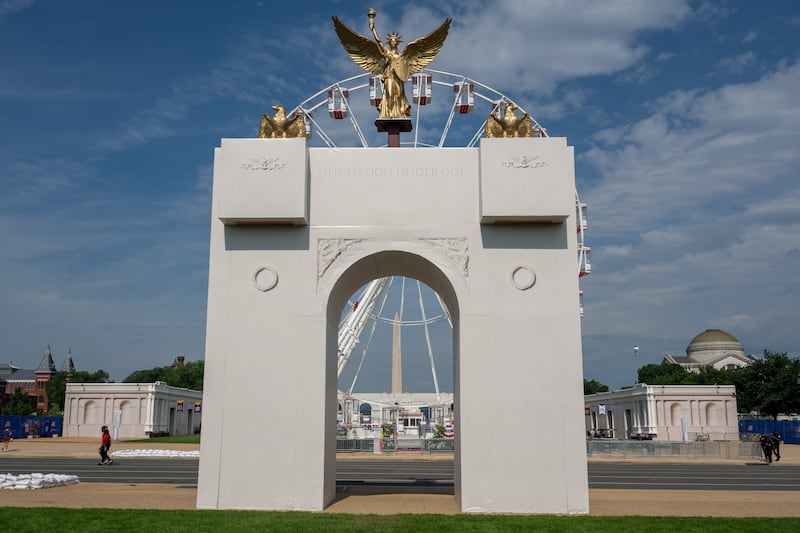
Trump’s bleak observation from a mid-1980s interview with New York magazine – “We’re here and we live our 60 or 70 or 80 years and we’re gone. You win, you win, you win and, in the end, it doesn’t matter a hell of a lot. But it is something to do, to keep you interested” – has been tested by the relentless, berserk agenda of his second term. He now appears to be losing interest. The remodelling of the National Mall, the White House ballroom project, and the planned Arc de Trump are, surely, his own attempt to leave his permanent stamp on Washington.
He knows that the future chroniclers and biographers will deliver a merciless verdict on his presidencies. Sooner or later, tongues will loosen. A new book on Trump contains an anecdote of what the president told other staffers about Natalie Harp, his unflinchingly loyal aide: “All of you will eventually leave to make money, but she will never leave me.”
By a unique confluence of circumstances, the United States has reached 250 with the most divisive and volatile president in living memory as its figurehead. A decade ago, the America250 committee was set up as a bipartisan group to formulate a celebration fit for US citizens of all political persuasions. Trump has made this July 4th extravaganza with himself as the star figure, because he could imagine no other party. As the poet said: I am great! I contain multitudes!
But there will be 350 million other parties taking place across the states on Saturday night, too. It’s a fragile moment in the Experiment, but crises of democracy are nothing new in the United States. Through the worst of it, Americans have always had a capacity to express their joy and gratitude – and to salute the greats and great-greats who arrived on this boat or that train or worked in this mine or that patch of hardscrabble farm on the Plains. And look at us now, Ma!
The Simpsons is often credited with saving the Fox cable channel from early extinction, facilitating the launch of Fox News in 1996, which continues to play an inestimably valuable role in boosting Donald Trump.
There’s a famous moment in that old Simpsons episode when Lisa, unable to get a hearing with Honest Abe, scoots across to the more remote memorial for Thomas Jefferson. She finds the Founding Father vividly awake and embittered by the fact that while the people flock to Abe, nobody ever visits him.

“I never did anything important,” he complains in a pompous, Anglicised accent. Just the Declaration of Independence! The Louisiana Purchase. The dumb waiter!”
You could imagine Trump nodding appreciatively at this lack of gratitude for genius, but he might be wise to take note of the closing exchange. When Lisa Simpson goes to leave, Thomas Jefferson calls after her.
“Wait!” he pleads.
“Please don’t go.”
“I get so lonely.”