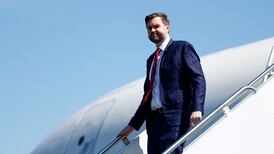
When US secretary of state Marco Rubio flew back from Europe to Washington on Monday, the ink was still wet on nuclear energy deals worth about €13 billion.
On flying visits to Slovakia and Hungary, Rubio praised their Trump-friendly prime ministers Robert Fico and Viktor Orban and said the central European countries were “key components” of future US engagement with Europe.
“We are entering this golden era of relations between our countries, and not simply because of the alignment of our people, but because of the relationship that you have with the president of the United States,” said Rubio alongside Orban, whose re-election in April is not a given, judging by opinion polls.
Regardless, Rubio did some impressive business with two European countries racing to wean themselves off Russian energy.
RM Block


Hungary is set to buy next-generation nuclear reactor technology and spent nuclear fuel storage solutions.
Slovakia, meanwhile, has ordered a large nuclear reactor from US conglomerate Westinghouse – and raised the prospect of buying an additional four F-16 US fighter planes on top of 14 already ordered.
Before Rubio left for home, aware that not everyone in central Europe thinks along Fico-Orban lines, Washington’s chief diplomat insisted that the US wanted to be the continent’s partner – not its adversary.
Three weeks after Donald Trump announced the “framework of a future deal” on Greenland, Rubio confirmed in Slovakia that talks with Denmark and Greenland were ongoing but that he felt “very positive and optimistic that we’re on a good trajectory.”
[ How Troy Parrott’s heroics may have dented Viktor Orban’s re-election hopesOpens in new window ]
Yet Rubio’s framing of Slovakia and Hungary as co-operative European allies prompted one journalist in Bratislava to ask: “Who are the non-co-operative allies from your point of view, and isn’t this kind of a creation of a two-tier EU or the policy of carrot and stick?”
The US chief diplomat side-stepped that question, adding: “We don’t want Europe to be dependent on [us], we’re not asking Europe to be a vassal of the United States.”
That may be a swipe at Polish prime minister Donald Tusk, who insisted last week that Poland “has been, is, and will remain a reliable ally of the United States”.
“But as long as I am prime minister, Poland will not be a vassal in this relationship,” Tusk added. “Allied relations cannot consist of someone constantly saying ‘yes’ to everything.”
While its central European neighbours are warmer or cooler towards the Trump administration, Poland is a country divided.
The critical Tusk is in a forced cohabitation with Poland’s Trump-endorsed national conservative president Karol Nawrocki.
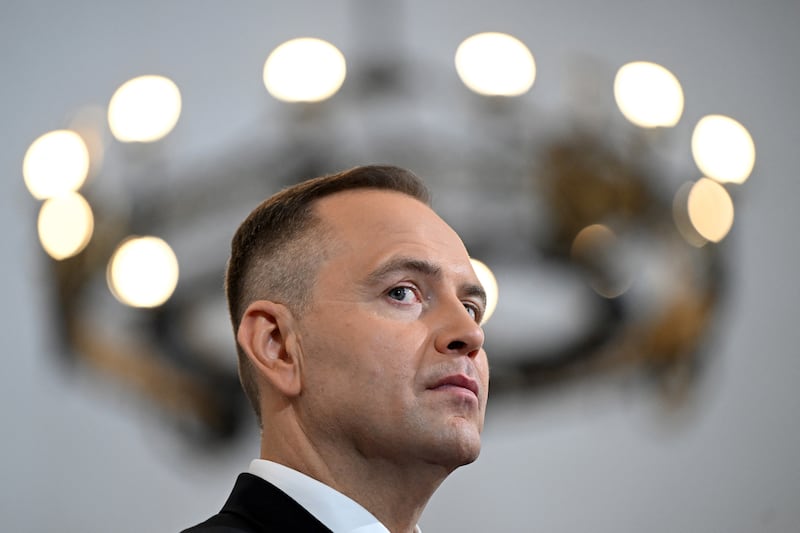
At a meeting last week of Poland’s national security council, Tusk said he had told Nawrocki “unequivocally” about his vassal view towards Warsaw’s bilateral relationship with Washington.
“I have the impression that he has a different opinion on this matter”, added Tusk drily.
On Sunday evening Nawrocki, who has far-reaching security and defence competences as head of state, got in his response.
He demanded Poland, “a country bordering an armed conflict”, develop a nuclear deterrent.
“It is clear what the aggressive, imperial Russia’s attitude toward Poland is,” he said in a television interview.
Pressed, he declined to say whether he favoured Poland joining a common European initiative or buying its own system – from the US or elsewhere.
Poland’s struggle to be a co-operative Trump ally is clear, too, from an ongoing controversy over Poland’s parliamentary speaker Wlodzimierz Czarzasty.
[ Europe ponders its future: embrace an ally, submit to a bully or go it alone?Opens in new window ]
He accused Trump of “destabilising” international organisations and “often violating international law”.
For US ambassador to Poland Thomas Rose, the remarks were “outrageous and unprovoked insults”, meaning the US would “have no further dealings, contacts, or communications” with the parliamentary president.