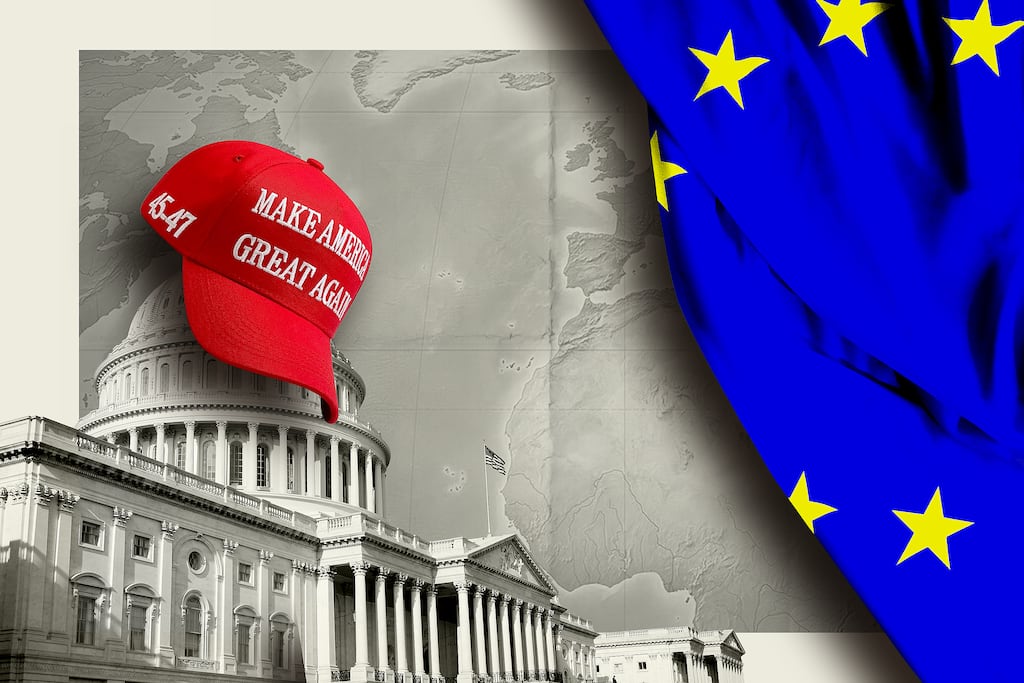

United States president Donald Trump has described Europe as “weak” and “decaying”. A strategy document published by the White House states that the administration wants radical right parties in power and a weaker, possibly defunct, European Union.
It’s worth sketching out what the national security strategy says, as it makes explicit much of what had previously been implicit in Trumpian foreign policy.
Washington’s priority is to be the dominant power in the western hemisphere, and it is moving military forces out of Europe to focus on this. It won’t tolerate nearby countries that ally with rival powers, hence the hostility towards Venezuela. It doesn’t care about Africa, and is withdrawing aid.
It is concerned about China becoming a dominant power and wants to curtail its growth, partly through restricting trade. Washington wants to deter China from invading Taiwan and controlling the South China Sea because it fears it could put “tolls” on global shipping routes or shut them down at will.
RM Block


The document states that the US will no longer seek to promote democracy in other countries, or “hector” states “into abandoning their traditions and historic forms of government”, at least when it comes to Gulf Arab states.
It does seek change in Europe, however. As a priority, the document states: “cultivating resistance to Europe’s current trajectory within European nations”.
This means supporting nationalist, or “patriotic”, European political parties as they seek to gain power. The European Union is named as a reason for the continent’s supposed “economic decline”, and “prospect of civilisational erasure”.
A leaked fuller version of the document reportedly names Austria, Hungary, Italy and Poland as countries the US should work with “with the goal of pulling them away from” the EU.
Ireland is a rare country to be mentioned by name. The document states that the “character” of Ireland is “strategically important” to the Trump administration.
The invitation of MMA-fighter turned alt-right influencer Conor McGregor to the White House on St Patrick’s Day and his promotion as a potential presidential candidate can be seen in this light.
The document appears to reflect the broader ideology that has been developed by the Maga movement, more than the personal views of Trump himself, though it coheres with his enduring beliefs and interests.
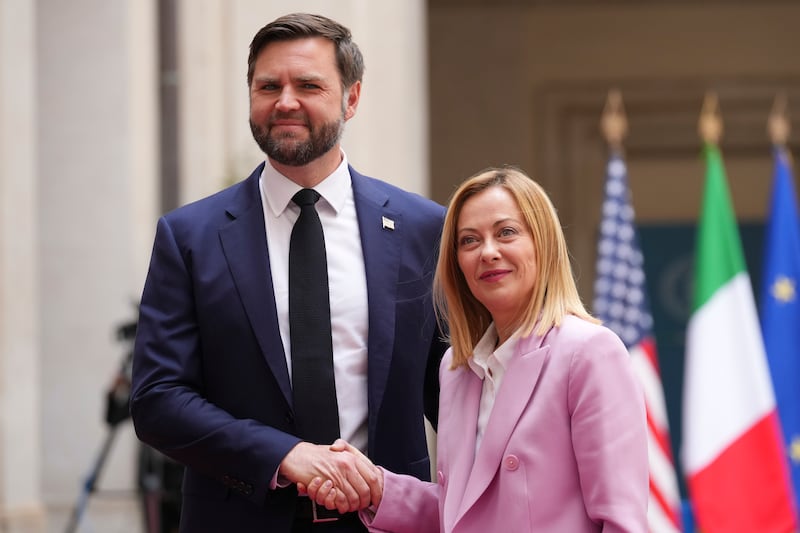
One author is probably US vice-president JD Vance, who has previously described himself as “plugged into a lot of weird, right-wing subcultures”.
Some of the content chimes with a speech he gave in Munich earlier this year, particularly the accusations that European governments are engaged in widespread censorship because of social media moderation, and the idea that “mass migration” is a greater threat than Russia’s invasion of Ukraine.
There are references to what the US “should want” and a leaked draft reportedly states that “Hegemony is the wrong thing to want”. This sounds like thinking influenced by René Girard, a French academic who gained a cult following in the right-wing fringes.
Vance has previously said he was strongly influenced by Girard’s “mimetic desire” theory, that people are often influenced in their desires by what others want.
The focus on migration to Europe is a long-standing preoccupation within these circles: scare stories about Muslims and immigrants in Europe have been stock fare for well over a decade on Steve Bannon’s influential Breitbart.
What is behind the hostility to Europe? Why single out the continent for disdain?
Europe is considered one of the “liberal bastions” that Vance and others blame for thwarting the plans of the first Trump administration, according to Jeremy Shapiro, research director at the European Council on Foreign Relations.
“Attack the universities, the think tanks, the foundations, the finance industry and, of course, the deep state,” he recently told Politico. “It was only through attacking these liberal bastions and conquering them to your cause that you could have a truly transformative effect.”
Trump dislikes the EU, and often brings up his struggles to get planning permission at his Doonbeg golf course as an example of EU over-regulation, though his antagonist was in fact Clare County Council.
Hard politics are part of this too. Trump is inconsistent in many things, but can be relied upon to seek to further his own power.
Europe is the most powerful remaining force upholding the rule of law, which Trump has sought to dismantle as he furthers his interests.
A thriving liberal Europe is also threat as an example of an alternative system, a proof of concept of liberal democracy that people in the US can look to, having a cultural impact.
The EU is also, of course, an economic heavyweight. Everything about how it conceives of that power conflicts with Maga ideology, which favours deregulation and rejects the concept of climate change.
The EU’s regulatory heft was most recently illustrated by its €120 million fine on Elon Musk’s X for violating the Digital Services Act. Trump has previously threatened tariffs or sanctions if the EU dares to curtain US tech.
“Allies must act as allies,” European Council president António Costa remarked this week in Dublin. The US national security strategy is prompting the EU to consider whether the US can still be seen as such.


