

She was short and sturdy, probably in her mid-seventies, and she wore a long, flower-patterned summer dress, and thick rimmed glasses below a short, black pudding bowl. Like nearly everyone in this little tree-lined park, she was holding a pushan, a round, flat fan made of dried palm leaves with a short handle, and she was pointing it at me.
“Chang! Chang! (sing! sing!)” she said.
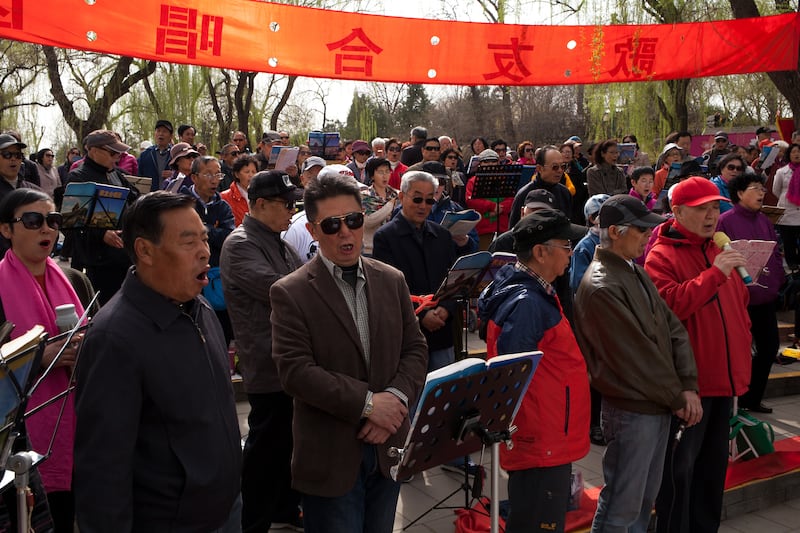
Everybody else was singing, taking their cue from a portly, male conductor dressed in black with a ponytail, who stood before a red banner. Next to him was a saxophonist and a keyboard player and in front of him, just to the side, stood the leader of the group, a tall, thin woman dressed in red.
Before each song, she would call out a number and the singers would go through a thick book with the words and music to find the right one. The singers, almost all of whom were over 65, were gathered in clusters around the park, most of them standing but many sitting on folding chairs and some with music stands they brought along with them.


This is the Beijing Zuojiazhuang Xinlianxin Singing Group, a community choir that has been meeting every morning from Monday to Friday at this little park next to a fruit and vegetable market since 2010.
“Everyone’s welcome, no questions asked. We kick off at nine, sing for about an hour, break for 15 minutes, then do another 45 minutes and wrap up by 11,” the woman told me after she gave up trying to persuade me to sing.
“We usually do about 12 or 13 songs a day. Someone leads the singing, and we learn new ones too. When there’s a new song, we just play it a few times on the speaker until everyone knows it. The lead singer walks us through it a few times and, before you know it, we’ve all got it.”
They use six songbooks which they rotate and the songs are all so old that the friend who was with me, a Beijing native in her mid-forties, knew hardly any of them. A mixture of patriotic, romantic and sentimental numbers, the songs we heard included Blue Homeland; Wishing Mother a Long Life; Slow Down, My Horse; and Chairman Mao’s Benevolence Is Higher Than the Mountains and Longer Than the Rivers.
While we were chatting, another woman joined us to say that she comes here because it means that she talks to people every day and it’s good for the heart and lungs.
“Honestly, singing gives me something to do. The moment I open my eyes in the morning, I feel like I’ve got a reason to get up,” she said.
“We sing for about two hours, though I might leave a bit early if there’s something going on at home, or if it’s blazing hot. I’ll pop into the market next door, grab some vegetables, then head back to cook lunch and take an afternoon nap and just like that, it’s evening. Dinner, a bit of television, and the day’s done. It’s nice, really.”
Almost one in four people in China are over 60 and a growing number of them are experiencing loneliness and social isolation, with studies saying that anything between a fifth and a third feel at least some degree of loneliness. Urbanisation, mass migration and the legacy of the one-child policy saw the proportion of older people living alone more than double within a generation, from 8.7 per cent in 2000 to 21.1 per cent in 2020.
Filial piety, the Confucian concept of a moral debt children owe to their parents for raising them, remains a powerful imperative in China and the country’s elderly rights law obliges spouses and children of the elderly to provide economic support, daily care and spiritual comfort. But although the one-child policy has been gone for more than a decade, the typical family structure still has four grandparents, two parents and one child.
With average life expectancy now close to 80, this can leave one adult with six older people to take care of at a time when they may also be raising their own family. Urbanisation has seen the loss of much village community life and the economic reforms that drove China’s prosperity also swept away the old danwei system of work units that provided lifetime employment and welfare built around the workplace.
For the woman who wakes up thinking about the singing group, it is an antidote to loneliness and a daily impetus to leave home and get moving.
“Otherwise, I’d just stay at home all day curled up on the sofa watching television and eventually fall asleep. When I wake up, the television is still on,” she said.
“Older people are afraid of going soft in the head if they stay at home too long, so it’s important to get out and about, no matter how long or short it is.”


