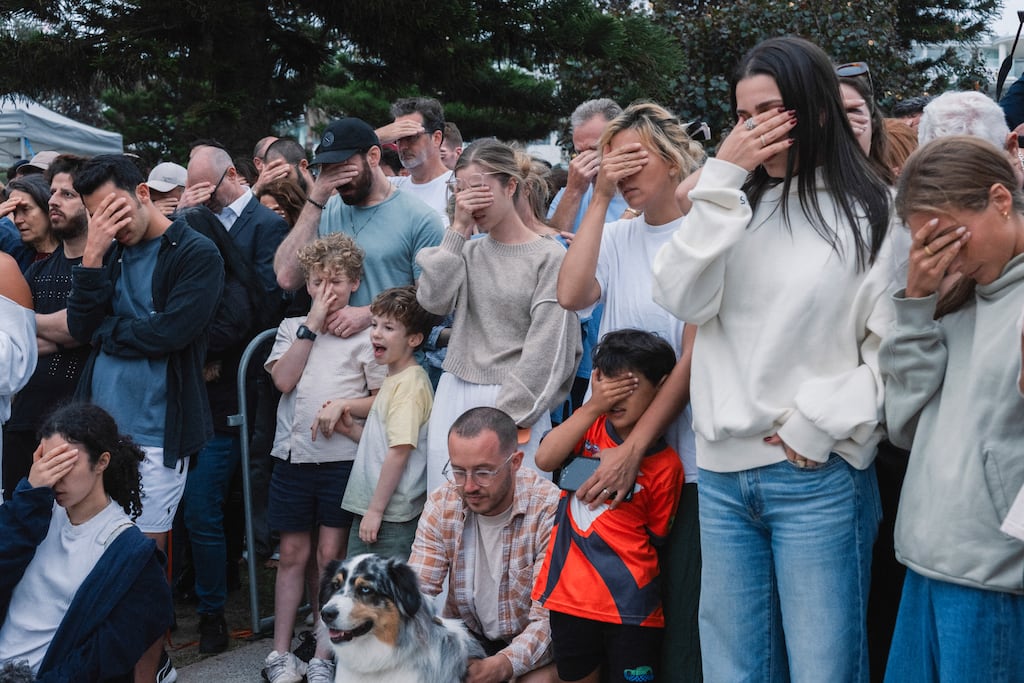

Sunday’s massacre of at least 15 people at a Jewish event on Sydney’s Bondi Beach shocked Australia, a country Jews have long regarded as welcoming and safe. It also resonated around the world, heightening anxiety within Jewish communities already feeling beleaguered and among Muslims who fear it could fuel another surge in Islamophobia.
Sunday’s candle lighting on Bondi Beach was one of the first such Hannukah events this year, as the sun set hours earlier than most of the rest of the world. The identity of the victims, who ranged in age from 10 to 87 and included a survivor of the Holocaust, made the slaughter all the more heartbreaking.
The single uplifting part of the tragedy was the heroism of Ahmed al-Ahmed, a Syrian immigrant who tackled one of the two gunmen and grabbed his gun. Ahmed, who was shot twice, has won universal praise, including from Israeli prime minister Binyamin Netanyahu who described him as “the pinnacle of Jewish heroism” while acknowledging that he is a Muslim.
Netanyahu accused Australia’s prime minister Anthony Albanese of ignoring his warning last August that Australia’s support for a Palestinian state “pours fuel on the anti-Semitic fire”. He said Albanese had done nothing to stop the spread of anti-Semitism in Australia.
RM Block



“Instead, prime minister, you replaced weakness with weakness and appeasement with more appeasement,” he said. “Your government did nothing to stop the spread of anti-Semitism in Australia. You did nothing to curb the cancer cells that were growing inside your country. You took no action. You let the disease spread and the result is the horrific attacks on Jews we saw today.”
Albanese rejected the criticism, pointing out that “overwhelmingly, most of the world recognises a two-state solution as being the way forward in the Middle East”. The exchange highlights the fact that Netanyahu will use the Bondi Beach massacre to reinforce his narrative that connects support for Palestinian statehood and opposition to Israel’s military campaign in Gaza with anti-Semitism and attacks on Jews around the world.
There is no doubt that many Jews have felt alarmed and alienated by the tone of some pro-Palestinian demonstrations and the anti-Semitic rhetoric and slogans used by a small number of protesters. They also face a persistent threat from far-right and nationalist actors who have, according to organisations like the European Union Agency for Fundamental Rights (FRA) and Britain’s Community Security Trust (CST), historically been the biggest source of anti-Semitic attacks.
There has been a shift since the Hamas attacks in Israel on October 7th, 2023, and the Israeli bombardment and blockade of Gaza that followed it, with more attacks now linked to that conflict. In the six months leading up to October 7th, 2023, CST recorded a monthly average of 161 anti-Semitic incidents. However, in the first six months of 2025, the monthly average stood at 254 incidents.
“Its impact is clear in the fact that 779 incidents – 51 per cent of the 1,521 instances of anti-Jewish hate reported to CST in the first half of the year – referenced or were linked to Israel, Palestine, the Hamas terror attack or the subsequent outbreak of conflict,” CST said in a report this year.
”For comparison, in the first half of 2023, a period unaffected by a significant trigger event in the Middle East, this discourse was present in just 16 per cent of anti-Semitic incidents.”
Anti-Muslim incidents in the EU have also increased sharply since the start of the current conflict in Gaza, according to the FRA, with most of the attacks coming from the far-right. The Bondi Beach massacre will make both Jews and Muslims feel less safe at a moment when the peace process in Gaza remains fragile and uncertain.