Remember when we used to argue about Messi and Ronaldo?
Theirs has been the defining individual rivalry in the history of professional football, and, in fairness, it used to be a reasonably fair fight. But the final few years of their respective international careers have seen Messi decisively settle the debate as to who has been the greatest of them all.
Just look at the contrast of this week. Where Ronaldo flounced out of the Portugal squad amid a storm of recrimination and bad feeling, Messi said farewell to Argentina at a specially arranged game in Buenos Aires that was less a farewell match than a last sacrament of consecration.
Benin provided the necessary cast of extras known as the opposition for a game that stopped in the 10th minute to celebrate Messi with a fireworks display and one last theatre of supplication from the Argentina fans in the stands. Messi would score, obviously, from the penalty spot in a 3-0 win, and afterwards everyone craned their necks to watch a drone light show in the sky. This was the first time Messi joined everyone in looking upwards in wonder – he was usually the subject of these slack-jawed gazes.
Ronaldo and Messi’s final playing days show a clear difference between the modern game’s two greats

Aleksander Ceferin to stand for a fourth term as Uefa president

‘Closest thing to what I imagine drugs would be like’: Ireland’s Conor McManus revels in win over England

Jessie Stapleton hoping fresh start at club level will give her Ireland boost

Messi took the microphone and delivered a farewell address to the stadium in that quiet, reticent tone of his while some of his team-mates sobbed uncontrollably. That Messi has inspired this level of devotion among team-mates is a reminder that not all leaders need to be stentorian speechmakers.

While Messi was saying goodbye, Ronaldo had taken a brief vow of silence. Having apparently fallen out with head coach Jorge Jesus over his decision not to use him as a substitute against Norway, Ronaldo exiled himself from the Portugal squad, saying little beyond issuing a gnomic promise to one day tell the truth as to what happened.
That day arrived on Wednesday, when Ronaldo published a statement of almost 1,800 words giving his version of events. In being so critical of the head coach, Ronaldo revealed he has a different kind of Jesus complex.
Across the long statement, Ronaldo claimed Jesus had denied him three times. First the coach told Ronaldo to stay at home for the Nations League games away to Norway and Denmark, only to relent. Secondly, Jesus agreed to put him on the bench against Norway and promised to play him for 30 minutes, only to have him warm up without playing at all. Finally, Ronaldo claims the coach promised to clarify the whole situation by reading a statement approved by Ronaldo at the prematch press conference, only for Jesus to allegedly renege on the deal.
The most absurd element of the whole story is the fact Ronaldo published the eight points that had been given to Jesus to read at the press conference. They read as an abject coda to Ronaldo’s career. They include Jesus taking full responsibility for what had happened against Norway and are heavily seasoned with gratuitous tribute to Ronaldo.
Jesus was supposed to describe Ronaldo as “exemplary, loyal, and professional”, herald the “the weight he has in the world”, and then castigate himself for his short-sightedness for “putting someone of the stature of Pelé or Maradona on to warm up and then not putting him in the game”. (That Messi isn’t listed here may mark a brief outbreak of self-awareness on Ronaldo’s part.)
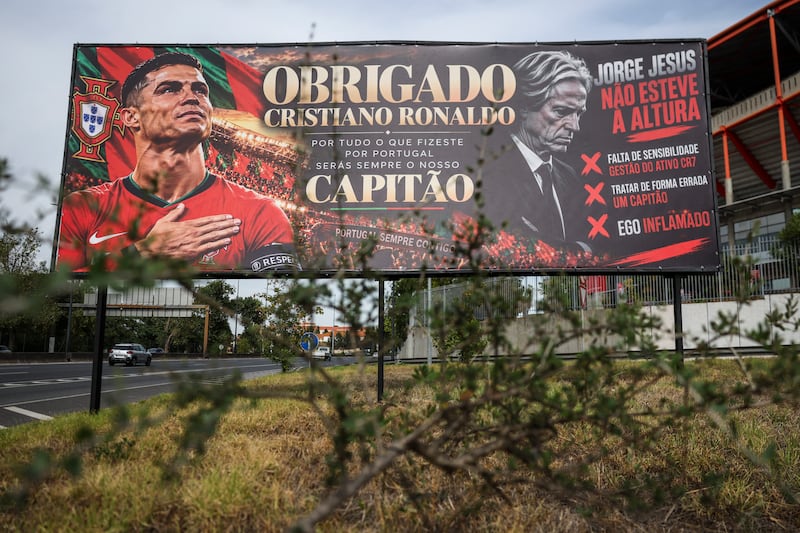
Ronaldo’s briefing document did not acknowledge that Jesus may have chosen to leave him on the bench because he is 41 years of age.
Ronaldo’s career end is now the familiar tale of the great player who has gone on too long. In Ronaldo’s case, he has played for much too long and is perhaps the only player in the history of the game who has gone on two World Cups too far. He did once stand in haughty defiance of his advancing age, but that was five years ago, when he broke the international scoring record with two late goals against Ireland. He has since been routed by Father Time at the top level; his tap-ins and penalties against low-ranking opposition a poor compensation for his inhibiting a hugely talented Portugal team at three straight major tournaments.
And yet Ronaldo has been unable to step away from the main stage, and has instead tried to pretend that everything is still as it ever was. He has tried to do with Jorge Jesus as he has done with so many others, continuing to try to arrange supplicants around him like a child arranging a teddy-bear picnic. It must be galling for Ronaldo that the deference that once came automatically from those around him must now be consciously demanded.
But this is the consequence of going on for too long. Messi’s career winter has been far more graceful because he is simply a better footballer. Unlike Ronaldo, his game is not rooted in belligerent physicality, but in an astounding ability to compute time and space. Messi’s gifts have a longer lifespan, and they have allowed him to retire an icon among Argentinians who embraced him more coolly in the early part of his career.
Ronaldo will ultimately be remembered in similar terms in Portugal, and he will surely be given a similarly grand farewell game at some stage. But his pretensions to be the greatest player of all time are over: he has lost the argument with Messi, and he has lost it partly because he has been unable to stop fighting it.