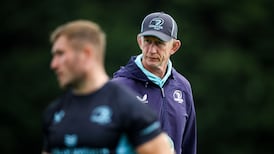
Being told you are dropped is an uncomfortable experience. For some players, ego gets in the way and they make the situation worse than it needs to be.
For others, it becomes a turning point.
In 2009, shortly after returning from the Lions’ tour of South Africa, Michael Cheika pulled me aside: “You are not playing well enough.”
Younger Leinster players were getting minutes ahead of me. I could not argue, the evidence was undeniable, and I knew Cheika was telling the other centres to prove that they deserved to stay in the team.


That is an uncomfortable conversation, between coach and established international, but a necessary one that needs to start happening across the provincial squads.
Players rarely remember any game. The losses are hard to shake. The wins that stay with them are the ones they earned, particularly derby matches where emotion and momentum collide.
Leinster’s performance against Ulster last Friday was flawed, but what is emerging this season is their willingness to fight through sketchy form. There was genuine appreciation on the players’ faces when the final whistle went. The winning mentality remains intact.
Individuals are putting their hands up. Joshua Kenny has been excellent since the switch from Sevens. Harry Byrne is consistently impressive at outhalf while Scott Penny and Alex Soroka keep showing their value in the backrow. Harry has four caps for Ireland, the other three have zero between them.

Their form raises a question Leinster rarely need to answer: are some selections beginning to tilt towards merit rather than reputation?
If you are selected for a province, Ireland or the Lions, you are there because you have the capacity to play at that level. Your challenge is to stay there.
There are matches that linger long after a season has finished. The ones when you sit in your locker a little longer, the body more bruised than usual as a quiet satisfaction numbs the pain. A line from A League of Their Own always comes to mind: “It’s supposed to be hard. If it wasn’t hard, everyone would do it. The hard is what makes it great.”
I remember some games so clearly. Toulouse. Croke Park. Twickenham. Some became personal reference points, while others defined teams that I played on.
That felt like the case for Leinster last Friday and, while a victory proved elusive for Ulster, the performance will go a long way towards building a clearer understanding of how they can take the next step.
These type of games form part of the story you return to when you want to understand how far you have come, or how far you still need to go.
From Leinster winning for the first time in France against Montferrand in 2002 to beating Munster in 2009, we built a body of work that proved we could win the tight games.
Despite being capped at 19, when it came to Ireland selection I was behind players like Tyrone Howe and John Kelly for a few years.

Kelly was someone I would later come to admire. Often underrated, the Munster winger was relentlessly consistent. He was a better player than me at that point, and I either had to improve or accept my fate.
Things began to shift under Cheika. There were landmark moments: our first win in Thomond Park, victory in Toulouse, the Bloodgate match against Harlequins. Each experience sharpened our understanding of what was required in pressure moments.
That is why, when I saw Leinster’s team to face Ulster, my initial reaction was surprise. It felt like a risk, a stick to beat them with over selection: a new half-back pairing, changes in the pack, a reshaped back three.
By winning, Leo Cullen and his coaching staff looked brave to trust squad depth and current form. It raises an important point about the club’s selection policy as picking a provincial side based on reputation rather than form does everyone a disservice.
[ Leinster’s bench makes the difference in entertaining win over UlsterOpens in new window ]
Cheika’s feedback in 2009 became a powerful motivational tool. If nobody taps you on the shoulder and tells you that you can do better, how do you adjust?
This is shaping into one of Leinster’s most unorthodox seasons in recent memory and, from a player’s perspective, that is exciting. There is real scope for change and opportunity.
Munster will be watching closely, encouraged by what Ulster managed for the opening hour until Leinster’s bench of Lions told their own story.
Rewarding performance creates competition. Competition improves standards. The aim is not to default back to the regulars, but to provoke a response, to create an environment where everyone is playing as though this is their last chance.
Maybe it is. The form centres in the provinces are Munster’s Alex Nankivell and Ulster’s Stuart McCloskey. The form wingers are Kenny and Tommy O’Brien. What are the other three-quarters going to do about this? Roll on Saturday night in Limerick and Galway.
Ulster were good value last Friday but, when it really mattered, they had no answer to Leinster’s power surge. Those are the games that define seasons – not because of the result, but because of what they reveal.