For the last two years the World Athletics Relays have proved an important springboard for Irish athletes. In many ways it helped put Irish relay teams on the world map, and part of the challenge this weekend is to make sure they stay there.
The 2026 edition of the event is set for Gaborone, the capital of Botswana, with the qualifying rounds set for Saturday, before the finals and repechage rounds on Sunday. As well as racing for medals and prize money, the event will also determine most of the qualifying places for the 2027 World Athletics Championships, plus the inaugural World Athletics Ultimate Championship, set to take place in Budapest this September.
Two years ago in the Bahamas, with Rhasidat Adeleke on board, the Irish mixed 4x400m team won bronze, qualifying for the Paris Olympics that summer, with the women’s 4x400m also qualifying. That turned out to be the best year ever for Irish relay running. The mixed relay went on to win European Championship gold in Rome, the women’s 4x400m winning silver, before at the Paris Olympics, the same women’s quartet finished fourth, just 0.18 of a second off bronze.
Irish relay running had never been in a better place. Then at last year’s World Relays in Guangzhou, China, again with Adeleke on board, the mixed and women’s 4x400m also qualified for the World Athletics Championships in Tokyo. Although with Adeleke subsequently withdrawing from Tokyo through injury, both relay teams were unable to get out of their heats, the women’s 4x400m almost 10 seconds off the national record set in Paris.
Fiona Everard on qualifying standards for 2028 Olympics: ‘They seem a bit crazy’

Relentless pace of the running boom shows no sign of slowing down

Dublin Marathon analysis shows club runners produce significantly faster finishing times

‘The brightest light never truly fades’: Ciara Mageean remembered at funeral

Some of the momentum gained in 2024 appeared to be lost. This time, and for a few different reasons, Adeleke didn’t put herself up for selection for Botswana. Her absence does afford younger Irish athletes the chance to shine, but it also makes qualification that bit more difficult.
She’s been a constant presence in those big performances over the last two years.

The long distance from her training base in Texas to Botswana was one factor, and athletes need to be a little more careful when racing in an undeveloped country, but for now Adeleke is entirely focused on her individual 400m aspirations this summer. She’s down to race at the Texas Invitational this weekend, before racing a world-class field at the Shanghai Diamond League in two weeks’ time, all building towards the European Championships in Birmingham in August.
It’s almost two years now since Adeleke ran her Irish record of 49.07 to win silver at the 2024 Europeans, staged in Rome that June. So, her individual targets must take priority this year. She needs to get back to where she was two years ago, not last year, so there’s quite a bit of ground to make up.
Athletics Ireland have entered three teams this weekend – the mixed and women’s 4x400m, along with a women’s 4x100m. There is still a depth of experience in Sharlene Mawdsley and Sophie Becker, while the likes of Molly Daly and Erin Friel, both still only 18, are called up to the Irish senior relay squad for the first time.
European Under-20 400m champion Conor Kelly is also unavailable, as the event clashes with his collegiate competitions in his first year at the University of Texas. It means on the men’s side, the mixed relay will be looking to the likes of Jack Raftery, Seán Doggett and Fintan Dewhirst.
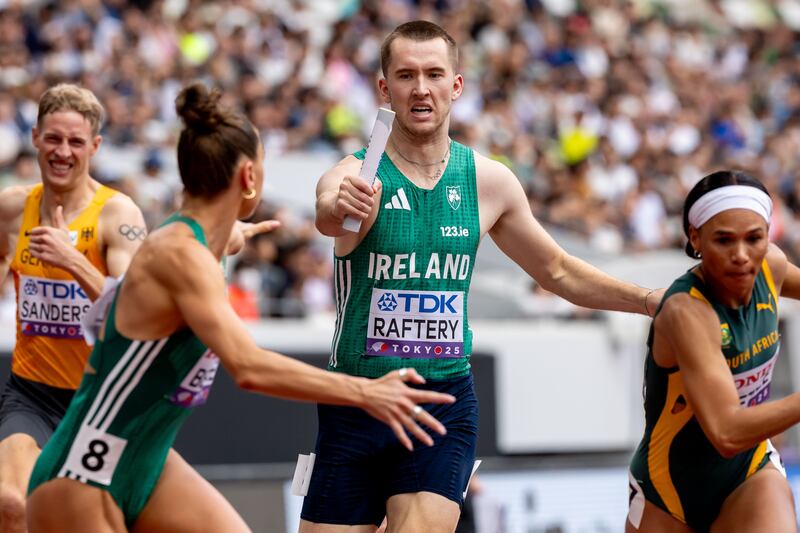
Young athletes have to start somewhere and this is their chance to make a mark and to test themselves against some of the best athletes in world.
In terms of qualification, the top 12 teams in each event will qualify for the 2027 World Athletics Championships, set for Beijing, with the top six teams in the mixed 4x400m relay qualifying for the World Athletics Ultimate in Budapest in September. The remaining four places for Beijing next year will be decided on rankings. Not every country is at full strength and the USA, for example, hasn’t sent a men’s or women’s 4x400m, reckoning they will qualify on rankings.
But with more countries focusing on the relays now, it will be more difficult for the Irish teams to qualify. I do think the mixed relay represent the best chance. Two years ago, they won a bronze medal, with Thomas Barr and Phil Healy on board, both very reliable relay athletes.
It’s now time for the next generation to step up and show what they’ve got, and to make the most of the opportunity. Sport Ireland has also directed significantly more funding into the Irish relays over the last two years, particularly the mixed and women’s 4x400m, so if neither of those teams come away with qualification this weekend, that would be seen as a huge disappointment.
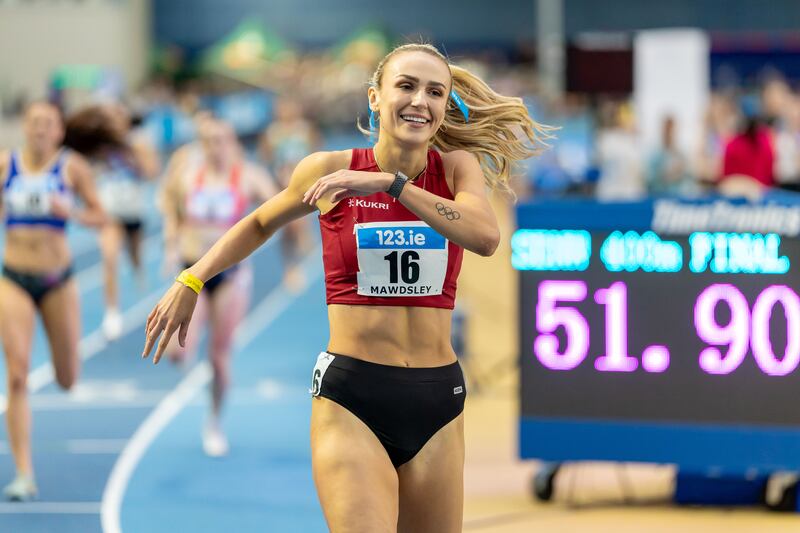
It’s interesting that Mawdsley has been selected for both the women’s and mixed 4x400m and also the women’s 4x100m, but you’d think her focus will remain on the 400m. The women’s 4x100m mightn’t be that far off, with the likes of Molly Scott, Ciara Neville, Sarah Leahy, and Precious Akpe-Moses.
Rachel McCann is also named in both 4x400m selections, and this is another opportunity for her to make progress. The Irish relay squads have been training in Stellenbosch in South Africa for the last two weeks, so there can’t be any excuses in terms of preparation.
Although not yet at the standard for Botswana, there’s also big hopes for the Irish men’s 4x100m over the next couple of years, now that Benji Richardson, who has run 9.86, has switched allegiance from South Africa.
There won’t be any World Athletics Relays next year, the following edition set for May 2028, when LA Olympic qualification will be on the line. But if two or possibly three teams can qualify this weekend, that would be a huge boost for the prospects of Irish relay running going into 2027.
It’s also important to maintain a competitive standard in 100m and 400m running, if this is an area of focus for Athletics Ireland. There also needs to be a deep pool of athletes to pull from, so that we’re not relying on the same athletes all the time.
As a nation we were all inspired by the success of the relay teams in 2024. It’s now time for the younger athletes coming through to stake their place on these teams of the future, and that quest begins this weekend.