The latest Irish Times/Ipsos B & A poll confirms Sinn Féin as the most popular party despite a small drop in support.
Sinn Féin are now polling at 24 per cent (down three points), still in advance of Fianna Fáil on 19 per cent (up two points) and Fine Gael on 18 per cent (no change).
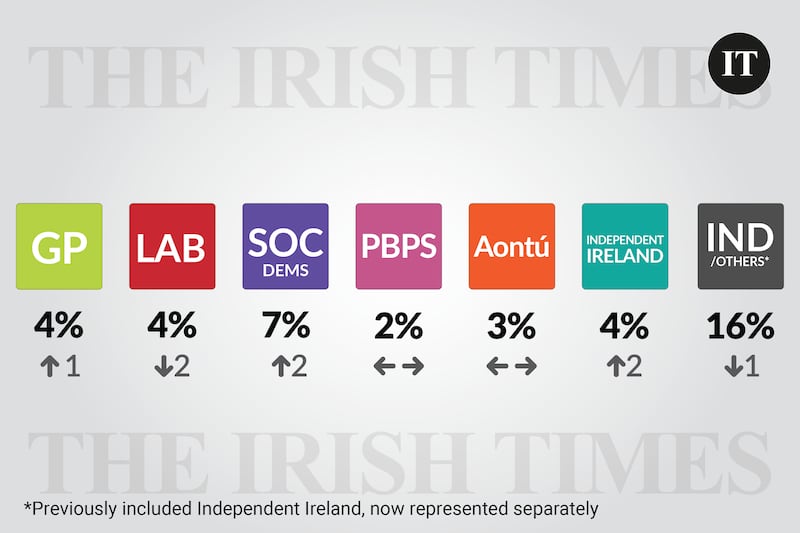
Leading the chasing pack are the Social Democrats on 7 per cent (up two points).
Labour (down two points), the Greens (up one point) and Independent Ireland (up two points) are all on 4 per cent, followed by Aontú on 3 per cent (no change) and PBP–Solidarity on 2 per cent (no change).
RM Block


An independent candidate is the preferred choice of 15 per cent of voters (down one point).
Inclement weather meant interviewing for this latest poll was spread across five days, between January 30th and February 3rd. A total of 1,200 interviews were conducted, in person, in every constituency and covering cities, towns and rural areas.
All key demographics are represented in Irish Times/Ipsos B & A polls in proportion to their representation within the adult population.
It may be the start of a new year but the priorities for Government look rather familiar. Housing, infrastructure, immigration and healthcare continue to exercise politicians and voters alike.
International events have been more distracting than usual for the Government lately. The upcoming EU presidency will offer a stiff test in diplomacy, with Ireland halfway between Boston and Berlin at a time when the gap between the two continents is widening. Staying neutral, economically and militarily, will be a challenge.
Jim Gavin’s withdrawal from the presidential race was likely behind the fall in support for the Fianna Fáil party in last October’s poll. With the presidential election now firmly in the rear-view mirror, Fianna Fáil have reclaimed some lost ground, edging up two points to 19 per cent.
Intention to vote for Fianna Fáil is highest in Munster, at 27 per cent.
Satisfaction with Micheál Martin’s performance as Taoiseach has rebounded somewhat, up four points to 37 per cent. He is the most popular party leader, in advance of both Mary Lou McDonald (on 35 per cent, down four points) and Simon Harris (on 31 per cent, down four points).
Fianna Fáil voters are far from convinced they need a change at the top, with 82 per cent satisfied with his Micheál Martin’s performance and just 15 per cent dissatisfied.
Fine Gael remain below their 2024 General Election support level, on just 18 per cent. Among middle-class voters, the party no longer enjoys a commanding lead, with the more affluent socio-economic groups (ABC1s) showing almost as much interest in Fianna Fáil (19 per cent) and Sinn Féin (18 per cent) as Fine Gael (21 per cent) in this latest poll.
What Fianna Fáil and Fine Gael have in common is a weaker connection with the newest generation of voters. Together they attract just 26 per cent of those aged between 18 and 34 years. Since the 1990s, support for the two ‘establishment’ parties has declined by roughly 10 points per decade. If demography is destiny, change may be inevitable, if not imminent.
[ Catherine Connolly touches upon Irish unity in first official visit to the NorthOpens in new window ]
On 24 per cent Sinn Féin are still on top, yet a long way off polling in the mid-30s like they did during the last government. One difference between now and then is a more crowded field and greater choice for voters.
The Social Democrats, on 7 per cent, will act as a drag on Sinn Féin just by virtue of being another option for floating voters to consider, even if compared to Sinn Féin their support is much more middle class (10 per cent among the ABC1s).
Independent Ireland, on 4 per cent, have only entered the fray very recently. The party’s strong working-class appeal (7 per cent among C2DEs) puts it in direct competition with Sinn Féin.
Even Aontú, on 3 per cent, is a potential thorn in the side of Sinn Féin – Aontú poll strongest in Connaught/Ulster (on 5 per cent), where a number of Sinn Féin strongholds are located.
Forming behind Sinn Féin is an orderly queue of alternatives, all aware that the electorate is frustrated – satisfaction with the Government’s performance is at 30 per cent, down one point and the lowest it has been since 2020. With the public finances in rude good health and the spending last year well in advance of inflation and population growth combined, something is not working.
Damian Loscher is Ipsos B&A president