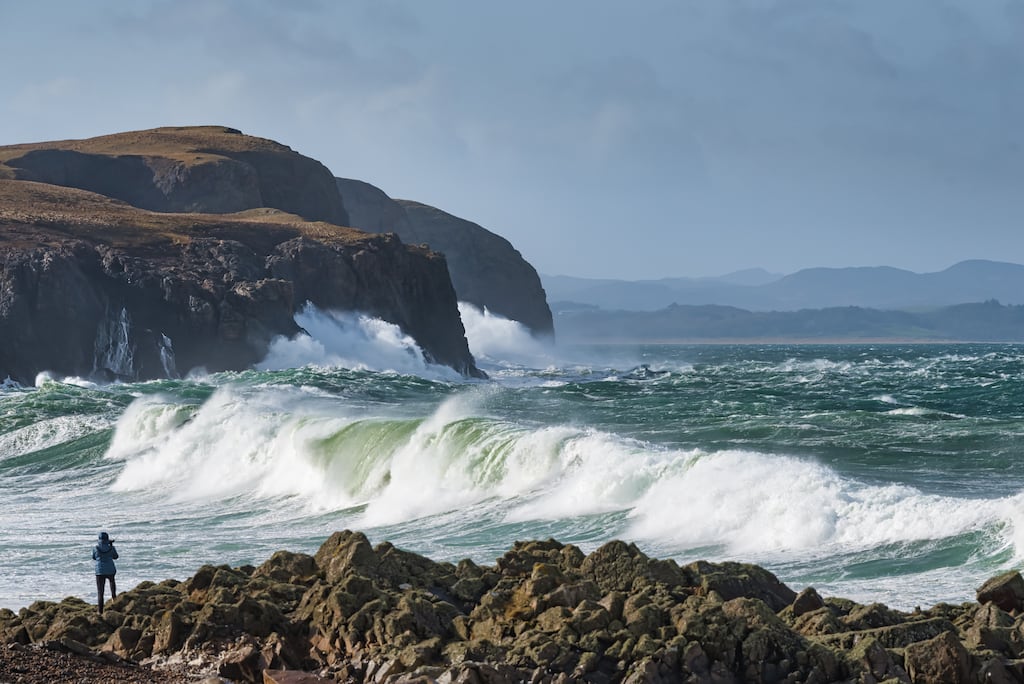

When the south wind hits the Atlantic coast as it did this week, the sheer power of nature on display is breathtaking. Is it any wonder that traditional musicians and poets were enthralled by An Gaoth Aneas? Perplexingly warm, yet enormously powerful, these winter storms build in the temperate mid-Atlantic, far to the south of our island, gaining momentum over hundreds of kilometres before crashing into the south and west coast. Facing directly into the tempest, Inchydoney beach in west Cork is both a beautiful and terrifying place to witness the full force of the Atlantic.
We have long realised the tourist potential of our coasts, but what about the energy potential? Imagine harnessing this Atlantic energy efficiently and on an industrial scale to become an energy exporter. The potential of Ireland’s Atlantic territory to turn this country from an energy importer to a European renewable energy superpower is enormous.
Granted it would take huge investment, transformative thinking and an appetite for large-scale infrastructural ambition, but the Atlantic is a resource like no other. Harnessing the Atlantic would be an engineering challenge but the potential is so gigantic that it must be at the forefront of any economic plan for this country.
The first thing to appreciate is the scale of Ireland’s Atlantic. At 490,000 km², Ireland’s maritime area is seven times its land mass. It also benefits from the highest wind speeds in Europe, which are stronger and more consistent than those in Denmark’s North Sea – Europe’s leading wind-electricity-producing country. The wind speed in the Atlantic is roughly 25 per cent higher than anywhere else on Europe’s coasts, meaning the turbines could generate more electricity than anywhere else in Europe. An ambitious report this week argued that because of these wind speeds, the same wind turbine in the Irish Atlantic could produce about 25 per cent more electricity than at a typical North Sea site. And remember, this is a permanent advantage. If we were to fully exploit the opportunity in the Atlantic, a permanently higher wind speed would mean that, over time, the costs associated with the huge initial investment would fall relative to turbine investment elsewhere in the world and this energy is free because nature creates it, renewably. Once the wind blows, the turbines capture the energy.


The numbers are mind boggling.
Studies estimate there is a technical wind energy potential of about 600 Giga Watts (600,000 Mega Watts) in Ireland’s Atlantic waters. In layman’s terms, 600GW is an enormous amount of energy. At a 50 per cent capacity factor, 600GW of offshore wind could generate 2,600TWh (terawatt-hours) per year. Before we get bogged down in unfamiliar terminology, this amount of renewable energy is equal to the entire European Union’s annual electricity consumption. If exploited to the maximum, this small country of about five million people could produce electricity for 500 million people. Even allowing for environmental and practical constraints, tapping only a fraction of this potential represents an extraordinary opportunity for Ireland and its people. A small percentage of that total would be game-changing not just for the west coast but for the nation as a whole. To put these numbers in perspective: Ireland’s current annual electricity demand is in the order of 30–35TWh.
Given that there is a potential 600GW of wind energy off the coast, the current Programme for Government commitment to deliver only 5GW of offshore wind by 2030 seems a bit unambitious. That said, the last government’s Future Framework, published in May 2024, sees production ramped up with targets for 20GW by 2040 and 37GW by 2050 – enough to exceed Ireland’s own electricity demand and enable large-scale exports.
While there is no doubt that Atlantic Ireland has the potential to become a huge electricity producer, do we have the engineering know-how and the vision to transform the west coast’s economy and infrastructure to achieve this outcome?
Here’s the tricky part.
The Atlantic waters off Ireland’s west coast are deep – often well beyond 60m. From an engineering perspective this means that traditional fixed seabed turbines like those used in the Irish Sea or North Sea, where the turbine is bolted to the seabed, is not possible for most sites. Instead, floating offshore wind platforms are needed, where colossal wind turbines are mounted on floating structures that are moored to the seabed using anchors. But they do work. For example, a pilot floating wind farm in Scotland (Hywind Scotland) operating since 2017 is achieving an average 54–57 per cent capacity, which is the highest of any UK wind farm, outperforming all fixed offshore projects. This demonstrates that floating turbines can survive harsh North Atlantic conditions and deliver exceptional energy performance.
While it can be done, from a marine engineering perspective this is challenging, to say the least. We are talking about fixing a 300m-tall structure in 100m+ deep Atlantic waters, 50–100km offshore, where 6-10m waves and fierce storms are common. The structures must be extremely robust to handle the constant motion and periodic battering by waves. But who said it should be easy?
We would also need a new port on the west coast because building and assembling these giant floating turbines requires heavy-duty port facilities. Belfast is the only port on the island currently capable of handling the staging of very large offshore wind components but it’s in the wrong part of the island. The Shannon Foynes port on the Shannon Estuary is often cited as a prime candidate for a major upgrade, with new enormous dry dock and wet dock facilities, heavy-lift crane capacity and space for dozens of 300m-tall turbines. Port upgrades would involve new quays, berths and assembly areas to handle simultaneous construction of many floating units. This is to say nothing of the many vessels, specialised ships or barges to tow and secure the floating turbines.
Building an entirely new industrial infrastructure would costs tens of billions of euros, and that is where the alchemy of money comes in. If Atlantic Ireland were to position itself as Europe’s renewable Norway, doing for offshore wind power what Norway did with its offshore oil deposits, it would take lots of innovative financing to come up with the cash for all this capital investment. However, it has been done before. Where there is a mutual benefit, most things can be financed. For example, 17th-century Holland financed its dykes and sea defences using perpetual bonds – bonds where the capital is never paid back but they pay a rate of interest into perpetuity. If the 17th-century Dutch could figure out how to finance huge national projects, surely 21st-century Ireland can do the same? By the way, some of those 17th-century Dutch bonds are still paying interest!
As this column argued a few weeks ago, we need more engineers (and maybe fewer lawyers) in this country to ensure we achieve our economic potential. Only engineers will figure out how to exploit the Atlantic. If they are stymied by legalistic barriers, nothing will happen. However, if we were to create a national project aimed at building the engineering, infrastructural, educational and financial ecosystem to turn the ocean into our greatest resource, Ireland would be transformed.
Surely that’s worth considering?