So BYD wants to take on Toyota? And indeed, not merely take on the Japanese giant but outsell it globally? That’s a big ask, if ever there was one.
Still, BYD’s chairperson and founder, Wang Chuanfu (who usually lets the fearsomely sharp BYD vice-president, Stella Li, do the company’s talking) recently proclaimed that the Chinese carmaker aims to outsell Toyota by 2031.
To do that, BYD is going to have to effectively double its current output, which sounds easy if you’re someone who’s been reading plenty of “the Chinese are coming” headlines in car magazines, but less easy if you consider that BYD has actually recently struggled for sales in its home market, and there seems to be something of a low-key recession breaking out in China.
So it’s exports all the way, then, which means BYD has to appeal to more of a global audience than ever, and this new Sealion 5 is right in the bullseye of what the car market both in Ireland and generally around the world seems to crave right now.
Never flippant or headline-grabbing, our restaurant critic Corinna Hardgrave always kept the reader in mind

A message for Ireland from one of the lesser-known Irish-American Kennedys
Swapping an office job for the Great Blasket Island: ‘It drove me to a remote island’

Ten of the best new shows to watch in October on Netflix, Prime Video, Disney+ and Apple TV

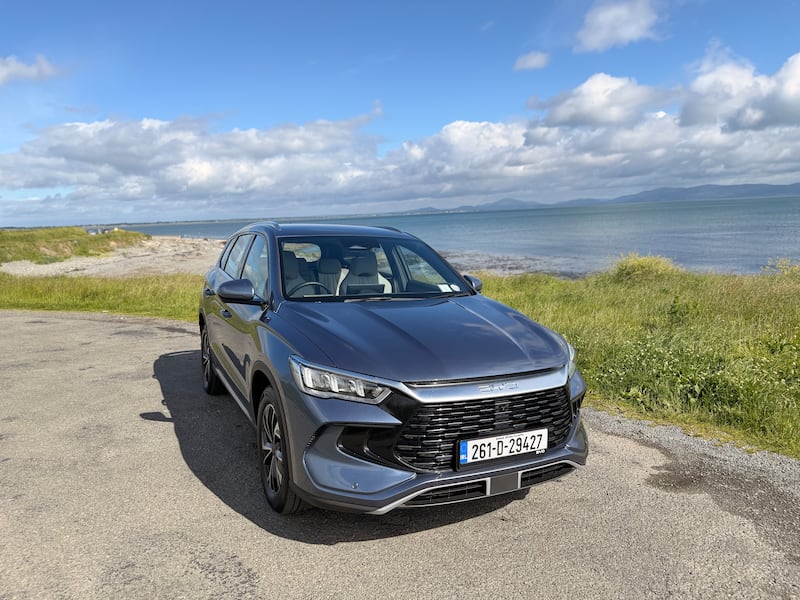
It’s a mid-size SUV with plug-in hybrid power. In fact, given that the Sealion 5 is possibly the most bland and copycat-esque model we’ve yet seen from BYD (it looks a little like almost every other similarly sized car on sale), you might say it’s the Acme of a mid-size SUV with plug-in hybrid power.
[ Stella Li of Chinese car maker BYD: ‘We don’t want to engage in a price war’Opens in new window ]
That’s not to say the Sealion 5 is ugly or offensive to the eye. Far from it. It looks perfectly acceptable from almost all angles. But you can’t quite shake the feeling that it’s one of those cars used in insurance adverts – so generic that you can’t reliably identify it. Oddly, it’s one of the few BYD models you can actually say that about. Generally, its cars have been more distinctively styled thus far.
While it doesn’t take much to forget the Sealion 5’s exterior, you’ll definitely forget it once you’re inside, as this car has possibly BYD’s most successful interior yet. It helps if you upgrade to the higher-spec Design model. With that specification you get lashings of beige, brown, and black imitation leather and plastic, and overall quality is exceptionally good, even if there are plenty of cheap materials on show.

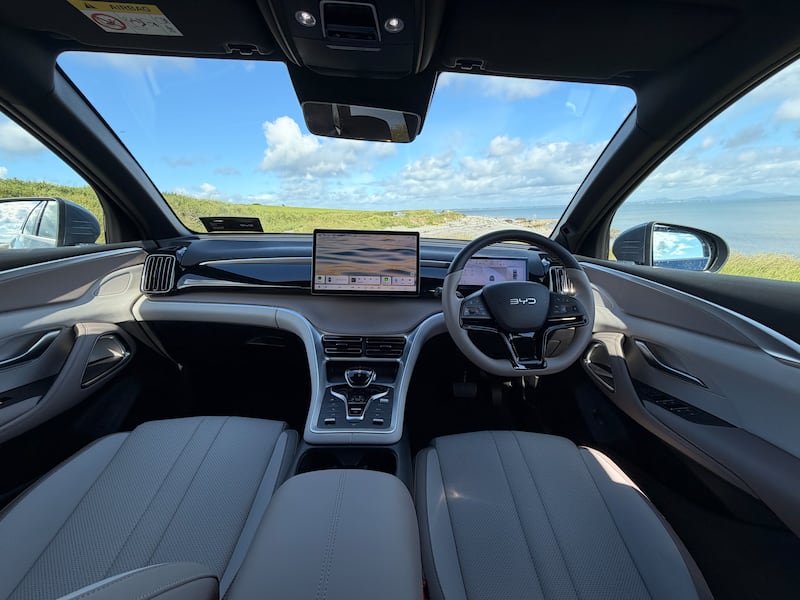
The big 12.8-inch touchscreen infotainment system is responsive and relatively simple to use, although, as ever, we’ll send up a call for more proper buttons. You do get some, but one of those – for adjusting the driving mode between Comfort, Eco, and Sport – doesn’t actually seem to do anything, although having a proper volume control is welcome.
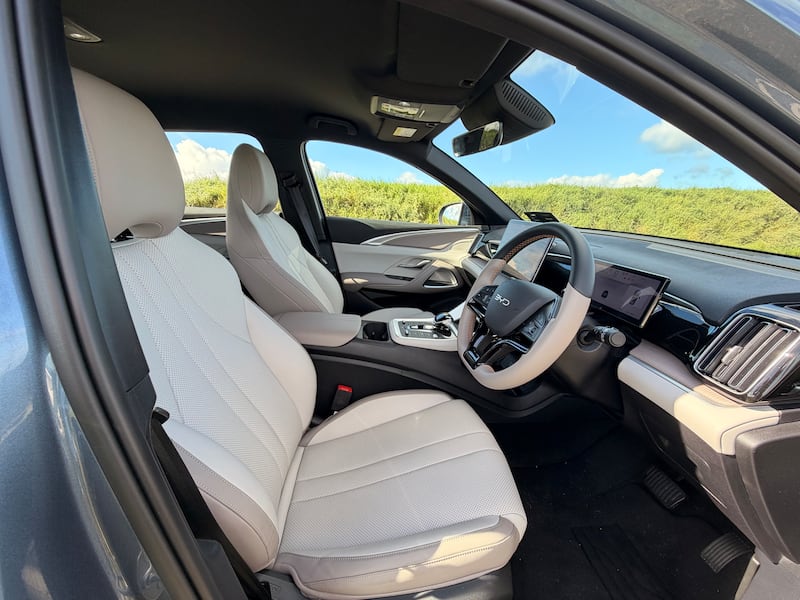
The stubby gear selector and the neat steering wheel feel good to touch and the high-backed front bucket seats are comfy, although the driving position feels a little too much like sitting on a pedestal for me.
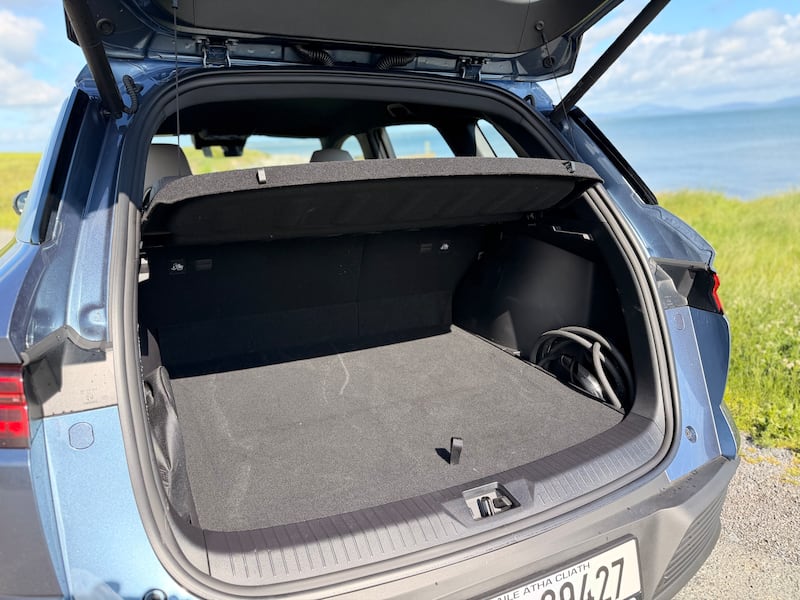
There’s plenty of space on offer in the back seats and plenty of useful storage areas in the cabin, although the boot – at 463 litres – is nothing special.

You can choose between two plug-in hybrid power trains, both based around a 1.5-litre four-cylinder engine. The entry-level Comfort version gets a 12.96kWh battery, which when fully charged has a claimed electric range of up to 62km. Meanwhile, the Design model gets an 18kWh battery, with a claimed range of up to 86km, although 65-70km is a more realistic expectation.
Combine a full battery and a full fuel tank and BYD says you can drive for an uninterrupted 992km, although I suspect that would be more like 800km if we’re being realistic.
That said, the Sealion 5 passes the toughest test for a PHEV: it’s not uneconomical when the big battery is drained. We managed to average 6.2 litres per 100km on a long motorway run, and even without charging up the battery, this car was averaging a very creditable 4.6 litres per 100km in city driving. For a big family crossover, this is a very frugal car.
Is it fun to drive? In short, no. But that unsurprising summary hides a touch of nuance, as the Sealion 5 is in its very quiet way one of the best BYD models yet in dynamic terms.
How so? Simply because there’s nothing to complain about. Take the sleek, electric, Seal saloon. It feels almost as sharp as it looks when you start driving it initially, but take it on a bumpy, twisty road and it just runs out of ideas, and suspension travel, too quickly. The bigger Seal-U PHEV SUV is smoother, but feels floppy and indistinct. The less said about the Atto2 the better.
This Sealion 5, though? It registers barely a single troubling note on the complain-o-meter. True, that’s possibly because it also registers not a flicker on the fun-o-meter. The steering has pleasant weight, but zero feedback or feel. The suspension is firm and jiggles occasionally but never clatters nor bucks. The Sealion 5 rolls a good bit in corners (my trusty greyhound was not happy about being skittered from side to side so much …) but it never feels as if it’s lacking for grip or becoming untidy. It is, in a word, fine.
[ BYD’s Seal 6 gets the practical car seal of approvalOpens in new window ]
Is that damning with faint praise? Maybe so, but think back a bit. That’s exactly the kind of review we might have given to a Toyota not so long ago, before car-nut scion of the Toyoda family, Akio Toyoda, got hold of the corporate reins and started making the company build cars that could entertain as well as endure.
This BYD Sealion 5 feels like it might just be the hinge point between the brand’s initial success and its eventual accession. In and of itself, it’s pretty unremarkable save for its high-quality cabin and its tempting entry price of €36,990 (our test Design model clocks in at €40,990), but the fact that it’s very hard to find fault with it is important. If BYD can keep moving along that kind of path, and built the sort of keen-driver-pleasing cars that Toyota currently makes, then all bets are off.
Lowdown: BYD Sealion 5 Design
Power: 1.5-litre four-cylinder petrol engine with 145kW motor and 18kWh lithium-iron phosphate battery producing 212hp and 122Nm (engine) + 300Nm (e-motor) of torque and powering the front wheels via a CVT automatic transmission.
CO2 emissions (annual motor tax): 48g/km (€140).
Fuel consumption: 2.1l/100km (WLTP) Fuel consumption: 6.2l/100km (Observed).
Electric range: 86km (WLTP). 0-100km/h: 8.1 secs.
Price: €40,990 as tested, Sealion 5 starts from €36,990
Our rating: 3/5.
Verdict: Utterly forgettable to look at, but, quietly, this might just be BYD’s best all-round car yet.


