

One night in early summer, Donie O’Sullivan found himself staring at the unpolluted sky in Palm Desert, prepared to see whatever it is that is out there. He was among a group of people bound only by their devotion to the idea – no, the certainty – of alien life. Notionally, O’Sullivan, who was there to report on “Contact”, an annual event that attracts the biggest gathering of UFO-ologists in the world, was the sceptic among the believers.
“But we were out there, about a hundred of us, and I ended up worse than anyone because anytime I saw anything moving at all up there, I was there: ahh, look! Look! And they’d say, mmh ... I think that was just a plane, Donie.”
He roars laughing at this – O’Sullivan has a wonderfully filthy south Kerry guffaw, which he is quick to direct at himself and, like all Kerrymen, he makes sense of the world by relating it to the local. On that weekend in the California desert O’Sullivan was with and his CNN producer Sean Clark - “a Kentuckian of German descent, but he spells his name like an Irishman,” O’Sullivan clarifies – and it was a trippy, fun departure from deep-dives into the doom-laden psychology of conspiracists or political reporting on the political and ideological furies that have sundered America.
They wanted to look at expressions of community in the contemporary US and settled on new witches and alien-believers for a series called Devoted (available to watch in the US).
RM Block


“Isn’t it better that these people are causing harm to nobody and they come together for a weekend and they look up at the sky?” he asks. O’Sullivan lives in New York, but his working life is nomadic. This noontime breakfast chat, at the Skylight Diner on 9th and 34th in Manhattan, is a five-minute walk from the CNN studio, where he was scheduled for an afternoon appearance.
“Better than going down a rabbit hole alone on social media. So, I say go for it ... and who is anyone to tell you you are wrong? Again: I do not believe in aliens! But! If you look back, whatever phenomena people saw down the decades, it is the same thing which they describe in different ways.
“UFOs came in after World War II when we had language to apply to it. And when I’m back in Mike Murts [pub] in Cahersiveen and they’ll say to me about ‘these Americans and believing in aliens ... they are crazy’. And I’ll say back, weren’t you going to Ballinspittle or wherever in the 80s to see statues of the Virgin Mary? And I respect that too! But these people believe they have seen something. What struck me about the UFO community was ... most religions, they clash. But the UFO people are like: we all need to come together because the intergalactic forces are coming. And that was so ... heartwarming.”
[ Mysterious bright light over Ireland’s skies sparks UFO theoriesOpens in new window ]
It’s a tonic of which the United States is badly in need. This is a moment of personal and career milestones for O’Sullivan. January will mark the 10th anniversary of his decision to move from Dublin to New York.
His family story belongs to the vast encyclopedia of Irish transatlantic journeys. His maternal grandparents were Irish immigrants who met in Boston and made a life in Jamaica Plain until the sudden death of his grandmother when his mother, Noreen, was just 16. “My mom was the youngest of three girls. My grandfather was a bit older and he was widowed and kind of figured he wanted to move back.”
We talk for a bit about the profound upheaval for a 16-year-old catapulted from Boston to rural Kerry in the late 1970s. His mother’s exotic background gifted O’Sullivan with an inherent curiosity about “America”. More practically, it gave him citizenship. As he explained to Simon Carswell in a powerful piece on these pages five years ago, O’Sullivan endured and sought help for crippling bouts of anxiety and depression in his 20s before taking up a job with Storyful, the social media verification company set up by Mark Little.
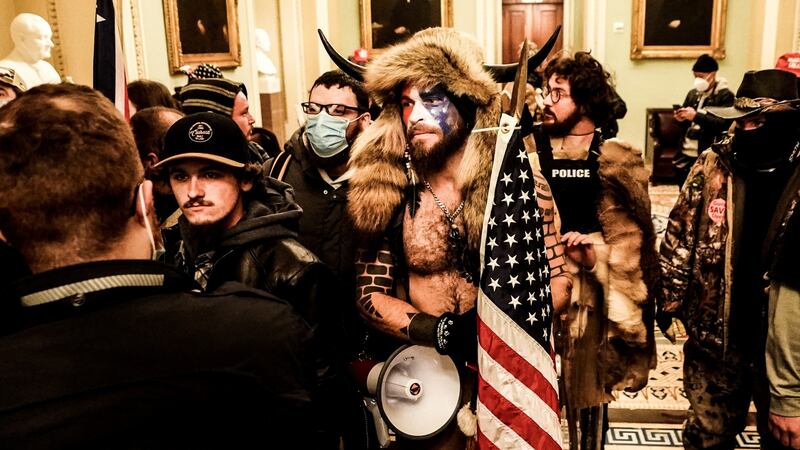
After moving to New York for Storyful, he was offered a job with CNN by Samantha Barry, the Cork journalist who is now editor-in-chief at Glamour magazine. Now firm friends, the pair didn’t know each other at all during the interview process. “They’re going to think I only hired you cos you’re Irish,’ Barry told him. His progression from researcher and off-camera journalist to presenter happened piecemeal but his profile was flipped into a different dimension after his poised on-the-ground reporting from Capitol Hill over the long day and night of the January 6th riots. An RTÉ reporter and crew landed unannounced at his parents front door the next morning, interviewing a proud and slightly bashful Noreen and Donal Timmy.
Ever since then, his surname has been all but superfluous in Ireland: he’s just “Donie”. But to the vast majority of Americans he encounters on his reports, he’s a stranger: if they watch CNN at all, many are hostile to the title. The life can be deeply unglamorous and he sees it as a privilege.
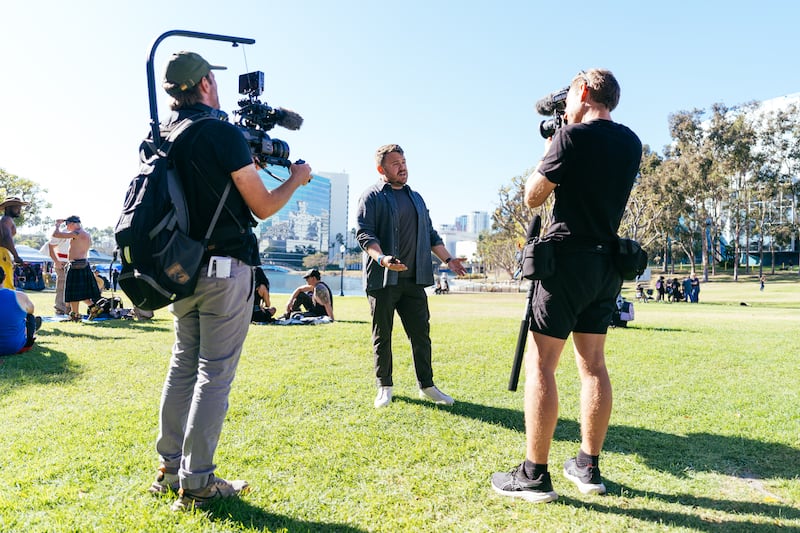
“Three or four us packed into a big suburban. We don’t need the massive equipment any more. We describe it as ‘raw.’ Nice way of saying unprofessional. A lot of places we go are not near airports and are not near nice hotels. But that’s when you know the story is good. The travelling light is easier but also people are more relaxed if there is not this massive TV thing around them. I see it myself. I think I’m terrible if I’m put under massive bright lights and there’s a big to-do. And you are waiting for the call to go live. Whereas if you can just walk up and talk to someone ... then it’s a conversation.
“Most times we don’t even get a press credential. We wander. And it is sort of a bit like being Forrest Gump in that way because you are next to history, you are just outside the gate of it. And I love that. It’s very important that our correspondents are in documenting what the politicians are saying. So, what I do is such a privilege – to be able to just wander. And sometimes CNN forget about me and let me go off for a while and I’ll come back with something. So, it’s an absolute dream to travel in the US.”
There are very few people I have met who are bad, malicious people. Most have good intentions
— Donie O'Sullivan
The “something” O’Sullivan has come back to CNN headquarters with amounts to a fascinating body of work that serves as a humanist explanation to the prevailing storylines and arguments dominating the discourse. He’s a curator of opinions and of voices – the lost and the marginalised more than the shouty and dominant. If he is drawn to presenting the ragged or psychedelic edges of US society, his fundamental interest is always in discovering how people came to find themselves where they are when he meets them.
In 2023, 60 years after the assassination of president John F Kennedy, he spent time outside the infamous, preserved book depository building in Dallas hanging with a cult group led by Michael Protzman, a QAnon conspiracist. They all believed Kennedy was alive. That delusion was interesting of itself but O’Sullivan spoke with Colleen Protzman, heartbroken and helpless as to how to rescue her son – and his followers – from their place.

“She was such a remarkable woman because she had total empathy for the loved ones following her son. But he went down the rabbit hole. He was lost. If someone is an alcoholic or a drug addict, there is help. These families are like: where is the help for this? I often think but for the grace of God. I alluded to that with Simon a few years ago. But I also think we all have crazy thoughts sometimes. And there are very few people I have met who are bad, malicious people. Most have good intentions. But it is our job to figure out what is going on and I still don’t know what is going on half the time.”
O’Sullivan’s upcoming schedule includes a trip to Florida to film a piece with former reality television stars and then a flight to Arizona to meet with Jacob Chansley, the QAnon shaman whose horned fur hat and painted chest announced him as a shocking, totemic figure among the January 6th rioters. “But, you know, he is not always the shaman guy. Next month is the five-year anniversary. He is not a CNN fan. So, it took a bit of time for him to agree to chat. We will go to his house and then he will bring us to the desert and he will show us some sort of shamanic ceremony. I will be talking to him about his regrets from that time.”
He has an abiding memory of January 6th of switching on the television long after midnight, exhausted, and only then comprehending the true scale of the attacks. His perspective of events had been limited to the section of the Capitol from where he reported. In the fast half-decade since, US media has further shape-shifted and fragmented beyond recognition. We spoke just before news of the proposed Netflix-Warner sale, which as well as sending tremors through Hollywood throws into question the future ownership of CNN. The round-the-clock news channel is shooting towards its 50th anniversary. It adheres to the 20th-century model of broadcast journalism, with star anchors, in-studio interviews and debates and on-the-ground reporting. It is regularly denounced by president Donald Trump as the liberal flag-bearer of “fake news”: the cable alternative to Fox News.
“And in some ways Fox News seems quaint now ... The next 10 years of how media plays out here will be interesting. Young people aren’t watching the news any more. They aren’t watching CNN or CBS evening news and our industry has to work very hard to figure that out. For the first time, they have a massive media ecosystem and very little of the talking points or conventional thinking or wisdom from the mainstream press is filtering through. Everything is distilled through this,” he says, holding up his phone.
“But I got to say: the current administration of CNN has been great in that they are experimenting a lot. I mean, they are letting me do stuff! Which is a testament to them. Might work out, might not. But they are taking these risks – going an unconventional route. And as much as people want to crap on cable news or on journalism, half the time when people are on YouTube, they are playing clips ... from cable news shows. Which costs money to produce. And without which, there would not be much for them to talk about.
When I started here, I did assume CNN would be a diva-esque kind of place. But it’s not
— Donie O'Sullivan
“Like the anchors at CNN – Kaitlan Collins, Anderson Cooper: they are journalists. I think Kaitlan is doing great stuff between bridging that world between White House, her evening show and leading that into social media. Anderson Cooper has a very successful podcast about grief, and he’s opened himself up a lot. Anderson was just so sweet and generous when I was starting out here. And Kaitlan, fortunately, is one of my best friends now in CNN. Myself and a friend Donnacha Lynch who lives in Cahersiveen, the last two years we’ve gone down to an Alabama football game, where she’s from, with her. And the parallels with Kerry football in terms of ... football is everything, similar humour. They like the beer. And anything less than a win.
“When I started here, I did assume CNN would be a diva-esque kind of place. But it’s not. Not in my experience. It is still surreal to me to sit on set with Anderson Cooper or Kaitlan Collins. And I don’t take that for granted.”
Later, we walk across towards the studio. There’s a razor’s sharpness to the breeze hurrying up 10th Avenue. O’Sullivan is a regular face on CNN now and a comfortable performer.
“I still get nervous,” he says.
“But at the start, I was sh***ing it. Didn’t want to do it. Sleepless nights.” He has sometimes quizzed himself as to how, given that period of time in his 20s when he was too petrified to leave the house, he has ended up on US national news television, week in and week out. It’s been a strange and wonderful circular journey. He moved across to his mother’s birth country with blind faith and no clue as to where it would bring him. Recently, the family were all back up in Boston, visiting relatives and his grandmother’s grave. And here he is, immersed in a very public, pressurised role that would seem contradictory for someone who still grapples with deep-rooted anxieties.
“It probably is,” he says cheerfully.
“Or else it distracts from my true insecurity. I honestly don’t know. A teacher, a policeman, a fishmonger like my father: there’s pressure in everything. I have thought about this but I don’t know the answer to it. I do know I love doing it. It makes me happy going out and finding these stories ... and talking to people.”
Donie O’Sullivan’s three-part podcast for CNN Persuadable: Why Do We Believe Crazy S**t? is available to listen to on Spotify


