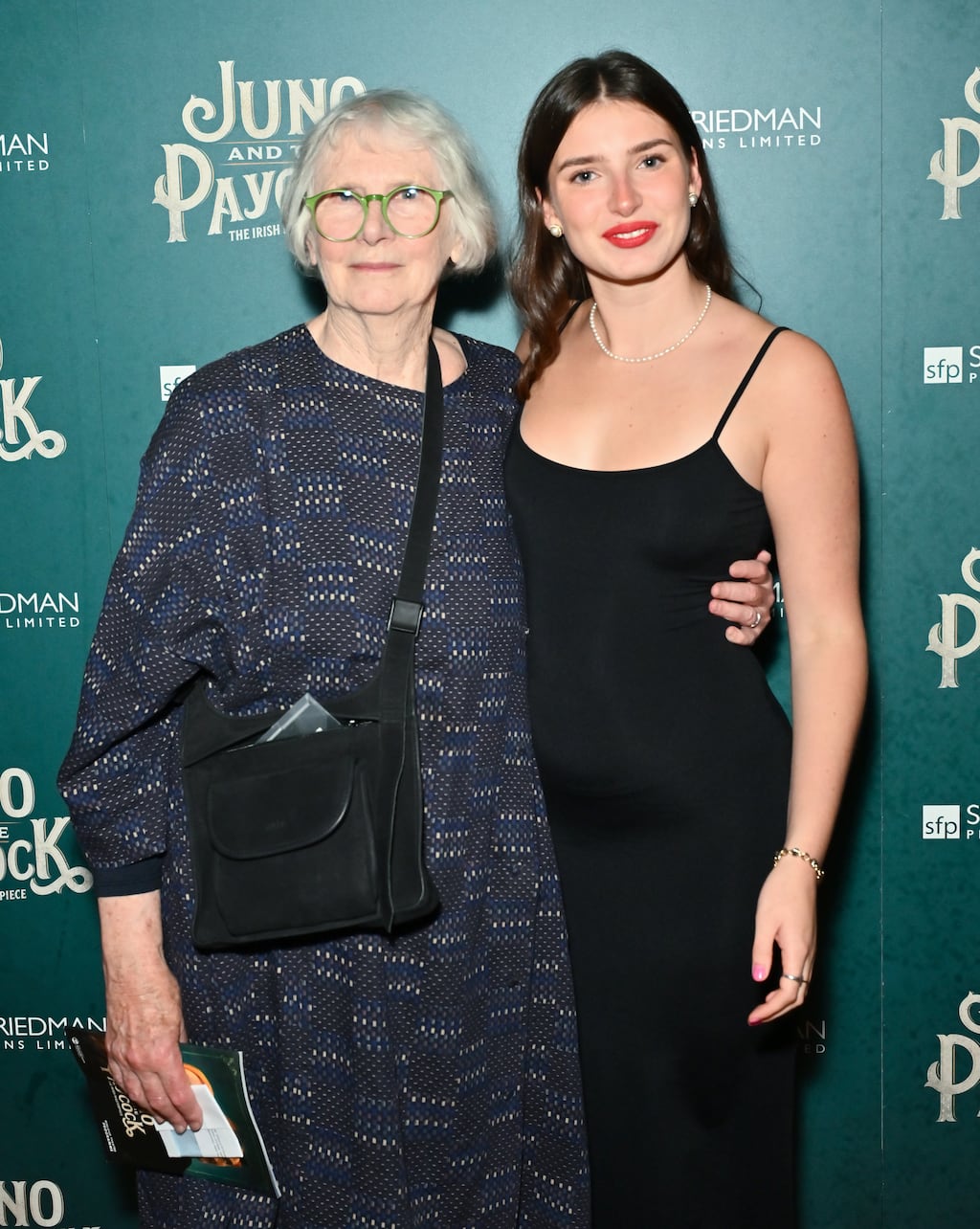

I am on a phone call to playwright Seán O’Casey’s youngest and only surviving child. Shivaun O’Casey lives in Ashburton in Devon, not far from Totnes, where she grew up. Now 86, she is a living link to one of our most famous playwrights. Next year, the Abbey Theatre will stage The Plough and the Stars to mark the centenary since its first production. The playwright’s daughter intends to be there on opening night to see it; a remarkable connection to a storied past.
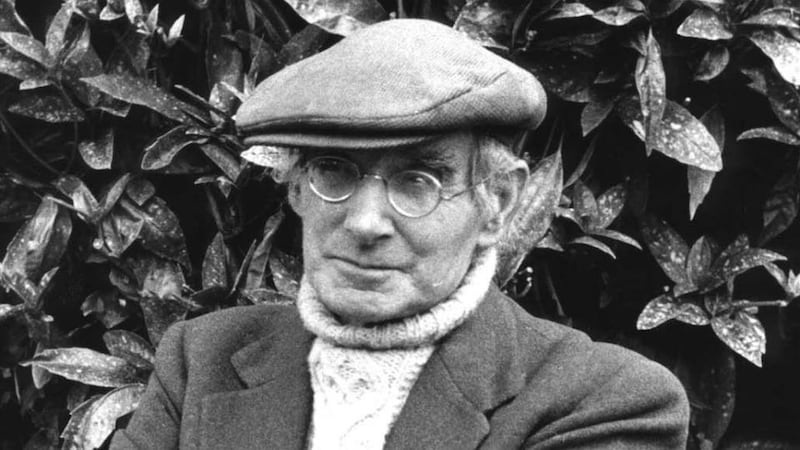
Shivaun O’Casey, a former actor, has just published a memoir. Next Year will be a Good One; Life with Seán O’Casey, My Family and Theatre. Her father was 58 when she was born in 1939 in England to mother Eileen. Seán had been living in Britain for some years by then. Shivaun was the youngest of three; there were two older brothers, Breon and Niall.
“He never seemed old to me,” she recalls now. “I remember playing with him a lot, and he was quite adventurous in playing; he would turn a table upside down and tie a tablecloth to one of the legs and we’d be on a boat sailing over the sea.” I take a moment to picture the man who wrote the famous line: “What is the stars, Joxer?” playing pirate ships on the floor with his small daughter.
The family had moved to Devon from London, almost entirely due to the advice of George Bernard Shaw, a friend of Seán’s. Son Breon was 11, and in need of a new school.
RM Block


“Seán and Eileen had not had much education. They asked Shaw for advice.” He recommended an experimental new school called Dartington Hall in Devon, which he was aware of through the Fabian Society, of which he was a member. The Fabian Society held a summer school there each year. In time, Shivaun went there too.
What does she recall learning there at that progressive school?
“It was a school where if you were good at the arts, that was encouraged. You weren’t pushed to the sciences. I was hopeless at maths, but quite good at other things. You didn’t have uniforms; it was coeducational, boys and girls together. There were wonderful teachers. Three of them were Spanish from the Spanish Civil War. One who taught biology was a very famous geneticist,” she says.
“It was very well endowed. We had two skeletons in the biology lab. We had a very good gym, and we had a swimming pool, where we all swam in the nude – which shocked a lot of the locals but we didn’t think much about it. And we had wonderful art teachers. It gave you an ability to not only use your head but to use your hands as well.”
Shivaun went on to study drama, and worked and toured as an actor. She also sometimes made props for shows. In her memoir, a good half of the 428 pages are given over to the reproduction of letters, notes and sketches by family members. Some were sent by her parents, some were to her from her father, some are from Shivaun to her father. Added together, it’s a significant archive.
Have any of these documents been published before?
“None of the letters that Seán sent me have been published before,” she says. They remain in her possession. The bulk of Seán O’Casey’s papers were sold to the New York Public Library by his widow after his death in 1964. Among them were drafts of plays and essays, diaries, notebooks, and letters between many writers, including WB Yeats, Lady Gregory and George Bernard Shaw.
“The New York Public Library were avid collectors at the time, when Seán died. It’s where most of the play material is,” she says.
The majority of the documents reproduced in Next Year will be a Good One belong to Shivaun. She also had some letters from Samuel Beckett, whom she met several times. Beckett was so taken by Shivaun that he told her he wanted to write a play about her. “He said I should come to Paris and he would write a play for me,” she writes in her memoir. They did have dinner together in Paris at one stage, but no play ever materialised,
She had some correspondence from Beckett, but it has since been sold. “I was very hard up,” as she puts it. The other documents – the letters and notes – which she includes in her memoir, are still in her possession. For now, anyway.
“I’ll have to sell them, I think because it would be the only money I would have at the end of my life,” she says. “I have not been very good at making money.”
I never worried about my identity. I suppose [I felt] both Irish and English, but never with any nationalist fervour. We used to get shamrocks sent to us for St Patrick’s Day which I did wear with a sense of pride and also shared them with my friends
As to where they might end up, she says, “I would want them to go to the Irish National Library because they have an archive there. They have his library, and they have his table and his desk and his hats; all the coloured hats, and typewriters and everything. So I’m trying to consolidate them in Dublin, but we’ll have to see what happens. But that’s what I would like. If I could afford it, so to speak.”
Shivaun O’Casey’s first visit to Ireland was to Dublin when she was 15. It was, in fact, her first time out of England. She travelled over with her mother Eileen to see a production of Seán’s new play, The Bishop’s Bonfire. It was being staged at the Gaiety Theatre. “Seán made it clear he never now sends new plays to the Abbey,” she writes in the memoir.
Mother and daughter were put up in the Shelbourne Hotel. Shivaun describes seeing the rehearsal in the Gaiety: “red plush and a horseshoe-shaped auditorium, Victorian and decorated as such”. Afterwards, they were taken to the famous Jammet’s restaurant. The following day, she went to designer Sybil Connolly for an outfit for opening night. It was the grandest of introductions to the city where her father’s famous play, The Plough and the Stars, had been set – not in one of Dublin’s finest hotels, but in the inner-city tenements in 1916.
What does she think her father would have made of the fact that the Abbey Theatre is staging a centenary version of The Plough and the Stars next year?
“I think he’d be delighted. I am certainly delighted. And Tom Creed is directing it, so that is exciting. I think he’d be very pleased about that. He did of course always long for his later plays to be done, The Drums of Father Ned, for instance. I think he’d be very pleased that Ireland is so different now. So much more open.”
She has probably seen more productions of The Plough and the Stars than anyone you know. Does she have any particular likes or dislikes of what she has seen?
“I don’t like it when it’s done in high-vis jackets,” Shivaun says, referring to the way period plays sometimes use modern dress. “I don’t think – this is my own personal opinion – that the history plays, because they are based within Ireland’s history, can be changed like that. I think it’s the same with some of Shakespeare’s plays, it makes a nonsense of the dialogue.”
She does have praise for a Nora (the character of Nora Clitheroe) in The Plough and Stars that she admired greatly: Cathy Belton, who played the part in a former Abbey production.
Does Shivaun think her father’s work is properly acknowledged in Ireland now?
“It’s difficult to say. Of course I wouldn’t say yes, being his daughter. I think his autobiographies are rather ignored, and I think they’re wonderful. And if you’re studying Irish history, they’re rather important, and I think the later work [later plays] is still ignored. But they are different to his early work, because they are imaginative, and more expressionistic.”
I ask her about identity. She was born and raised in England, but to Irish parents, one of whom wrote about a country she didn’t visit until she was 15.
“I never worried about my identity. I suppose [I felt] both Irish and English, but never with any nationalist fervour. We used to get shamrocks sent to us for St Patrick’s Day which I did wear with a sense of pride and also shared them with my friends. Seán was an internal socialist and I fell into thinking the same way.”
[ New to the Parish ‘I knew nothing about this island’: From Venezuela to IrelandOpens in new window ]
Seán O’Casey’s ashes were scattered in the Tennyson and Shelley rose gardens in Golders Green Crematorium in 1964. By the time her mother Eileen died some decades later, it was forbidden to scatter ashes at that location, so Eileen O’Casey is as close as her daughter could get her to Seán.
The memoir stops in 1964 with her father’s death. Will there be a follow-up? “I don’t think so,” she says. “It stopped there because I really wanted to show Seán’s family to the world.”
Shivaun O’Casey continues to paint and draw. “It is something I want to do and I’m driven to it. I don’t know if it makes me happy, because you are always looking at it and criticising it and wondering about it, but it is something I enjoy doing, and will do more of.” She has just finished a pastel drawing of a still life of quinces.
Several times in our conversation, she praises the generations coming after her, including her two granddaughters, Agnes and Esther, both in their 20s.
“I would say to the younger generation – which I never managed to do myself – to be confident in yourself. Not to be reliant too much on loving a man or a woman, or whoever you love. Not to feel you have to be with them. As my father advised me in one of his letters, I was always inclined to make a swan out of a goose. I always felt you could change people for the better, but you can’t.
“I wish I had been more confident and lived my own life and I wish that all the young people would feel confident. And I think they are much more confident in this day and age than our lot was, or certainly more than me.”
At the end of the interview, I ask if there is anything else she’d like to add.
“When will something be done about the terrible things happening in Palestine and Ukraine and the Sudan?” she says. “I want some glimmer of hope, but it is pretty disastrous at the moment. That can’t help but impinge on one’s outlook. But the young people are wonderful. They have great spirit, the ones that I know. I think that brings me a sense of hope.”
Next Year will be a Good One; Life with Seán O’Casey, My Family and Theatre, by Shivaun O’Casey and edited by John Wilson Foster, is published by Belcouver Press.