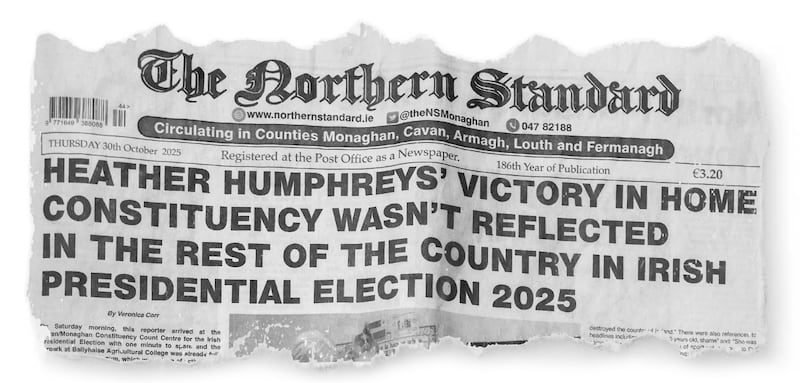
News this week that the Northern Standard is to cease publication after 186 years is a reminder of the challenges the local media sector is enduring as reading habits change, news continues to shift online and the big tech firms take an ever growing proportion of the advertising revenue pool.
“Monaghan’s leading primary source of local news, sports and entertainment,” as the Standard describes itself, is just latest weekly title to fall in a sector that has been significantly thinned out since the crash.
Yet there is a determination among those that survive that there is still a market for what they have to offer in communities across the country. The economics are clearly challenging, especially for those on the frontline but there are also some who believe that local news done differently can carve out a new future for itself.
When journalists Sam Tranum and his partner Lois Kapila moved to Dublin in 2013 after a stint working in Kolkata, India, they quickly realised it was a tough time to get into the business here.
RM Block


Revenues across traditional media outlets had contracted dramatically after the financial crash some years earlier, with jobs lost and freelance budgets slashed.
The pair did get work but ultimately settled on starting their own paper; in 2015 the Dublin Inquirer was born, publishing on Wednesdays and Fridays online, and in print monthly.
“After we learned about the media landscape a little bit, it seemed there was a gap in the market for a publication doing broadsheet-style reporting, but on local issues,” says Tranum. “I guess one of the inspirations was the alt weeklies in the US, like the Village Voice or like Miami New Times, locally focused stuff.
“I wouldn’t call it investigative, just, you know, basic journalism, where you generate the stories yourself, you check the facts, you do the interviews. We felt there was room for that in Dublin.”
Kapila edited the mostly online operation that still focuses often on neighbourhood issues, many involving the work and spending of the city’s local authorities or its cultural life, while Tranum says, “My role was initially to have another job and pay the bills.”
A decade on, their couple of thousand subscribers do that – just about – and Tranum has taken over as editor to allow Kapila do more reporting. They employ a handful of others and operate the business as a co-operative. Tranum doesn’t make it sound like something to wow potential Dragons’ Den investors but, in a sector still struggling at all levels to deal with changing technology and reader habits, the migration of advertising and now the growing threat of AI, it seems quite the achievement that Dublin Inquirer revenues continue to edge ever so slightly upward and the couple remain optimistic about the future.
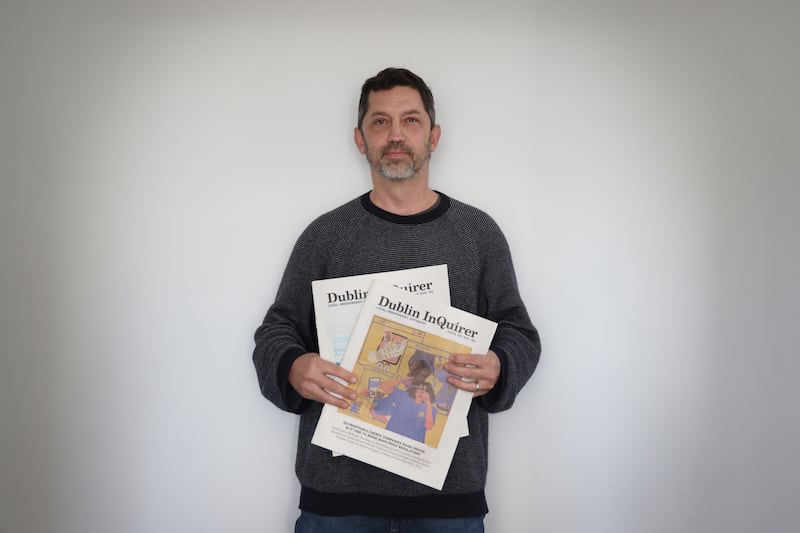
“We spend all of our money all of the time so we’re always short and scrambling to convince people we are worth subscribing to. But before Russia invaded Ukraine we were growing subscriptions 30 per cent year on year from a very small base. Right now, it’s more like 1 or 2 per cent but I like to think that’s because of the cost of living and not because we got crap.”
Even such modest growth is to be applauded in a local newspaper market that has lost 18 titles since 2010 and seen the steady decline of independent ownership. Most of the State’s more than 50 paid-for weekly titles are owned by Mediahuis, Formpress/Iconic (both with overseas owners) or The Irish Times.
Iconic, owned by London-based Malcolm Denmark, is the sector’s largest operator, with more than 20 titles, a stable to be added to shortly assuming its purchase of the Connacht Tribune is formally approved by the Government.
The Irish Times group owns six regional titles - Western People; Waterford News & Star; Carlow Nationalist; Kildare Nationalist; Laois Nationalist and Roscommon Herald. It bought the media interests of the Cork-based Landmark Media group, which also owned the Irish Examiner and Cork Echo daily newspapers, in 2018.
There are a few smaller groups, then a handful of independents but, says one long-time journalist working in the sector, ownership “is only going one way”. Detailed breakdowns of the various papers’ finances can be hard to come by because of their size and ownership structures but Iconic’s London-based parent Media Concierge, which initially bought into Ireland when Johnston Press offloaded a collection of titles for €8 million having bought them for more than €200 million during the boom, lists its Irish subsidiaries as lifting group profits by about €2 million.
The Mayo News, which it acquired from the last of the Berry family in 2022 (but which still filed separate, abridged accounts in 2023), recorded turnover for the 12 months to September 2023 of €457,437 and a profit of €3,351.
Figures for sales in Ireland are hard to pin down because few publications have them independently audited any more. But a look at ABC data for a random selection of British regional weekly titles paints a bleak picture, with most down by 40-60 per cent. Even that is mild compared to the decimation regional dailies have suffered, though. The Manchester Evening News once sold almost half a million copies a day; last year it was 5,291. The Belfast-based Irish News is now the largest-selling regional daily in Britain or Ireland, with a circulation of more than 20,000.
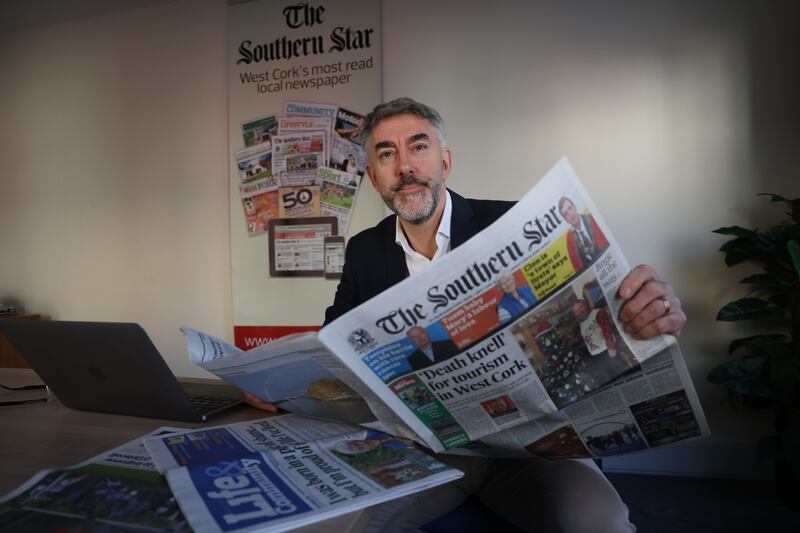
Seán Mahon grew up reading the Sheffield Star, which has been hit as hard as any of them. But after stints at News International – publisher of the Times and the Sun – and Associated Northcliffe, the Daily Mail-owned publisher of a string of local British titles which has since changed hands, he found his way, with the help of his wife from west Cork, to overseeing operations at the Southern Star, still owned by the O’Regan family and based in Skibbereen.
Founded in 1889, its rival for a time was the Skibbereen Eagle, famous for once having its eye on the Russian Tsar, but the Star ultimately bought its rival out in 1929, perhaps because its focus was more relentlessly closer to home – something, Mahon says, that is at the heart of its operations today.
Mahon, who also serves as president of Local Ireland, a trade body for more than half the country’s weekly paid-for papers, acknowledges the challenges the sector faces, but remains steadfastly upbeat about its prospects. He cites figures which suggest that while fewer people now buy printed local papers than 20 years ago, more are reading them because of their online reach. Local Ireland puts total readership for the sector’s titles at over 1.5 million.
Mahon became managing director of the Southern Star in 2009 just as advertising revenues crashed along with the wider economy and customers were suddenly finding things much tighter.
The website was basic but technical limitations with a printing press acted as a restraint on the paper’s development. One requirement was for supplements to be manually folded into the main paper. While cumbersome and costly, it did have a positive upshot: many locals had a personal connection with the Star because at some stage in their youth they had earned a few quid folding its supplements.
Broadening its appeal, though, and generating new revenues to compensate for the gradual decline in print advertising and sales, has been a big part of Mahon’s role since. While he credits many for contributing to the changes made, he recalls difficult decisions, including closing the printing side of things.
“I think the owners had already identified what the business needed which was somebody to come in and say: ‘Where do we take this business? Where do we take this brand? How do we increase advertising sales? How do we diversify our revenue streams? How do we set the business up for the next 20 to 25, years?’ Because, as we know, certain titles that maybe didn’t bring that thought process to bear either aren’t still around or have found it very difficult.”
The Star, he says, has added podcasts to its editorial output, bolstered its farming content and become far more proactive in selling its advertising. It has gradually adopted a website paywall mainly because, Mahon says, it was hard to tell buyers of the paper that they needed to pay up while their neighbours got the same content for free.
The challenge now, as for so many others, national or local, including The Irish Times, is to have the online element steadily assume more of the revenue generation required, something few have managed so far despite the wide range of business models employed.
“This is not an overnight thing,” Mahon says. “We’re talking here about ensuring the Southern Star is here in five, 10, 25 years still providing the content and news that make it a vital part of the community in west Cork.” Whether in print or purely online remains to be seen. “We have to be on our toes about how we evolve businesses.” But, he insists, all research shows people tend to trust their local media organisations and that trust, he says, “is our superpower”.
At the National Union of Journalists, Ian McGuinness is hopeful rather than confident about the future as he speaks of “wave after wave” of redundancies across the sector. That is not a local phenomenon. The Irish Times, Mediahuis (which owns the Irish Independent), RTÉ and Reach (which owns the Star and Mirror) have all recently shed jobs.
Dr Eileen Culloty of DCU Institute for Future Media, Democracy and Society (Fujo), agrees local media benefits from exceptionally high levels of trust among its audience but adds: “A lot of our local media is owned by international companies, so it’s not actually all that local. And if you have these contracting markets, there’s less money to be made in print. So you would wonder what it’s going to look like in 10 years’ time.”
Her colleague at Fujo, Dr Roddy Flynn, points to new public funding streams run by Coimisiún na Meán as having the potential to aid the sector significantly. This year, two programmes providing support for court and local democracy reporting came into effect, with others on news reporting and digital transformation in the pipeline.
“We haven’t got through the first funding period,” he says. “So it’s too soon to step back and go, ‘Has this led to kind of an appreciable increase in content?’ But I would say the answer is probably yes.”
Mahon certainly believes the sector has felt the benefits, but while Tranum is grateful for Inquirer funding, he has reservations about rules requiring the content to be freely available when many, though not all, publications are trying to drive subscriptions.
The finer points, suggests Flynn, will need to be closely examined at the review stage.