

Is there anybody here with any Irish in them, Phil Lynott once asked on Thin Lizzy’s celebrated live album Live and Dangerous. It’s a question Overheard regularly asks when considering international news.
Andy Burnham has cleared a path back to parliament. Polling indicates that many members of the Labour Party back him, and much fewer back anyone else. That makes him the tánaiste, in the heir-apparent sense, to the taoiseachdom of the United Kingdom.
Which means it’s time to check how Irish he is. At first glance it’s not great: Burnham is a Saxon surname. His mother’s name, Eileen Mary Murray, is more promising, but possibly a dead end. It “came via Scotland”, per Andy in a 2013 interview with a Scottish magazine.
The Murrays were Protestant and his father’s side of the family Catholic, which reportedly caused some tension initially, but his support for Everton apparently cleared the way. Burnham himself was raised Catholic.


We can’t trace these strands fully from this remove, but he has reported some specific Irish heritage further back. His Louth ancestry is more recent, for example, than Joe Biden’s. His family, according to his own account, left Drogheda for Liverpool “in the late 1800s”, which is decades after Owen Finnegan departed Carlingford to begin preparations for begetting a US president.
In a 2010 interview, Burnham revealed that he and his family had consulted research on their ancestry that revealed “lots of people, Finnemores and Kellys and other names, coming from parts of Northern Ireland to work in the docks in Liverpool” at the time, mentioning Donegal in particular.
Should Burnham succeed in winning the Makerfield byelection, triggering a Labour leadership contest and winning it, Overheard estimates that he would be in the top five most Irish UK prime ministers in history. Only the Dublin-born Duke of Wellington and a few others (Tony Blair’s Donegal mother, Jim Callaghan’s Famine-emigrant grandfather) are unambiguously ahead.
We invite “Our Andy” to become sentimental about his roots – especially if it helps sort out the customs fees on things you order from Britain these days.
Cereal offender
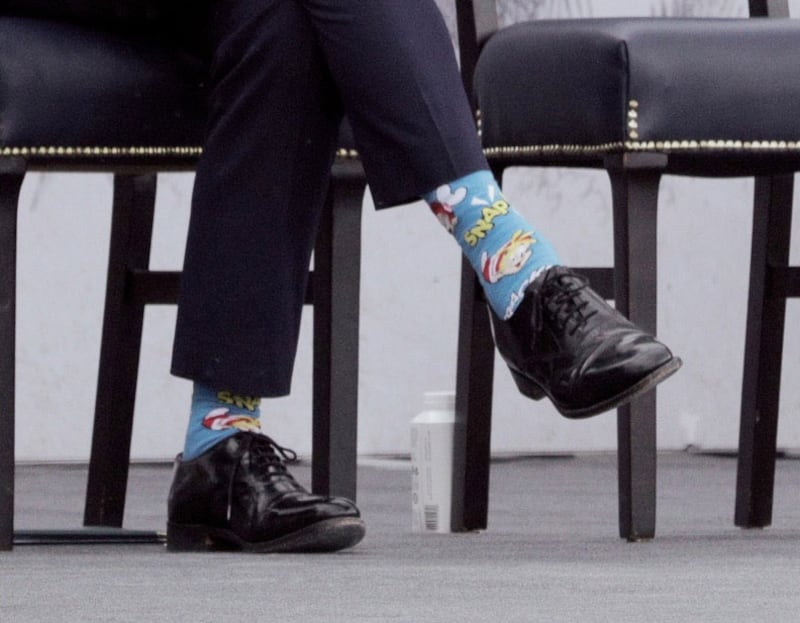
During the years of the potato blight, Indian corn was an unfamiliar introduction to the Irish diet, intended as famine relief. Not present in the government depots at that time were Rice Krispies.
Objection, irrelevant, you might shout. Not so. Last weekend, Patrick O’Donovan, the Minister for Culture, Communications and Sport, attended the National Famine Commemoration at the Irish Workhouse Centre in Portumna, Co Galway. He made some poignant remarks, highlighting that in Galway, “where the Famine destroyed communities, they did not remain broken, they were rebuilt, strong, vibrant and diverse in all their forms”.
“This is surely one of the most fitting and important tributes to our ancestors,” he added.

A little less fitting perhaps was the fact that he was wearing Snap, Crackle and Pop socks at the time, depicting the Rice Krispies cereal mascots in vibrant colour. The socks themselves were sky blue, matching the tie he wore with his otherwise appropriate suit.
They were revealed as he sat cross-legged on a stage, flanked by members of the Defence Forces and the Mayor of Galway, as Taoiseach Micheál Martin described a population decline of nearly half a million people in Connacht between 1841 and 1851.
Who isn’t ‘exceptionally busy’?
Bartleby the Scrivener, when asked to perform a task of any description, would reliably respond with: “I would prefer not to.” The antihero of Herman Melville’s 1853 short story has that in common with an increasing number of companies invited to explain themselves to the State.
This week, Ires, the State’s largest private landlord, refused an invitation to be berated by elected representatives for attempting to maximise profit, claiming its executives were “exceptionally busy”. Cue a load roar of “ah here” from hotshot policy wonks on the Oireachtas housing committee. “Shocking,” said Rory Hearne, Social Democrat and author of Gaffs: Why No One Can Get a House, and What We Can Do. “Deeply disappointing,” per Eoin Ó Broin, Sinn Féin TD and author of Flats and Cottages: Herbert Simms and the Housing of Dublin’s Working Class 1932-1948.
The lack of enthusiasm on the ownership side will not be surprising to anyone who has attempted to contact a landlord about repairs. But they’re not alone.
American tech companies, which fuel the economy by putting a mystery amount of money into a box marked “corporation tax receipts” that is subsequently opened with excitement once a year by the Government, have also been shy to come to the table. In February, Elon Musk’s social media platform X refused a request sent by the very Taoiseach to explain the situation with harmful material on its platform.
Semi-States have had their no-shows too. DAA’s then-chief executive Kenny Jacobs and chairman Basil Geoghegan didn’t go to the Transport Committee in September last year, while Dee Forbes, the former RTÉ director general, famously didn’t attend the Media Committee in the wake of the Tubridy controversy, due to illness.
Nobody, it seems, wants to talk about it.
In defence of birds

Fear not, wading birds of Donegal: reinforcements are on the way. The various curlews, dunlins, oystercatchers and redshanks of the northern wilds are being harassed by predators, but we’re not going to stand for it.
Birdwatch Ireland, an independent conservation organisation that is nonetheless under public procurement law for these purposes, has issued a request for tenders for “predator contract services”.
The species to be blasted with shotguns – or “humanely dispatched”, as the tender puts it, though it does require you to have a shotgun licence – include the despised invasive American mink, but also wily locals including the red fox, the hooded crow and the magpie.
The mammals are skilled at nabbing the waders, which spend their days carefully plodding about, eating worms, molluscs and small crustaceans. The cunning crows more commonly nick eggs or small hatchlings from ground-level nests that are already at dire risk from mowing, dogs off leash and humans going cross-country.
So: crosshairs. Conservation-minded sharpshooters are offered €88,118 (excluding VAT) for four years’ worth of 21-week seasons, part-time, working out at 252 seven-hour shifts over the course of the contract.
Many of the species in question have seen dramatic declines over recent decades, so they need what help they can get.


