
The Curragh in Co Kildare is Ireland’s largest area of open lowland grassland, stretching across approximately 2,000 hectares. It may well be one of the oldest areas of continually managed grassland in the country, with a history of commonage grazing going back at least 2,000 years. It has, miraculously, avoided the fate of nearly all other pastures in that it has never been ploughed, reseeded or ‘improved’ with artificial fertilisers.
The Curragh is important for a number of reasons, including archaeology, local amenity, its association with horse racing and as the main training ground for Ireland’s army since the foundation of the State. Given its unique openness and land use history, it should also be among the country’s premier biodiversity sites and a showcase for the exuberance of life that is associated with semi-natural grasslands, particularly in summer.
Well-managed grasslands provide a range of benefits including flood prevention, carbon storage and wildlife habitat, according to a website on the subject managed by the Department of Housing, Local Government and Heritage. This says species-rich grasslands are “now among the most threatened habitat types in Ireland due to changes in agriculture over the past 50 years” and that even the small areas that remain have shrunk by 30 per cent in the last 10 years.
Early June is peak season for grassland flowers and flying insects such as bees and butterflies. Healthy grasslands at that time of year are waist-high and awash with colour: yellows of bird’s-foot trefoil and lady’s bedstraw, purples of tufted vetch and spotted orchids, the creamy whites of ox-eye daisy and stitchwort.
RM Block


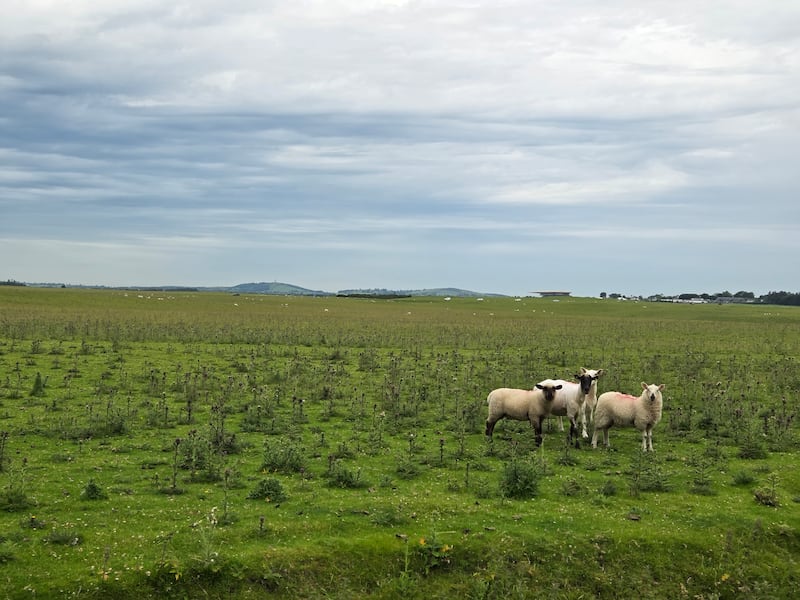
Yet on the Curragh you’ll see none of these. Rather, the eye stretches to the horizon skirting over tightly nibbled grass and sheep – quite a lot of sheep.
Sheep are not the only problem affecting the environmental quality of the Curragh, but because they range over so much of it they are the most significant. A 2024 conservation management plan, prepared for Kildare County Council and the Department of Defence – the latter being the owner of the land, acknowledged the grazing pressure, stating it was “well over that which would be prescribed on a habitat in other jurisdictions” and that “adjusting the grazing regime to allow the grassland to recover species-richness ... would represent an important biodiversity enhancement”.
That the Curragh has never been “improved” for agriculture is remarkable given that there are no particular protections in place to prevent it. The Curragh Act, in its most recent form dating from 1969, prohibits excavation of soil, sand and gravel or the enclosure with fences without ministerial consent.
Grazing rights are granted for sheep only and are limited to a maximum of about 6,000. However, this is substantially higher than the 1,660 sheep that the conservation management plan suggests would be sustainable for year-round grazing.
The Curragh Act does not place any limits on the timing of grazing. According to best practice guidelines for the management of biodiversity-rich grasslands, including those from Farming for Nature, an NGO promoting nature-friendly agricultural practices, there should be no grazing at all from May to July, while the intensity of grazing at other times needs to be carefully managed.
The practice of keeping the sheep out all year means in winter, when the grass is not growing, the plains become “essentially a sheep holding pen” according to the conservation management plan, and as a result supplementary feeding is required.
Supplementary feeding is in many ways a more pernicious threat to the Curragh than overgrazing. It disrupts the nutrient balance in the soil, indirectly adding fertiliser to what has been a naturally nutrient-poor environment. Added to this is the use of the Curragh for exercising about 1,000 horses, something that adds more nutrients via their dung and urine (along with the waste from the many dogs that are walked on the Curragh every day).
The extra nitrogen and phosphorous present a fundamental threat to the botanical diversity, as has been seen in other grasslands where supplementary feeding has been followed by a drastic drop in the variety of plants and a proliferation of nutrient-tolerant species such as nettles, docks and rough grasses.
Despite these issues, the Curragh retains important biodiversity value. BirdWatch Ireland regularly counts up to 3,000 wintering golden plover, now an extremely rare bird, as well as flocks of lapwing. The grassland fungi – including a range of colourful waxcap mushrooms – has been described as “internationally important”, while in the early 1990s a survey found more than 50 species of rove beetle – another indicator of grasslands that have never been ploughed or fertilised.
Yet the Curragh was passed by in the late 1990s when sites were being identified for legal protection under the EU’s Habitats Directive. Its condition simply wasn’t good enough.
A 2005 report from the National Parks and Wildlife Service described it as of “considerable natural heritage significance” and placed it on a list of proposed Natural Heritage Areas, a designation under national law. However, full protection never arrived, leaving the Curragh Plains with the limited safeguards under the Curragh Act of 1969 and under the guardianship of the Ministry of Defence – which is hardly best placed to manage large areas of biodiversity interest.
[ Doubts raised about companies’ ability to meet EU climate targetsOpens in new window ]
All of this was comprehensively laid out in the conservation management plan in 2024, which identified two “fundamental issues”: the need to amend legislation to provide proper protection and management; and assignment of the Curragh to an appropriate government agency. The plan’s introduction was written by then minister for defence and now Taoiseach Micheál Martin, who said: “The report represents my commitment to achieving these goals.”
The 2025 Programme for Government commits to establishing a management plan to ensure the Curragh’s preservation “with careful consideration of which agency is best suited to manage this historic landscape”.
In November 2025, Fianna Fáil Senator Fiona O’Loughlin called for the Curragh to become a national park – but while such a move would bring profile to the area, it would not come with any additional protections or resources.
Chris Pender is the Social Democrats councillor for the Newbridge area of Kildare and wants to see the conservation management plan implemented. He says the tasks assigned to Kildare County Council are “all but done” but that since publication it has “sat on a shelf with little to no movement”.
“I’m not seeing any actual movement in terms of conservation and every day we’re seeing the negative effects on the Curragh,” he said, raising the issues of dumping and dead animals. “The lack of any cohesive approach up to now has left it completely abandoned.”
In a statement to The Irish Times, the Department of Defence said it had engaged with “the National Parks and Wildlife Service and other agencies” to transfer responsibility for management of the Curragh, but in a parliamentary question in June this year, Minister for Defence Helen McEntee declined to give any timeline for legislative changes or the transfer of responsibility to another agency.
“The longer it languishes in uncertainty, the worse it’s going to get and the harder it’s going to get to manage it,” said Pender.
He would like to see the area become a national park but emphasises that there must be additional resources attached to whatever new dispensation comes to pass. He described the conservation management plan as “extremely comprehensive” but says it could have pushed harder on excessive grazing. He would also like to see some areas fenced off and allowed develop into wilder natural habitats.
[ Arsenic 133 times above legal level found in Aughinish Alumina groundwaterOpens in new window ]
The plan is not the first to address the problems facing the Curragh. In 1997, the Department of Defence commissioned a report which concluded that significant environmental damage was occurring on the plains. This prompted the formation of an interdepartmental taskforce which, in 1999, delivered its recommendations to the government of the time. However, its main recommendations for legislative changes were not implemented.
This was despite the taskforce’s warning: “If the unique environment of the Curragh is to be preserved, action must be taken as a matter of urgency.”
Fast forward nearly 30 years and another set of recommendations, that sense of urgency remains in short supply, just like the wildflowers on the Curragh itself.


