
With our hedgerows now in full summer leaf, and as hawthorn berries and blackthorn sloes begin to ripen alongside sweet-smelling honeysuckle flowers, members and supporters of our Hedgerows Ireland group can be forgiven for hoping that our hedgerow corridors are a little safer from future destruction.
This follows Judge Deirdre Browne’s imposition in March this year of a record €100,000 fine on a Coolmore company for extensive illegal hedgerow removal in Co Tipperary. Our organisation provided key evidence, including video footage, to Department of Agriculture inspectors which led to the successful prosecution under EU Environmental Impact Assessment (EIA) regulations in Clonmel Circuit Court.
While it is hoped this fine will act as a deterrent to illegal removal, hedgerows remain under ongoing threat. Current regulations in this area are ineffective and contradictory, and their application is patchy.
Two conflicting sets of restrictions address hedgerow removal. Conditionality rules which govern farm payment schemes provide reasonable levels of protection to hedges. However the outdated EIA regulations have much higher thresholds for permitted removal. Bizarrely, the two systems are overseen by different sections of the Department of Agriculture, a recipe for confusion.
RM Block


In addition, rising agricultural land sale and leasing prices, allied to inadequate farm payment incentives for retaining and maintaining existing hedgerow corridors, are adding to the pressures on farmers to maximise output on every available acre in our productivity-driven food system.

Consolidation of family farms by the corporate investment sector, a growing trend, is strongly associated with the widespread removal of landscape features, not just hedgerows, but trees, ponds and scrub. Finally, and in contrast to the Coolmore Circuit Court case, the much lower fines imposed in District Courts for breaches of the law in such cases do little to curb wealthier offenders.
Local authorities are also responsible for the piecemeal attrition of trees and hedgerows. There have been multiple recent examples of planning permission being granted for new developments, both urban and rural, that entail the avoidable erasure of landscape features, in some cases ancient townland boundary hedges predating English settlement and of irreplaceable heritage and biodiversity significance.
Despite the pressures on hedgerows, there is a growing appreciation of their multiple values. There are countless well-attended hedge-related events taking place each year
There is a notable disconnect between these planning decisions and county development plans, as well as national biodiversity and climate policies – all of which recommend the retention of trees and hedgerows. Further unnecessary damage to roadside vegetation is precipitated by local authority roads departments whose legalistic and threatening communications to landowners can lead to excessive hedge flailing and the widespread felling of healthy trees.
The need to minimise risk for road users is unarguable, but a “balanced and proportionate” approach to safety is recommended in the Guide to the Management of Roadside Trees issued by the Department of Agriculture in 2021. This sensible guide emphasises the need for a proper and skilled assessment of risk to ensure that this balance is achieved. We think that this approach should be applied to all roadside vegetation.
To help improve hedgerow protection, our group worked with the Climate Bar of Ireland under the leadership of the late senior counsel Leesha O’Driscoll to develop the 2024 Protection of Hedgerows Bill. This draft legislation, which reached the Second Stage in the last Dáil, seeks to establish a register of “significant” hedgerows that confer particular environmental, biodiversity and social benefits, and to provide them with robust safeguarding.
The Bill proposes prohibiting the removal of significant hedgerows except in specified circumstances, but an appeals procedure would be put in place to allow consideration of exceptional cases. Breaches would be criminal offences and penalties would be appropriate to the harm caused.
Some amendments to other pieces of legislation would be required – the Roads Act, Forestry Act, Electricity (Supply) Act, Transport (Railway Infrastructure) Act, Transport (Dublin Light Rail) Act and Communications Regulation Act – an indication of how much our infrastructure and hedgerows can come into competition for space and regulation.
The Bill is now awaiting relaunch to complete its passage to enactment. Unfortunately, it is not on the Government’s current legislative programme, and its original sponsors – three Green Party members – are no longer TDs.
The Government has said, however, it is reviewing and updating all wildlife legislation.
“The protection afforded to hedgerow habitats under our legislation is one of the issues that will be closely examined as part of this project,” Minister for Housing James Browne said. That was in May 2025. The review, begun in 2023, is still under way.
Despite the pressures on hedgerows, there is a growing appreciation of their multiple values. There are countless well-attended hedge-related events taking place each year, from farm walks to hedge maintenance and hedge-laying demonstrations. A recurring message is that hedges are an asset to productive modern agriculture and to the wider environment, but that over-management in the form of severe flailing is very damaging and eventually leads to gappy, failing hedges.
Taller, wider and denser hedges are best for maximising all the services they provide, especially as wildlife havens, but also for shelter, shade, carbon storage, disease containment, pest control, water quality and flood prevention. Many of these benefits are directly relevant to increasing climate and biodiversity challenges and can be enhanced through a variety of hedge management techniques.
Our group’s experience to date points to the need for a combination of stronger financial rewards for hedgerows, and consistent application of hedgerow removal regulations
A key point is that established hedgerows are in a different league compared to new ones. Centuries-old hedges typically have a rich mixture of plant species, are often set on earthen banks with a ditch alongside, and have intermittent trees. All their benefits, especially for biodiversity, greatly exceed those of new hedges which are, too often, a monoculture of imported whitethorn.
Overall, we are encouraged by a growing awareness and appreciation of hedgerows. This is evidenced by the popularity of our annual hedgerow photography competition, sponsored for the last two years by the Irish Creamery Milk Suppliers Association, which attracts hundreds of entries celebrating all aspects of hedges and ditches, and what lives in them.
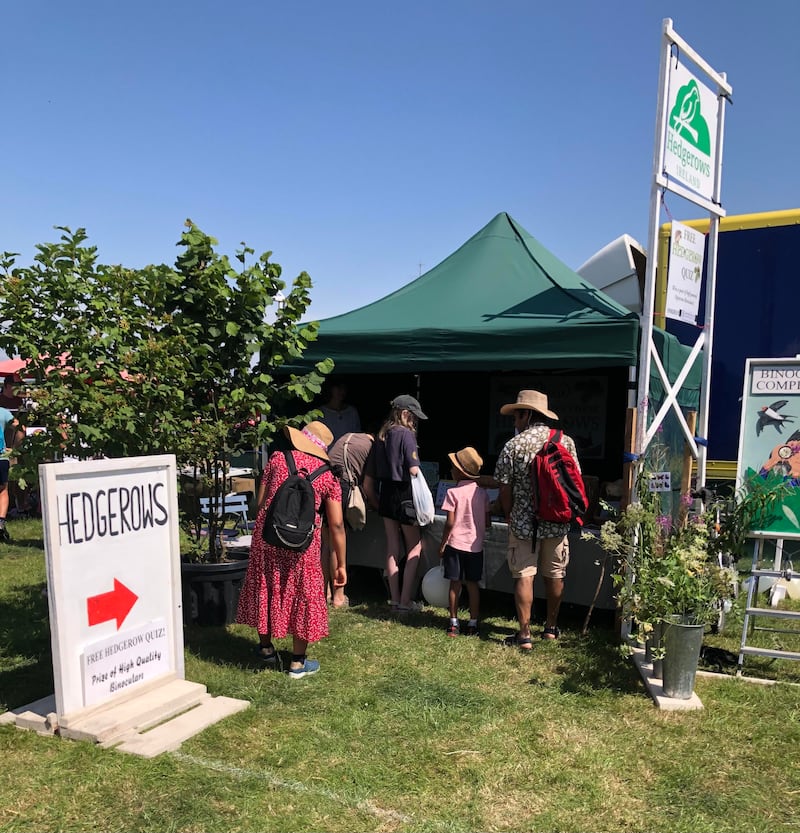
Stands at our agricultural show each summer attract people of every age who seek information on planting and maintaining hedges. In conversation at these events, many older farmers recall with regret being encouraged to remove their hedges and ditches under previous payment schemes. A frequent comment is that some fields are now prone to regular flooding following hedge removal. Younger attendees typically admit to very limited knowledge of hedge plant species and associated flora, but are enthusiastic to learn more.
Our group’s experience to date points to the need for a combination of stronger financial rewards for hedgerows, and consistent application of hedgerow removal regulations, which are themselves overdue reform.
To accomplish both these ends, we are currently developing proposals to the Department of Agriculture for results-based hedgerow payments in the next round of Common Agricultural Policy farm payment schemes that would reward farmers for hedge quality, measured using a combination of aerial and on-farm assessments. We are also engaging with Minister for Agriculture, Food and the Marine Martin Heydon to request the publication of the overdue review of the EIA regulations.
In his writings, Manchán Magan reminded us powerfully of our profound and ancient connection with land and nature. Perhaps more than any payments or rules, resurrecting this innate love and knowledge will ultimately turn the tide in saving and enhancing our native hedgerows.
Alan Moore is secretary of Hedgerows Ireland


