
“Hurry,” the woman said as groups around her quickened their pace through the still-closed Damascus market, merging together into a swelling crowd.
It was just after 6am, and they were almost at Umayyad Mosque, one of the oldest and most significant in the world.
Other mosques across the city began broadcasting chants at 5.30am to mark what is now known as Syria’s day of liberation; 6.18am on December 8th last year was the exact time Bashar al-Assad’s ousting was announced on Syrian television.
That minute came and went, as the crowd craned their necks and held aloft their phones to see could they get a glimpse of Ahmad al-Sharaa, the Islamist rebel leader turned interim president who has led the country in the year since.
RM Block


Sharaa turned up at the mosque for dawn prayers, wearing the same style of military fatigues he had worn a year before.

Drinking coffee and smoking outside, Mohammad, who only gave his first name, said he would love a glimpse of Sharaa, but said he had mostly come for the “celebration.”
“How do Europeans see our president?” he asked. “Is it as a terrorist? He is a good man. Write that.”
Mohammad said he moved back to Syria from Turkey the week after the Assad regime fell. He said he had been up all night celebrating the anniversary and would go home to sleep right after.
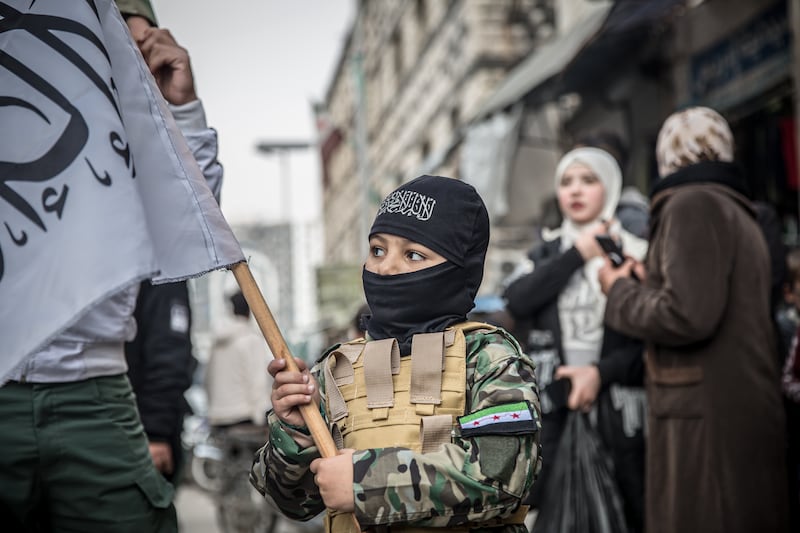
Others were just beginning a day that saw the city filled with people waving or wearing flags, hanging out of car rooftops, blasting music, honking horns, setting off fireworks or dancing in the streets.
Posters were hung as decorations. One with Assad’s face read: “The coward fled.” Another stated: “The country remained and Assad burned.”
A military parade ended in Umayyad Square, before helicopters performed manoeuvres over the thousands gathered there, including the Syrian rescue workers known as the White Helmets.


Among the crowd were people who lived abroad for more than a decade and finally returned home.
There were also foreigners present. Tim Schuijt, a 24-year-old with hundreds of thousands of social media followers, hitchhiked into Syria from Lebanon on Saturday. “It feels like a dream,” he said. “I haven’t been to war ... but I felt the hardship ... You feel all the emotions that this country has been through to reach this point.”
Syrian phone numbers have been receiving SMS messages from accounts called “Liberation” and “Eid Tahrir” (liberation festival). “Victory comes with responsibility, and our responsibility today is to continue shaping the future,” read one. Another invited citizens to come and celebrate in “our free country’s squares”, at 8pm on Monday.
Billboards went up around the country, including one showing a militant hugging a teddy bear. Another showed with Syrian citizens from different backgrounds lined up reading “shoulder to shoulder ... building the nation”, with the date the regime fell underneath.
Years after many Syrians completely gave up hope, a lightning rebel advance brought the Assad regime to an end in less than two weeks. Celebrations were held on different dates in various cities, marking exactly when they fell to the rebels.


On Sunday, the celebrations reached Homs, Syria’s third largest city. In Khaldiyeh, a neighbourhood once under siege by the regime, hundreds of people gathered to chant and sing revolution songs.
“I’m feeling so good right now,” a woman said, standing beside an area used as a temporary cemetery during the siege when citizens could not leave to bury their dead.
People were wearing scarves and hats in the new Syrian three-starred flag, while umbrellas decorated with the colours were on sale in case of rain.
Another woman approached. “Welcome to Homs,” she said proudly. “The earliest protests happened here.”


About half a million Syrians died in almost 14 years of war. They included more than 200,000 civilians killed by Bashar al-Assad’s regime, according to the Syrian Network for Human Rights. More than 160,000 were disappeared by the regime. More than half of Syria’s population were displaced.
Last October, the World Bank estimated Syria’s reconstruction costs at €186 billion.
The United Nations refugee agency says more than 1.2 million Syrians returned to Syria from neighbouring countries over the past year, along with 1.9 million internally displaced people who could finally return home.
Despite ongoing calls for accountability, Assad remains in exile in Russia.
Over the past year, Sharaa has gained notable praise and international support – including sanctions relief – though concerns remain over the future of minorities in the country, including Druze, Christians and Alawites, women’s rights and what will happen to the Kurdish-led semi-autonomous northeast region.
Israel has been accused of contributing to instability by carrying out bombing, incursions and seizing land in southern Syria.
“Every single step we have taken has helped the international interest of Syria ... We went from being a country that exported crises to a country where we have an actual hope of delivering stability,” Sharaa said in Doha, Qatar, on Saturday.
In a speech on Monday, the president said he was declaring the “beginning of a new chapter – the chapter of building the nation”.