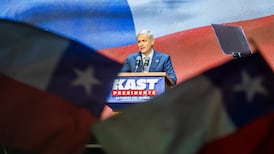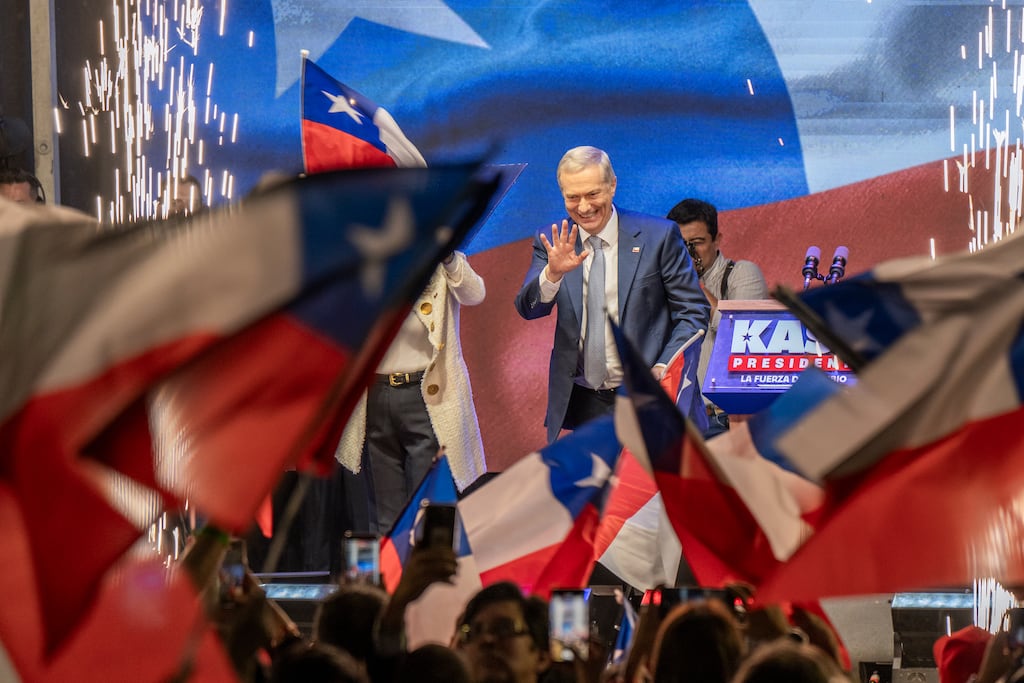

José Antonio Kast will be Chile’s next president after the ultraconservative admirer of the country’s murderous dictator Augusto Pinochet scored a crushing win in Sunday’s presidential run-off.
The former congressman confirmed his status as front-runner throughout the campaign by beating his communist rival Jeannette Jara by 16 points – 58 per cent to 42 per cent – to become the latest hard right candidate to be elevated to power by Latin American voters.
As the scale of her defeat quickly became clear Jara conceded, telling supporters “democracy has spoken loud and clear”. Her defeat brings to a bitter end the four-year leftist administration of outgoing president Gabriel Boric in which she served as labour minister.
[ Why is Latin America shifting hard right?Opens in new window ]
Kast wins the presidency at his third attempt after a campaign centred on law and order allowed him to reach voters suspicious of his deep social conservatism but terrified by surging crime in recent years.
RM Block


In his victory speech Sunday night he promised supporters: “We are going to restore the rule of law, we are going to restore respect for the law, in all regions.”
He has vowed to deploy the military in areas with high crime rates, stiffen sentencing laws and build at least another 100,000 prison spaces.
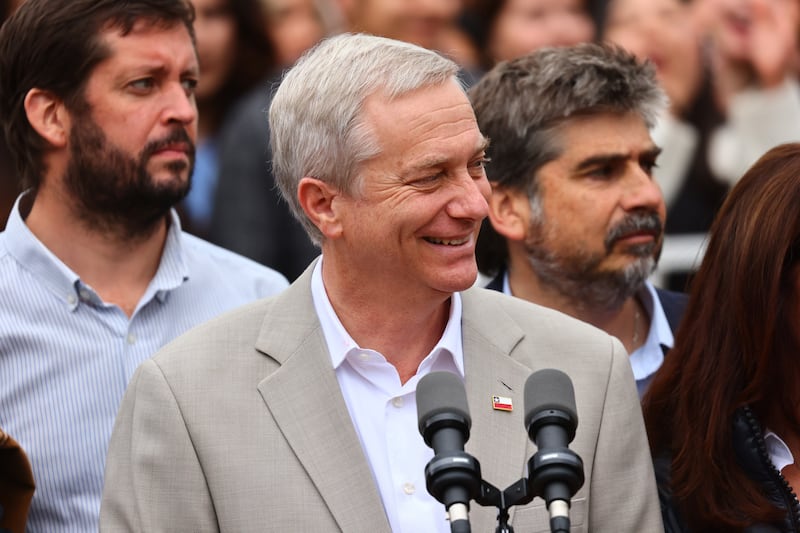
Kast has also pledged to expel an estimated 330,000 undocumented migrants in the country and seal the border to prevent future arrivals. Most of these migrants are Venezuelans fleeing the collapse of their country’s economy at the hands of dictator Nicolás Maduro. Among them came members of the Venezuela prison gang, the Trende Aragua, which is widely blamed for a surge of kidnappings for ransom.
During the campaign Kast said undocumented migrants would have 98 days to leave before he is inaugurated on March 11th. After that they will be expelled. Challenged on how he planned to implement his policy as Peru has already closed its border to Venezuelans coming from Chile and the country has no consular relations with Caracas, he replied: “In life, nothing is impossible.”
A lawyer by training, Kast, 59, is the son of a former German soldier who emigrated to Chile in 1950. He always denied his father was a Nazi until in December 2021 Chilean investigative reporter Mauricio Weibel found German documents proving his father’s membership of Hitler’s party.
Faced with the evidence Mr Kast, then in the middle of his second presidential bid, responded: “Regardless of what a paper from 50 years ago says, my father, I and our entire family abhor the Nazis.”
He has also faced accusations that members of his family were involved in the dirty war waged by Pinochet against leftist dissidents during his 17-year dictatorship in which over 3,000 people were murdered and thousands more tortured. His brother Miguel served in several prominent roles in the regime, including as labour minister and head of the central bank.
Kast has never sought to hide his deep admiration for Pinochet and boasted if the dictator were still alive he would have voted for him.
He first entered congress in 2002 for the Independent Democratic Union (UDI), a conservative party that allied with centre-right groups in opposition to the centre-left Concertación bloc that dominated the country’s politics following the return of democracy in 1990.
Even within his party Kast was long viewed as an ultraconservative, allied with traditionalists in Chile’s Catholic Church in campaigns against the legalisation of divorce and the morning-after pill. He eventually broke with his more moderate colleagues and quit the UDI in 2016.
[ New Chilean leader faces task of keeping good terms with both US and ChinaOpens in new window ]
Claiming the party had abandoned its conservative principles, he launched an independent bid for president in 2017, coming in fourth with eight per cent of the vote. For his third presidential campaign, Kast has sought to play down his ultraconservative positions on social policy that first brought him to national attention to focus instead on law and order. Though in the past he called divorce an “evil” in society and said marriage can only be between a man and a woman, he now says he will respect Chile’s divorce and marriage equality laws, passed in 2004 and 2021 respectively.
But on the country’s still highly restrictive abortion laws the father of nine children has been more ambiguous. He opposed the partial decriminalisation of abortion in 2017 for cases of rape, when the woman’s life was at risk and foetal non-viability. During the campaign he refused to rule out an effort to roll back the legislation as several prominent allies are demanding, reiterating his belief life begins and conception and declaring himself “Catholic first and politician second”.
Though in many ways more of a reactionary than his regional peers, as evidenced by his ultra-Catholicism and reverence for Pinochet, Kast becomes the latest hard right politician from outside Latin America’s traditional party structures to come to power in recent years, joining the likes of the libertarian Javier Milei in Argentina and authoritarian populist Nayib Bukele in El Salvador.