
Ireland’s kicking kings
Thirty-one kicks, 890m. Ireland’s kicking return was almost double that of England’s – 453m. Steve Borthwick, a man who knows the value of putting boot to ball in an efficient manner, was full of praise for his opponents: “I thought their kicking game was excellent today.”
Robert Baloucoune’s try came directly from Tommy O’Brien winning an aerial duel. Jamison Gibson-Park harshly had a second score chalked off for a penalty on O’Brien when it looked like he made a genuine attempt to catch the ball.
Ireland pull off one of the great Twickenham days against England
The periods in possession that resulted in tries for Dan Sheehan and Jamie Osborne after half-time started with, yep, good quality kick chase. Sixteen days after the kicking nightmare that was Paris, with Ireland unable to earn any reward in the sky, an emphatic improvement spearheaded Saturday’s assault on English rugby HQ.
Speed kills

For the first time, Ireland got two of the fastest – if not the fastest – players in the country on to the field at the same time. It was unfortunate that Tommy O’Brien and Robert Baloucoune came together because of a nasty-looking injury to James Lowe, believed to be a groin issue, but the results were devastating.
RM Block


Not long after O’Brien came on, the link with Baloucoune was plain to see, the Ulster man taking on Henry Arundell on the outside – a footrace worth the price of admission alone – before offloading inside to his Leinster colleague. Later, O’Brien benefited directly from Baloucoune’s turn of pace and ability to break the line, taking a scoring pass before beating Tommy Freeman in his own footrace.
On the other side of the ball, when Jamie Osborne was in the bin, O’Brien and Baloucoune showed their speed when corner-flagging to tackle Freeman into touch. Plenty have bemoaned Irish rugby’s lack of pace. Here’s what it looks like to have two high-speed options.
Offload away

Ireland threw 10 offloads on Saturday; Stuart McCloskey and Jack Crowley were responsible for a pair each. The last time they reached double digits in a single game was against Japan in November.
They haven’t had that many successful offloads since beating Wales at home in 2024. In last year’s Six Nations matches against Italy and Scotland, Ireland notched as few as one and two offloads, respectively.
The key trends of attacking rugby at the moment include winning aerial battles, striking in transition and, arguably most crucially, keeping the ball alive. France, widely viewed as the best side at scoring within a handful of phases of winning possession, had thrown a ludicrous 45 offloads in their opening two games – 30 more than next best Italy.
Multiple aspects of Ireland’s attack clicked beautifully on Saturday. The offloading game was a small part of that, but an important one.
Under-20s attacking joy

Speaking of offloads, Ireland’s under-20s side were at times a joy to watch in their 21-31 upset victory over England in Bath.
Former 20s coach and current Bordeaux attack specialist Noel McNamara previously told these pages that age-grade rugby is the sport in its most pure form, young men unafraid of taking risks if the attacking reward is there.
On Friday night, Ireland threw 11 offloads, Rob Carney leading the way with three, including one sumptuous effort in the build-up to a score. In contrast to plenty of senior sides these days, Ireland were happy to dominate the ball, making 154 carries to England’s 94.
Seven line breaks came, but, crucially, so did 340 post-contact metres.
A frequent criticism of sides who attack with such ambition is that their admirable qualities are too often paired with inefficiency. Generally speaking, a marker of an efficient side is to score three points per 22 entry. Ireland just missed that with 2.8 points per each of their 10 entries. Crucially, though, it bettered England’s total of 2.3 points per their nine entries.
Louis’s world
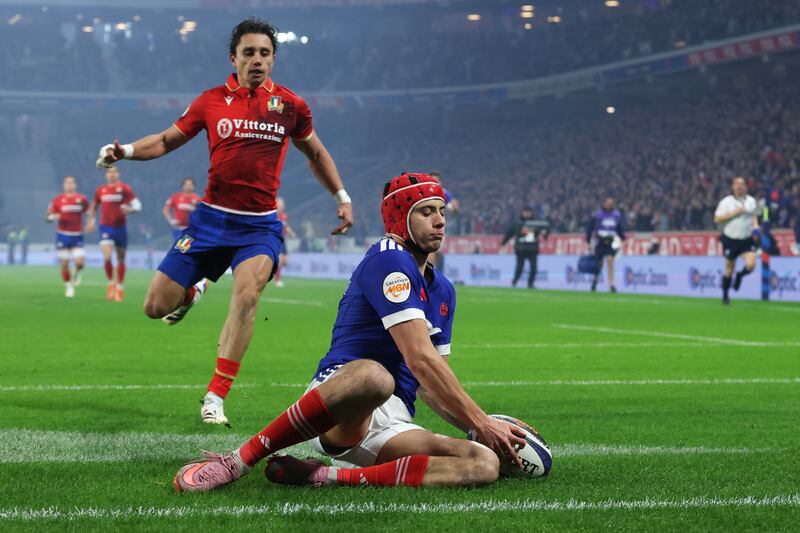
This isn’t something we learned. Everyone knew this already. But as long as Louis Bielle-Biarrey’s speedometer remains capable of hitting its current heights, there is no sign of him, nor France, provided they keep giving him the ball in space, slowing down.
It took the Bordeaux flier fewer than four minutes to make his mark on France’s victory over Italy, scoring after Antoine Dupont kicked ahead. The source of the try? Inevitably, scrappy ball from an aerial battle.
Bielle-Biarrey has now scored in eight consecutive Six Nations matches, the first to achieve such a feat. During this run, dating back to the Wales match in 2025, he has scored 12 tries. The team Louis Bielle-Biarrey has most tormented during this eight-match tear? Ireland, against whom he has scored four times in two games.