
On the week of the 1996 Leinster hurling final, Liam Griffin told his Wexford players about Alain Mimoun, the great French runner.
Though the story ended in glory, it was mostly a parable about struggle. Mimoun was a contemporary of Emil Zatopek, one of the greatest athletes that ever lived. Time after time, Zatopek asserted his dominance over Mimoun.
At the 1948 Olympics and twice at the 1952 Games, Mimoun won silver to Zatopek’s gold. At two World Championships, the outcome was the same. By the time the 1956 Olympics came around, Mimoun decided the marathon would be the battleground for one last tilt at Zatopek, even though he had never attempted a marathon before.
On the day, he was inspired. At halfway he kicked clear from the leading pack and at the finish line he was a minute and-a-half clear. Then, a strange thing.
Without each other, Willie Mullins and Gordon Elliott would never have scaled such heights

JP McManus aiming to break King George duck through Fact To File

Tracks report ‘weather gods’ behaving in advance of busy Christmas schedule

Honesty Policy leads hopes of a first Irish success in Ascot’s Long Walk Hurdle

“All he could think about was celebrating with Zatopek,” said Griffin, recalling the story. “And Zatopek ran up to the line and he put his arms out to grab him and said, ‘You have beaten me at last’. And they hugged and they danced around the place.”
It sounded like a mutation of Stockholm Syndrome, where hostages become attached to their captors. But how long can you hate someone for beating you? At what point do those feelings amount to self-sabotage?
During Tony McCoy’s unbroken 20-year run as champion jumps jockey in Britain, Richard Johnson finished second a staggering 16 times. And yet McCoy and Johnson were friends. They sat next to each other in the weighing room. They had the same agent.
Whatever frustrations Johnson felt dissolved into other feelings over time. McCoy was one of the most prolific, hungry, obsessive jockeys there had ever been. In any other era, Johnson would have been the dominant figure, but the closest he ever came in the end-of-season standings was 11 winners shy of McCoy. One year, he was beaten by 157 winners and still finished second.
By a quirk of fate, Johnson won the last race in which McCoy rode. “I knew it would be a sad day,” he said a few months later, “but I was surprised by how much it affected me.
“It hurt for many years (finishing second to McCoy). I got disappointed and annoyed with myself. At the same time, I’m so glad I raced against him my whole career, rather than someone I didn’t get on with. It would have been much harder if I didn’t like him.”
Johnson was only three years younger than McCoy, but after McCoy retired, Johnson had enough fuel in his tank to win four jockeys’ championships.
Willie Mullins was born in 1956, the year Mimoun finally conquered Zatopek. Gordon Elliott was born 22 years later. In any other sport, that age separation would have spared Elliott from Mullins’ shadow. Good trainers, though, last for decades. Immortal trainers last longer, naturally.
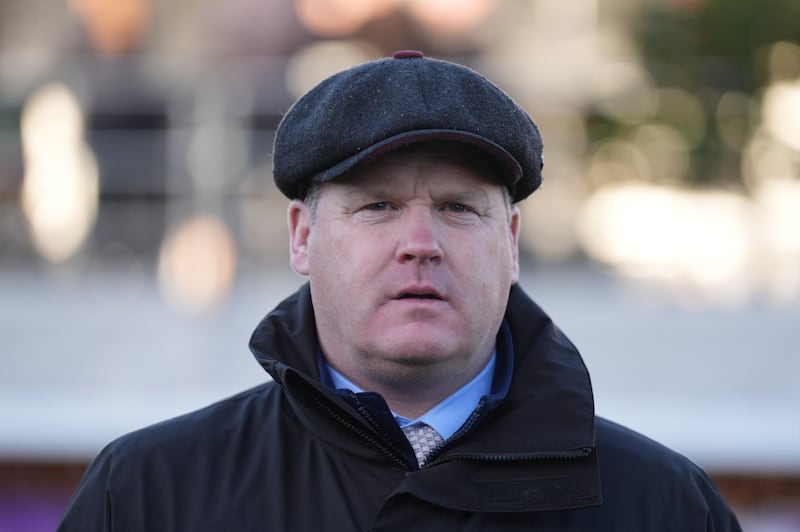
In the Irish trainers’ championship, Elliott has been runner-up to Mullins 13 times, including the last 11 years in a row. Everybody else has given up the chase or never entered the race.
You wonder how Elliott has reached an accommodation with this. None of his peers are ever asked if they want to be champion because, for all of them, it is unrealistic. Henry de Bromhead or Gavin Cromwell have never expressed that ambition. Elliott has never recoiled from it. He has never changed his answer: he wants to be champion.
It is 15 years since Elliott led the trainers’ championship for the first time. It was only his fifth season with a full licence and he had just trained his first Grade One winner. Willie Mullins’ dominance was still in its infancy. Elliott believed time was on his side. All he had to do was keep going. Be relentless. Be patient.
For how long? Nobody could tell.
For how long more? Nobody can say.
Elliott, though, has not just accepted his fate. To make a fight of it, he turned himself into a southpaw. As Mullins developed the most productive recruitment chain for young bloodstock in the history of jumps racing, Elliott bombarded him with volume.
In eight of the last nine seasons, Elliott has saddled over 1,000 runners; in six of those seasons, he saddled over 1,200 runners. Mullins has never even reached 900 runners.
But to stay ahead of Elliott, Mullins had to play the numbers game too. When his run of 18 consecutive titles started in the 2007/2008 season, Mullins had 555 runners and for the next six years, he averaged around 500. That wouldn’t cut it now, or at any time in the last 10 years. He didn’t change by choice; Elliott forced him.
The trainers’ championship, though, is decided by prizemoney and Mullins has more horses than anybody for the most valuable races. In the 2017/2018 season, Elliott accumulated more than €5 million in prize money, a staggering amount that he hasn’t been able to match since. In the meantime, Mullins has exceeded €7 million in prize money twice, and €6 million on two other occasions. Elliott made him do it.
Elliott has some extremely resourceful owners, but not as many as Mullins; he buys horses in France too, but nobody can compete with Mullins’ scouting system in that market. Nonetheless, Elliott’s stamina has been remarkable.
“Four or five years ago, I was taking it a lot harder than I am now (being second),” he told Mark Boylan in a terrific interview in The Irish Field two months ago. “I’ve just got to realise that I’m probably both lucky and unlucky to be training in the same era as one of the greatest trainers of all time.
“The other thing is, he’s 20 or so years older than me. At my age, a lot of other trainers haven’t achieved what I have. I’m hungrier than ever. I’m going nowhere.” Elliott is 47; Mullins didn’t win his first trainers’ title until his mid-40s and didn’t win his second until his early 50s. Maybe time is on his side.
Heading into the biggest week of the season so far, Elliott leads Mullins by €712,000. Is that a lot? In 2017, he led Mullins by €737,000 going into the Punchestown Festival, the final week of the season, and still came second by nearly 200 grand.
Like Mimoun, Elliott’s only chance is the marathon.