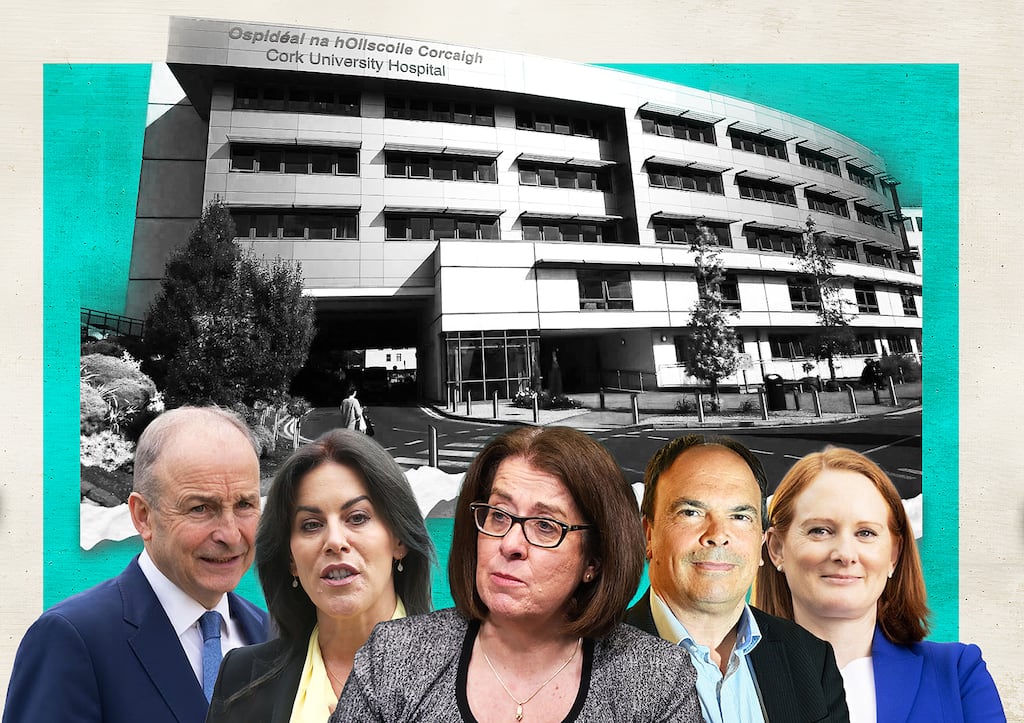

Today was supposed to be about patching up relations at Cork University Hospital (CUH) – but things took quite the turn this morning.
Amid bafflement and incredulity as to why neither Minister for Health Jennifer Carroll MacNeill nor HSE chief executive Anne O’Connor would be attending crisis talks, news broke that O’Connor would be leaving her role after just nine months.
In a statement, the HSE said it believed her removal was in the “best interests of the future operation of the organisation” and had followed a process that was in accordance with her contract.
O’Connor said in her own statement that she intends to “challenge this matter as vigorously as possible” and she “did not resign or voluntarily stand down” from her position.
Taoiseach had ‘constructive meeting’ with Cork University Hospital chief

Ireland seen as light touch on AI regulation because of reliance on tech, Oireachtas told

Catherine Connolly says she will put aside 25% of salary for ‘different projects’

Smart meters, switching suppliers and shift to renewables: new energy action plan launched

She endured a bruising time before the Oireachtas health committee last week and took brickbats after revealing she had not spoken to CUH’s boss since September. O’Connor also endured criticism over her comments that CUH was choosing to argue its case through the media.
The hospital has been warning that patient safety is being threatened by understaffing in what is an increasingly vocal stand-off.
Taoiseach Micheál Martin has headed to the hospital in his capacity as a local TD – with the Opposition describing the whole thing as “nonsense”.
Social Democrats health spokesman Pádraig Rice questioned just how the Taoiseach will magically transform into a mere local Dáil deputy when he crosses the threshold.
The Opposition also wanted to know if Carroll MacNeill would make the trip to Cork later in the week. Sinn Féin’s Louise O’Reilly said it was “extraordinary” that such a meeting had not yet taken place, and the party’s health spokesman David Cullinane called it “incredible”.
The Labour Party, meanwhile, asked what the point of such a meeting was given the absence of the Minister.
Follow the latest developments with our live story.
Triple lock amendments
The health front is not the only challenging terrain for the Government this week.
It looks highly unlikely that there’ll be any meeting of minds over the triple lock Bill – and the controversial legislation will be before the defence committee over the coming days.
There are scores of proposed amendments from the Opposition parties – on top of one from a group of Fianna Fáil TDs.
Nine of them have lined up behind “rebel” leader Willie O’Dea and his demand that any future Irish troop deployment would have to be predicated on a current resolution of the UN General Assembly.
The Government wants to remove the obligation that deployments of more than 12 troops overseas on peacekeeping and other missions only can occur under the condition of a UN mandate.
Such deployments would instead come down to a Government decision and a Dáil vote.
With more than 100 amendments to be considered and voted on, the committee’s chairwoman Rose Conway-Walsh says she intends that process to “take as long as it takes”. The Sinn Féin TD says she wants to do it “thoroughly”.
This will involve the chair allowing every TD from the Government parties and the Opposition to speak in what could be lengthy exchanges.
Minister for Foreign Affairs Helen McEntee says she will not be signing up to any amendments that tie the Government’s hands further and is “confident” that the legislation can be passed before everyone heads home for Christmas.
Cop out in Turkey
Speaking of the United Nations, the meagre expectations that surrounded the build-up to the climate talks in Turkey look like a moon shot in comparison to the actual outcome.
After a week of inconsequential pulling and pushing, the Cop31 negotiations collapsed in ignominy last evening, with Europe and others rejecting a proposed agreement.
Saudi Arabia, Russia and other petrostates managed to excise any reference to oil, gas and coal – which parts of the rest of the world consider to be a bit of an oversight.
Speaking on behalf of the European Union, Minister for Climate Darragh O’Brien said “it fails to meet the moment”.
Instead of proposing effective new enforcement of commitments to reduce the use of fossil fuels, the final draft instead talked about early warning systems and that hoary old carbon capture solution.
And when it came to climate finance for the less well-off countries, it seemed the EU had itself managed to water down any firm commitments there.
It just won’t do the job.
“Fossil fuel giants will be dancing in their boardrooms,” was the view of Friends of the Earth.
Brexit ‘reset’
A meeting that does seem to have had a good outcome was, what Helen McEntee has called, the “reset” that occurred between the British and the EU on Friday.
The Minister says the deal is good for the UK and is good for Ireland too – having removed the need for many agri-food checks and certificates. Micheál Martin, speaking to The Sunday Times yesterday, went so far as to raise the prospect that Britain’s re-entry into the customs union could even be considered at some point.
British prime minister Andy Burnham, you’d suspect, might move cautiously on that one – and for now instead enjoy the warm glow of the burgeoning rapprochement.
Finally, the first of a few big elections on the Continent takes place on Sunday.
The Spanish will be heading to the polls and a defeat appears on the cards for Pedro Sánchez’s left-wing coalition.
The conservative People’s Party and the far-right Vox are eyeing up seats in government in what could see a gradual swing to the right throughout Europe over the next 12 months.