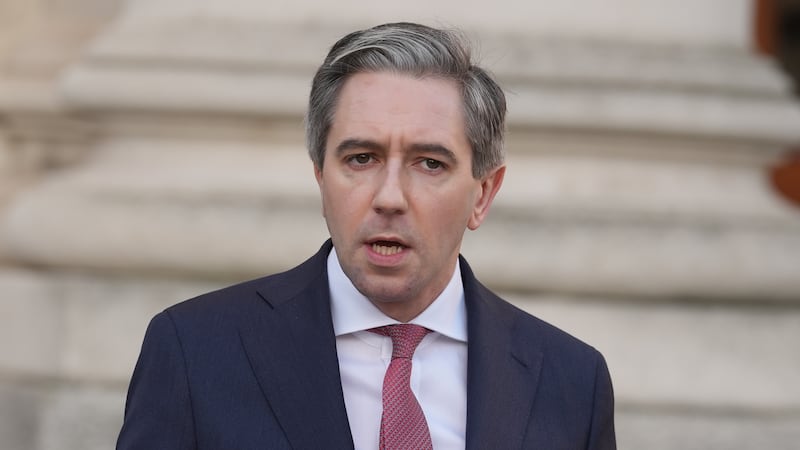
Fears about “a breakdown in social cohesion” are prompting the Government to seek to reduce the number of people coming to Ireland to seek asylum, Minister for Justice Jim O’Callaghan has said.
Mr O’Callaghan also signalled likely future reductions in the number of foreign students permitted to come to Ireland to learn English.
In an interview with The Irish Times Inside Politics podcast, Mr O’Callaghan said that he wanted to be “careful” talking about immigration.
Jim O'Callaghan: We made a bad decision on the presidency
“But I have to be frank about it as well. Like, it’s a fine aspiration to say ... we can welcome into Ireland everyone who wants to claim asylum. I can’t. That’s not realistic. And I have to be careful that the numbers, which were exceptionally high last year − 18,500 people arrived last year − that those numbers are reduced as otherwise, we will have a breakdown in social cohesion. We will have tents on the streets. I know there are some, but we’ll have too many tents in the streets, and it’ll look like a system that the Government is not in control of.”
RM Block


Mr O’Callaghan declined to supply a number of asylum seekers that he believed would be sustainable.
“I’m not setting any numbers as a goal to get asylum figures down to. But what I do want to see is that there’s a system that is designed and is operating for the benefit of people who are fleeing persecution and war,” he said. “Those who want to come here to work have another method of applying, which is through the work permit application.”
Language schools
Mr O’Callaghan said that 60,000 students were given permission to come to Ireland last year − which was something that the Government may seek to reduce. He said there was likely to be a focus on English language schools where many students also work.
“It’s very legitimate that people are coming here to learn English,” Mr O’Callaghan said.
“But also I think it is being used as a mechanism to come in to work … We’re going to try and tighten things up in respect of it. I suppose that’ll involve greater assessment of the English language schools in the first instance.”
Mr O’Callaghan said that the rate of increase of Ireland’s population, at 1.6 per cent a year, is too high and that “efforts should be made to try to curtail it. And in order to curtail it, the only way we can is through trying to introduce some policies in respect of inward migration.”
“It’s fantastic that our population is increasing for years in this country with the declining population. The reason the population’s increasing is because of the success of the Irish economy, because of the success of Ireland as a country. But we just need to be conscious that that rate of increase is very significant and is obviously putting huge pressures on other services that we provide.”
He did not suggest a rate of increase which would be more sustainable, but said that his department was working on a policy on migration and population which is expected to be published next year.
Family reunification
The Minister for Justice has taken a noticeably tougher line on migration, recently hardening the rules for family reunification and on citizenship. .
On family reunification, he said: “I have to also take into account not just the interest of the individual’s concern, I have to take into account the general public interest as well.
“And obviously, if family reunification is ongoing and elderly parents are coming in, or younger children are coming in, the State is going to have a significant responsibility and cost and respect to those individuals.
“So, that’s why it’s important that people will be allowed to achieve family reunification, but you’re going to have to display self-sufficiency and that you can take care of them yourselves financially.”
However, he also said: “I don’t want people to think that I’m trying to make negative decisions in respect of asylum applicants, but there are issues that arise in respect of asylum applicants that don’t arise in respect of others who come here and serve on work permits.
He said his department’s calculation is that about 87 per cent of people who come to Ireland to seek asylum arrived across the Border with Northern Ireland.
Micheál Martin
Mr O’Callaghan has said that while he acknowledges errors were made during the presidential election, he supports Micheál Martin as Fianna Fáil leader and that people “need to be fair in terms of the assessment of a leader’s performance and achievements”.
When pressed, he said: “I’ll say it to you. Listen, I’m backing Micheál Martin. I think we need to have a broader perspective of the past rather than just going back to September.”
Anti-Semitism in Ireland
The Occupied Territories Bill is “sensitive” and “complicated” and the Government must “take into account Ireland’s interests” when deciding how to proceed with legislation, the Minister said.
These comments come after the junior minister for European affairs, Thomas Byrne, said the Bill would not be changed to include services.
Mr O’Callaghan said although Ireland was “very strong in seeking to defend the rights of the Palestinian people”, it was also important Ireland acknowledges the “Zionist position that Israel has a right to exist”. He outlined the importance of speaking out against “language that seeks to challenge the existence of Israel”.
The Minister condemned the “murderous, anti-Semitic attack” in Bondi Beach, Sydney, and said anti-Semitism in Ireland was “something we have to confront”.
Drone activity
He said he did not have a “definitive response” about who was responsible for drone activity over Dublin Bay during the visit of Ukrainian president Volodymyr Zelenskiy, but added that during a meeting last week of EU defence and security ministers, “one of the big topics of conversation was the increased use of drones by Russia within European Union territory”.
He expected significant collaboration with other EU countries on security and defence during Ireland’s EU presidency next year. Mr O’Callaghan said there are “international players out there who will want to target Ireland and we need to increase our capacity to defend against that”.
“Obviously the world is changing,” he said. “We need to recognise the threats to which Ireland is exposed, not just in terms of the area of drones, but also in terms of cybersecurity as well. So, we need greater investment in our defence technology. We’re no longer in a position where nobody’s interested in us.”