Sinn Féin Senator Pauline Tully announced earlier this year in a short video on Facebook that she would be holding an open clinic every Monday in her office at 39 College Street, Cavan.
“Just call in,” she said. “No need to make an appointment.”
Two months later Stiofán Conaty, a Sinn Féin councillor in Cavan, announced he would be holding a constituency clinic every Tuesday at the same address.
Number 39 College Street is on a terrace of two-bedroom houses. In 2000 planning permission was granted for a change of use of the building from residential to office use. A two-bedroom house up the road, currently sale agreed, has a guide price of €120,000.
RM Block



Sinn Féin is the wealthiest political party in the State, with a substantial property portfolio, but it appears to be struggling to comply with new transparency rules that require political parties to identify the number of properties they own.
Land records show 39 College Street in Cavan has been owned since 1999 by Tully, Bernard Reilly, Patrick McDonald and Charles Boylan. The four act as trustees of the local Sinn Féin organisation, according to Tully.
“I don’t own it,” she told The Irish Times.
“It was the local party within the county that fundraised and bought the building. It is not the national party that owns it.”
The ownership of the property is currently being examined by lawyers, the Senator said.
“We just said, as trustees, in case anything happens, we have to make sure it belongs to the party and not any individual.”
Initiating the legal process was decided locally. Among the questions to be answered is whether “the property should be included as part of the national portfolio”, Ms Tully said.
Party headquarters did not direct the review “but they are aware of it”, she said. “We discuss everything with Pearse Doherty.”
Doherty, the Donegal TD and Sinn Féin spokesman on finance, is the party’s joint national treasurer along with Senator Conor Murphy.
New rules governing the financial accounts filed each year by political parties with the public ethics watchdog, the Standards in Public Office Commission (Sipo) in Dublin, include changes in the declaration of property.
The new regime requires consolidated accounts that encompass the activities of not just the central party but qualifying branches or associated bodies, which are called “subsidiaries” in the legislation.
Subsidiaries are bodies “effectively controlled” by the party that reach certain financial thresholds, including whether a body has combined assets, including property, worth more than €100,000.
Property that is not owned directly by the party or a qualifying subsidiary may also have to be declared in a party’s financial accounts, according to Sipo.
“In considering whether property owned by another person is controlled by a political party or a subsidiary organisation, regard should be had to the substance of the relationship, in addition to any formal or legal relationship,” Sipo said.
In its consolidated accounts for 2024, filed with Sipo earlier this year, Sinn Féin said it has fixed assets worth €3.6 million and listed 12 properties owned by it or its qualifying subsidiaries.
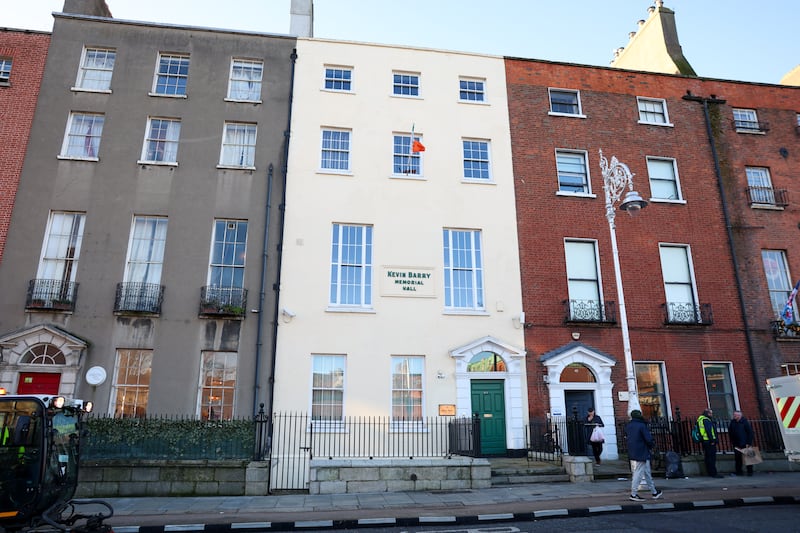
The properties listed include numbers 44 and 58 Parnell Square, Dublin 1, and 51-55 Falls Road, Belfast. The list does not include 39 College Street in Cavan.
Two years ago, when The Irish Times published a report on property owned by Sinn Féin, the party confirmed it owned 19 properties north and south of the Border, including 39 College Street in Cavan.
[ Sinn Féin has 16 constituency properties in Republic and Northern IrelandOpens in new window ]
Some of the 19 properties the party then said it owned are included in the party’s 2024 accounts, and some are not. It is not clear why. A spokesman for the party said it was currently conducting an “audit” of the property it owns.
One property in Tralee, Co Kerry, is listed in the 2024 accounts but was not among the 19 properties identified to The Irish Times in 2023.
This means eight properties identified as being owned by the party in 2023 are not listed in the accounts.
The Eddie Fullerton/Bobby Sands centre
Another property not listed in the party’s accounts is the Eddie Fullerton/Bobby Sands centre in Letterkenny, Co Donegal, which was opened by Doherty and his party colleague in Donegal, Pádraig Mac Lochlainn TD, in June 2017.
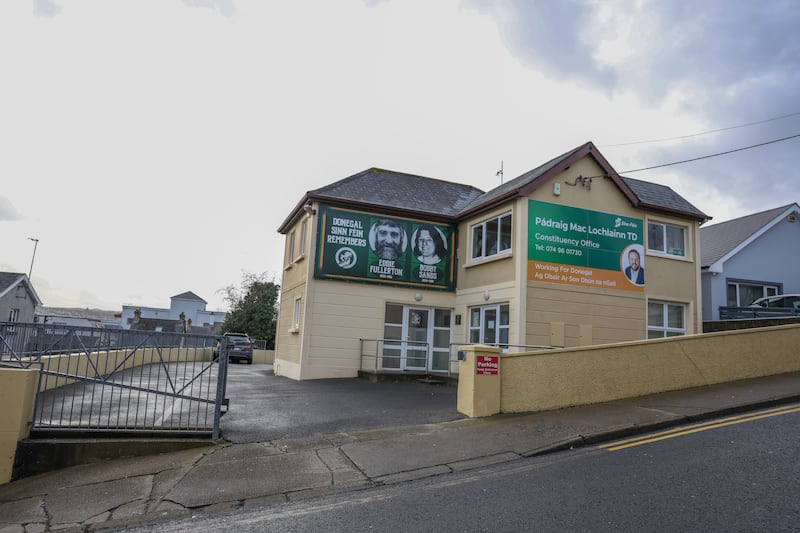
Mac Lochlainn, speaking on Highland Radio the day after the opening said: “We have worked at this for a long, long time, for over a decade; you had not just Donegal people here but also abroad in Australia, America.”
The centre, he said, would be used for meetings, training, education and cultural events.
Political parties in the Republic are not allowed accept financial donations from abroad. In 2018 Mac Lochlainn said some money raised for the centre came from supporters living abroad who contributed to fundraising events while on visits home.
The building was bought from a receiver by Donegal Office Services for a reported €180,000 without taking out a mortgage. Mac Lochlainn uses an office in the building for his constituency work.
In 2018, in a statement to the Sunday Times, he said: “Donegal Office Services is a company associated with Donegal Sinn Féin that was established for the sole purposes of purchasing, refurbishing and managing a building/office with Donegal Sinn Féin having the beneficial interest.”
Sinn Féin now says the company holds the property as trustee for a republican group called the Drumboe/Tir Chonaill Commemoration Committee.
Mac Lochlainn was asked if he wanted to comment on the ownership of the property for this article. No response was received.
Gulladuff
Another property not mentioned in the 2024 accounts is the Ionad Poblachtach Lár Uladh, or Mid Ulster Republican Centre, in Gulladuff, Co Derry.
The hall and a memorial garden beside it for the republican dead was opened by the late Martin McGuinness in September 2004 at a ceremony that included the laying of wreaths on behalf of the IRA.
“Sinn Féin in Mid-Ulster is set to open its new headquarters building in Gulladuff, County Derry this coming Sunday,” a report in Sinn Féin’s publication An Phoblacht said at the time.
Sinn Féin members Ian Milne and Seán McPeake told the publication it was intended the centre would “served the whole Mid-Ulster constituency” and that republicans from southwest Antrim would also make use of it.
“We want the community to see it as somewhere for them to go and as much for their use as Sinn Féin’s,” said Milne, who is now a Sinn Féin member of the Mid-Ulster District Council.
Property records show the hall, which includes offices, a conference room and a hall, is owned by four individuals, one of whom is Michael McGonigle.
“I’m a trustee of it,” he told The Irish Times. “It was bought as a Sinn Féin hall.”
McGonigle was elected as a Sinn Féin councillor in the 1980s, but is now honorary vice-president of Republican Sinn Féin.
“The hall belongs to Provisional Sinn Féin,” he said.
“They asked me to take my name out, but I wouldn’t take it [off the Land Registry folio]. My name will be on that until the day I die.”
In 2014 the BBC Northern Ireland programme Spotlight investigated payments made by the Northern Ireland Assembly for offices being rented by assembly members (MLAs).
They found that rent on the use of an office in the Gulladuff Hall by Sinn Féin was being paid to the South Derry Cultural and Heritage Society.
Some registered owners of the hall wrote to the programme saying they were acting as trustees of the society, but McGonigle told the programme he had never heard of it.
“That’s only a bluff; it’s a bluff name,” he told The Irish Times when asked about the society. “You can print that and say I said it.”
Milne, when contacted by The Irish Times, said he “believed” the hall was owned by the South Derry Cultural Society. Asked if he was certain who owned the hall, he said: “It’s not Sinn Féin anyway,” and hung up.
The South Derry Cultural and Heritage Society is registered with the Charity Commission for Northern Ireland. The charity’s trustees are different from the registered owners of the hall.
One of the charity’s trustees, Anne Gribbon, is a former Sinn Féin councillor. Another, Barry Murphy, is a long-time party worker in the Derry area who acted as election agent for the Sinn Féin Mid-Ulster MP, Cathal Mallaghan, in the UK general election last year.
When contacted, Murphy said any questions about Sinn Féin’s accounts should be directed to the party’s press office. He did not want to talk about the society and ended the call.
In 2023, the Sinn Féin press office told The Irish Times that the hall in Gulladuff was not owned by Sinn Féin.
In February 2008, the Northern Ireland Assembly, in response to a freedom-of-information request, disclosed the landlords and property owners who were being paid rent on offices being used by MLAs.
The list included the South Derry Cultural and Heritage Society, which was being paid for use by Sinn Féin MLA Michelle O’Neill, now Northern Ireland’s First Minister, of a constituency office in the Gulladuff hall. An office in the property is currently used Sinn Féin MLA Emma Sheerin.
Also on the list were two offices then being used by Sinn Féin MLAs where the rent was being paid to an entity called the Tyrone Cultural Society. Neither address is currently used as constituency offices by Sinn Féin, public searches indicate.
The society has no presence on the internet. The party has also in the past paid rent to an entity called the North Antrim Historical Society for the use of MLA office space. That society also does not have an internet presence.
In 2020, Sinn Féin’s then finance director Des Mackin told The Irish Times the party had up to 50 constituency properties, in addition to its headquarters properties in Dublin and Belfast.
“Not all of the constituencies have properties, but in Northern Ireland there are constituencies that have two or three,” said Mackin, who was the party’s finance director for about two decades but stood down last year.
“We tried to tidy it up some years ago, but it was too difficult. In Belfast alone we would have seven, easy. Nationally, I’d say it exceeds 40 or 50, easily.”
[ Inside Sinn Féin: the party with 200 staff and an extensive property portfolioOpens in new window ]
It was presumed at the time that Mackin was referring to ownership, though Sinn Féin’s 2024 accounts do not support this.
Mackin did not want to comment for this article when contacted.
For many years the Sinn Féin accounts were audited by Kinsella Mitchell and Associates, of Prussia Street in Dublin 7. The consolidated accounts for 2024, however, were audited by a new firm, Brady & Associates, of Meath Street, Dublin 8.
In their notes accompanying the accounts, the auditors drew attention to the fact that the accounts were prepared under the new regime and included subsidiaries.
“Due to the decentralised and voluntary structure of these entities, there are limitations in the party’s ability to identify all subsidiaries that fall within the scope of consolidation under Section 83 of the Electoral Act 1997 (as amended),” they said.
“This identification process is ongoing and based on information provided by the party. It remains possible that further subsidiaries exist but were not included. Responsibility for identifying such entities rests with the party.”
Included in income for the year is rental income of €46,644 and a profit on the disposal of a fixed asset of €348,102.
A spokesman for Sinn Féin said the party was compliant with the new obligations on declaring property but also that it was conducting an ongoing audit of the issue.
“The new Act ... includes additional obligations regarding the declaration of property interests, including assets that may not be directly owned by the party but could fall within scope due to their relationship with the party’s subsidiaries,” he said.
“Sinn Féin will continue to review its reporting obligations in this regard each year as we prepare our audit accounts and to ensure full and ongoing compliance.”
Asked if it was satisfactory that a party should submit accounts while also conducting an audit of its property portfolio, Sipo said its review of all the political parties’ accounts for 2024 was ongoing.
“In relation to the specific questions you put, due to the nature of Sipo’s role as an impartial oversight body, and in order to be fair to all parties involved, we would not be able to provide any comment regarding cases of compliance,” it said.
Accounts for Fianna Fáil show it had property worth €758,984 at the end of 2024. The properties listed are 75 Church Street, Cavan, and Denis Lacy Hall, The Mall, Clonmel, Co Tipperary.
Fine Gael declared one property, its headquarters, at 51 Upper Mount Street, Dublin 2. QRE Real Estate Advisers valued the property at €2.3 million in June 2024 on an open market basis, according to the accounts.
According to Sipo, no party can receive State funding under the Electoral Act 1997 unless Sipo has told the Minister for Public Expenditure it is satisfied the party has supplied a set of accounts that “substantially complies” with the Act.