
With a name like his, he was probably condemned to a foray into literature sooner or later. But the Robert Burns behind a new book called Kings and Queens of the Road is an accidental writer. He fell into the role from his day job as a civil engineer, and more particularly a civil engineer committed to creating “people-friendly public spaces”.
Born in Monaghan, he’s back there now as the county’s chief executive. In between, however, he cut a swathe through south Dublin, where the former Green Party TD and junior minister Ossian Smyth recalls him as “The TK Whitaker of cycle lanes”.
His book, a joint production with the Museum of Childhood Ireland, takes its inspiration from the Patrick Kavanagh poem Inniskeen Road: July Evening, in which “the bicycles go by in twos and threes”.
But in Dublin, during Covid, Burns oversaw construction of the 4.5km segregated cycle route between Blackrock and Sandycove for a mere €1 million. Now the bicycles go by there, not just in twos and threes, but at a rate of 20,000 a week.
A Passage to Innocence – Frank McNally on an anthology of old school routes remembered
Craicing the Case – Frank McNally on the origins of a cultural and linguistic phenomenon

Frank McNally on a grand stretch in the evenings, a new Dublin restaurant and ‘Gloomsday’
Drum role: Alison Healy casts an incredulous eye over a much-loved Christmas carol

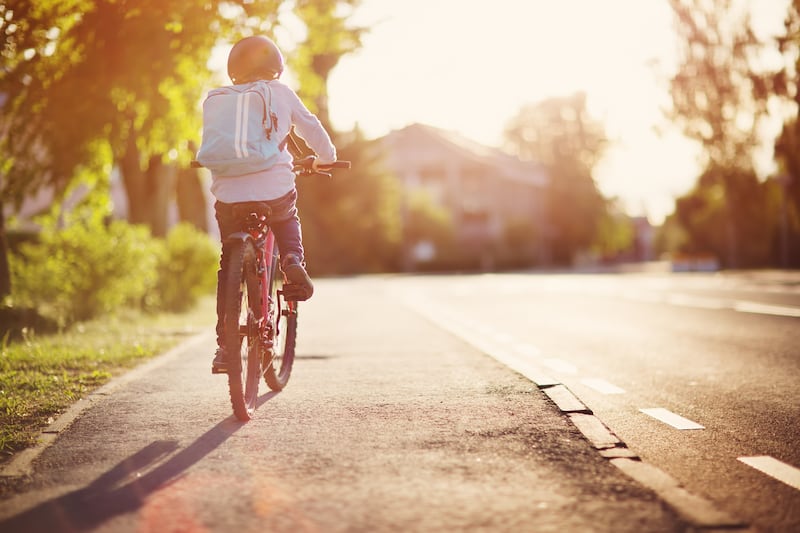
The idea behind Kings and Queens of the Road was to get people – around 60 of them in this case – of all ages and backgrounds to recall their childhood journeys to school: a rite of passage that, as the anthology of their stories prove, stays with you all your life.
The title too comes from Kavanagh’s poem, although it was somewhat ironic in that context, where the poet’s social exclusion from a dance in Billy Brennan’s barn makes him the reluctant monarch of a now empty road, “a mile of kingdom”.
The new book, by contrast, is inclusive to a fault. Routes described range geographically from Caherdavin to China (where the Irish-exiled artist Jin Yong grew up in a town where it could be -30 degrees in winter and where once, as a nine-year-old, he took a short cut across a frozen river only for one of his legs to slip through the ice.
Luckily, the rest of him didn’t, and he survived to reach school, where the teacher let him and his “rock-hard” trousers thaw out by the fire).

The stories are not all about walking and cycling either. Another artist, Leanne McDonagh, a Traveller, recalls the excitement of days in the 1990s when her father would turn up at school not in the usual Hiace van but a horse and cart.
“This of course was the coolest thing ever ... myself and my siblings would climb on to the sulky hoping to get the side seat first because we all knew that to be sitting on the edge was the most exciting place to be, only topped by the chance of holding the reins and taking the lead on the journey home to the site.”
The well-named Aidan Herdman, now retired from a job in Guinness’s brewery, was one of several who read his contribution at the book’s launch last week.
Although his school was in Stoneybatter, he recalled a time – not much more than 50 years ago – when the hazards of the route included herds of cattle being walked from a train station in Cabra to the market at Prussia Street.
He was not much of a herdman in practice, alas: “I was so scared when they approached me that I ran into a house driveway and closed the gate.”
[ Dublin city cycle lane funding slashed by €16mOpens in new window ]
The cattle drive was a gauntlet also run by journalist Frank McDonald, formerly of this parish. He grew up just off the North Circular Road and wove his way to school through an area dominated less by cycle paths than cow pats: “It took a bit of skill on the bike to avoid them.”
The longest memory in the book is that of Desmond Morris, the English zoologist and broadcaster, now in his late 90s and living in Kildare. His childhood in Swindon included the second World War, when along with his books he had to carry a gas mask to school.
The war in Northern Ireland features too. Writer Sheena Wilkinson recalls 1980 and the hazards of taking two buses across a barricaded city centre to her grammar school in “posh south Belfast”.
Late on her first day there, she then walked into a no-warning ambush of middle-class smugness: “’Not a good start,’ says my form mistress, and the other girls, who arrived in their mummys’ Range Rovers, or who walked through neighbouring leafy avenues with their pals form the prep school, look at me with scorn.”
As Museum of Childhood founder Majella McAllister writes in an introduction, the anthology and a related exhibition is the product of a two-year conversation begun on “Back to School” day 2023.
Part of the aim, she said, was to reframe the role of children “as rightful users of public space whose needs have been systematically marginalised”.
The book, with illustrations by Molly Buí Hennessy, is available in selected shops and, as part of a travelling exhibition, will be distributed free to libraries across Ireland.