There’s a grand stretch in the evenings now – or a small one anyway. Yes, the days are still getting shorter, but thanks to the mismatch between solar time and the semi-fictionalised version used in clocks, the earliest sunset of 2025 happened on Saturday (whereas the latest sunrise will not be until December 30th).
The difference may be negligible so far. Indeed, when I attempted to photograph the December 13th sunset from Dublin’s Ha’penny Bridge, it was invisible: a mere rumour in the grey skies off to the southwest, behind Guinness’s. Still, amid the gloom of mid-December, it was cheering to know that the nights were no longer drawing in.
***
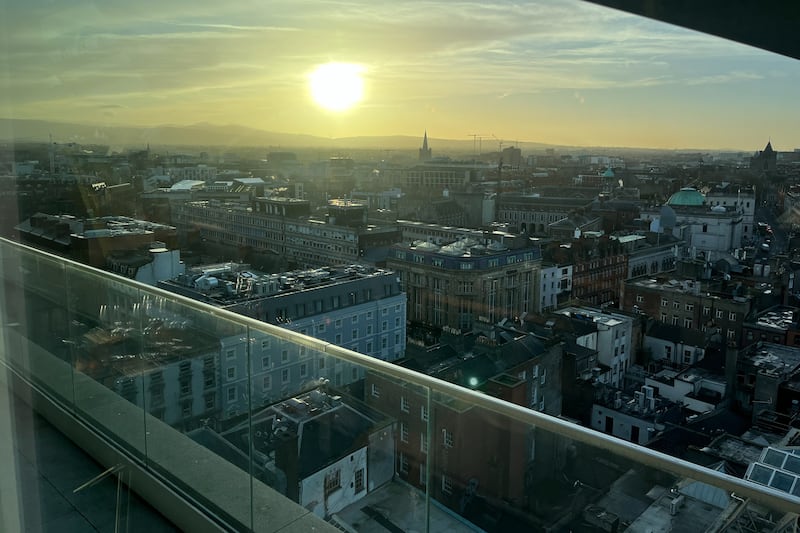
By Monday, happily, the sky was blue again. And as the sun went down a full eight seconds later than on Saturday, I had one of the best views of it in the city, thanks to a late lunch in that new restaurant at the top of the old Central Bank.
Frank McNally on a grand stretch in the evenings, a new Dublin restaurant and ‘Gloomsday’
Drum role: Alison Healy casts an incredulous eye over a much-loved Christmas carol

Kindred spirit: Áine Ryan on the joys of reliving a Christmas childhood through her grandchildren

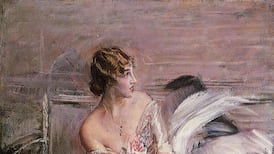
The woman who enchanted Proust – Frank McNally on the rise and fall of Gladys Marlborough
The venue’s name, Díon, is Irish for “roof” (or alternatively, according to Dinneen’s Dictionary, “thatch”). And the four-sided panorama up there included the Dublin Mountains, over which Monday’s sunset lingered lovingly before stealing a short extra bow.
The last time I’d been in the thatch of the old Central Bank was back in November 2001, when journalists were given a preview of the then-soon-to-be-introduced euro banknotes.
This involved a visit to the top-floor boardroom. I can’t remember the external view that day. But I do remember the breathtaking vista of a €500 note, close up, something I haven’t seen again since.
***
The food in the new restaurant was good too. So was the company, although we were a random collection of friends, half of whom I hadn’t met before, arranged around a big oval-shaped table that could have been a left-over from the former boardroom.
Speaking of tables, one of my fellow guests – a London-based Irish businessman who had fallen in late with the gang – told me afterwards that, so sparkling had the conversation been, it was like eavesdropping on the Algonquin Round Table, or something similar.
I was briefly flattered until remembering that most of the dazzling repartee at ours was supplied by Paul Hayes, a PR consultant and one-man round table with whom Dorothy Parker would have struggled to get a word in edgeways. Paul frequently has to interrupt his own funny stories with spontaneous witticisms. But it takes the pressure off the rest of us.
***
It’s hard work being a diarist. No sooner had that lunch ended on Monday than it was time to go to dinner. I had no choice in this, really. Because despite the lengthening evenings, December 15th is also “Gloomsday” – the aphelion of June 16th – and the latest unholy day of obligation for fans of James Joyce’s Ulysses.
Strung-out Joyceans will use any excuse for a hit, clearly. Last year’s inaugural edition involved only five attendees (none of them female). But proving there was a latent demand, this year’s congregation mushroomed to more than a dozen, including all the main genders.
As in 2025, the venue was Davy Byrne’s. And again, the food and drink was accompanied by readings from “the book”, printed into missalette form.
I say there were “more than a dozen” present. Ominously, there were 13: something of which Charles Stewart Parnell (who was mentioned in one of the readings) would not have approved.
Parnell was notoriously superstitious. Even at the time when he bestrode Irish and British politics like a colossus, he was a confirmed triskadekaphobe. If he noticed there were 13 people at a meeting, he would ask someone to leave or get someone else to come in.
But we couldn’t very well ask someone to leave. The only alternative was dragging an innocent by-passer in off Duke Street to participate in Joycean readings. And there’s probably a law against that.
***
By a more serendipitous chance, I was amused to see a review in Monday’s London Times of an Irish production of Playboy of the Western World in London, about which the critic’s misgivings included this: “It’s also delivered in accents that will leave outsiders straining to make sense of the dialogue.”
Well, excuse us for being outsiders, I thought, indignant. But then on Tuesday – lo! – the same paper had an interview with Chloé Zhao, the Chinese-born film director who has just made Hamnet, admitting she understood only a fraction of Shakespeare’s work until Kildare’s finest, Paul Mescal, made sense of it for her.
[ Hamnet review: Five stars for Jessie Buckley and Paul Mescal’s devastating filmOpens in new window ]
And – lo! again – it had so happened that our Monday night readings included the bit from Ulysses where a joking Buck Mulligan (in real-life Oliver St John Gogarty) affects unfamiliarity with the Bard of Stratford’s work.
“Shakespeare?” he wonders: “I seem to know the name.” Then a smile invades his features. “To be sure,” he says, remembering: “The chap that writes like Synge.”