Imagine you have a shell in your hand that’s a bit rough around the edges. At first, it’s nothing more than a sensation, a thing you feel on your skin.’
But then, you try to do something – cook a meal, get groceries, take a shower, go to the loo, drive a car, work at your job – and what was just a sensation on your skin turns into a bothersome feeling.
You can’t put the shell down, no matter what you do.
At night, when you try to sleep, it keeps waking you up. It doesn’t take long before you’re tired, really tired of carrying this shell around. And then, as every little task becomes monumental, you realise all you think about is this shell. Your world revolves around it.
RM Block


And you can never, ever just put it down.
And remember, this shell is invisible, so nobody can see it.
The pain of endometriosis – a condition where tissue similar to the lining of the womb starts to grow in other places – is sometimes a shell, and sometimes it’s the entire beach, breaking over you in waves, crushing your bones, leaving you gasping for breath.
Pain is measured on a scale of one to 10. This numerical pain rating was invented by two men in the 1970s. If you’ve ever shown up in hospital or a GP’s office with a hurting body part, you’ll be asked to rate your pain. One is meant to be ‘generally grand’ but there’s an ache somewhere, whereas 10 is a place the pain is so bad, you can hardly speak and your mind leaves your body. Going by Melzack and Torgerson’s scale, for years I lingered around a six or seven on a daily basis, hitting eight more frequently than I care to admit. I was 43 when I learned that four is the number at which you pull the emergency chute and take medication.
I was even older when it landed for me that living in daily pain is not, in fact, normal.
My pain started in my teens, in my legs, knees and right shoulder, in addition to crazily painful, heavy periods. I was a basketball player, on a court five or six days a week, training and playing multiple games. All I wanted to do was play hoops. So when pain began to interfere with my ability to play, I was brought to a GP. There followed two years of medical evaluations, tests, probes, consultants and physios. I’d take ibuprofen before a game, tape my knees, and play through the pain. Finally, when I was 19, with no real diagnosis or explanations, a consultant told me I would never run again, and, that I would never again play basketball.
Throughout my life, I have reported pain to every medical professional I’ve ever encountered. ‘It hurts when I ...’ ‘The pain moves when ...’ ‘It’s burning and radiating ...’ ‘It feels like a hot poker ...’ ‘I double over if ...’ ‘It’s constantly stabbing ...’ ‘Please help me ...’ somebody help me. Please, somebody help me.
I was finally given a diagnosis (at age 42) for the decades of mysterious and relentless pain I was enduring. Endometriosis. A disease in which cells similar to the lining of the uterus grow anywhere. It’s a whole body, systemic, inflammatory disease that is chronic and has no cure. It is one of the most painful diseases going, and the pain it can cause is unimaginable.
Here’s a snapshot of patient descriptions shared with me by women in the endo community:
“Like my bones were being broken from the inside out.”
“Like being on fire.”
“Being ground through a meat-crusher.”
“It’s a feeling of pulling, as if the organs in my lower abdomen are being held up by chewing gum that’s stretching down.”
“I feel like someone is twisting my organs.”
Words like “agony,” “debilitating,” “sharp and spiky” and “unbearable stabbing and writhing pain.”
And then, this: “my appendix was pulled from my right side and fused to my small bowel and left abdominal wall.”
That last one came from a woman whose pain had been dismissed and ignored in Ireland. When she sought treatment abroad, a specialist surgeon discovered the true extent of the damage inside her body.
Within the endometriosis community in Ireland, this is a common experience.
In early September, the Minister for Health, Jennifer Carroll McNeill, convened an endometriosis patient symposium at the Department of Health. The chief executive of the HSE, Bernard Gloster, and senior officials of the department and HSE were present, as well as the Minister, listening to story after story of women describe the excruciating pain of endometriosis.
After that harrowing day, at which we pleaded for many things, including access to pain clinics, I felt confident that relief might be on the way. It takes a long time to upskill surgeons, develop the multidisciplinary teams required to treat the disease, and put in place the other services endometriosis patients badly need (such as pelvic physios, specialist dietitians, mental health professionals). But, increasing access to relieve the worst symptom of all, pain, would surely be top of the “can do” list, right?
Weeks after the symposium, the patients in attendance received an email from the Minister with a list of short-term action items. Not one of them was about pain clinics. The wait time for public pain clinics is up to two years. Most endo patients I asked have been waiting at least a year.
What’s so important about pain clinics?
For one, they do the obvious: help with managing the pain. For those who can tolerate them, opioid medications can and do make it possible to function with this debilitating disease. For the tiny few who have access, medical cannabis can help. Part of managing chronic, severe pain is having a plan. Knowing there are tools in your belt when a flare comes is crucial.
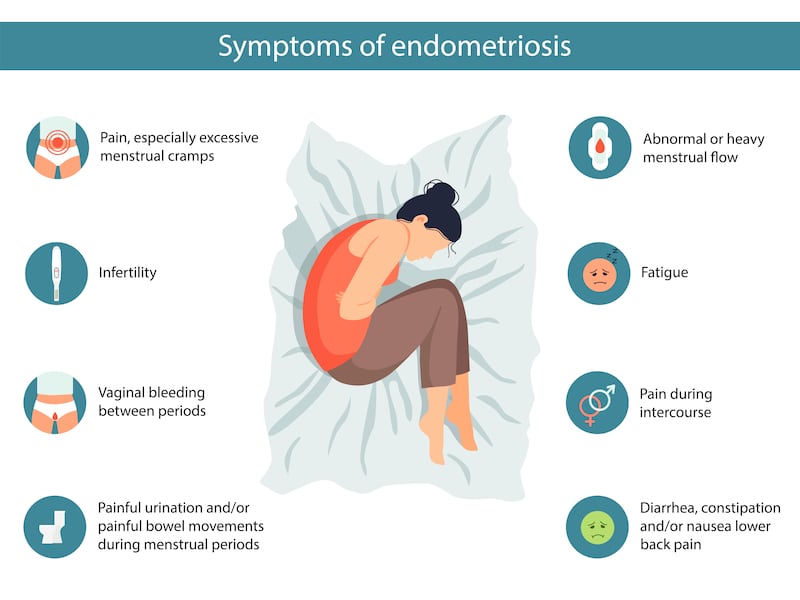
Having a professional pain consultant to support patients is a no-brainer. Pain is complex and notoriously hard to manage, so why would a health service and its boss, the Department of Health, expect patients with a disease synonymous with severe pain to just ... handle it by themselves?
Because these patients are all women. Duh.
On October 18th, the National Framework for the Management of Endometriosis in Ireland was launched by the Minister and Department of Health. This wordily titled Government document was, is, an outline for what the plan is to address the endometriosis crisis in Ireland.
And it is a crisis.
The framework is such a hot mess, it set the endometriosis community on fire. One of the most egregious statements contained within it – and there are so many – is about managing pain.
On page 14, under the subsection “Treatment,” the following sentence is printed: “Simple analgesia, in the form of paracetamol and/or non-steroidal anti-inflammatory drugs have been shown to be effective in alleviating symptoms of pain caused by endometriosis.”
Simple analgesia is paracetamol. It’s ibuprofen. These are incredibly useful drugs. But not for endometriosis. This has been said to the Minister, her predecessor, HSE staff, its chief executive. The inclusion of this statement in the framework is an attack on the dignity, sanity and health of endometriosis patients, not just in Ireland, but globally. With the primary, most difficult part of this disease being the complex pain it causes, why would anyone write such an insulting statement?
Women are living day to day, many in agonising pain, with no pain relief
Why was it included in the framework after the Minister for Health, the chief executive and senior officials of the HSE were present at the hours-long patient symposium in the Department, after they’d listened to women in so much pain it would turn your blood cold? Why was it included after the Minister met patients and advocates, and, why was it included after many other women shared their testimonies with the Department in 2019, as part of the consultation process for the National Women’s Health Programme? It is impossible to parse apart State failure from the pain of this disease. One feeds the other.
So here we have one of the most painful conditions known to medicine, and women in Ireland are currently waiting up to two years for adequate pain relief.
How is this even possible?
Maybe, and just go with me on this, maybe, it’s the irrefutable, research-proven fact that women’s pain is dismissed, and ignored.
In all of the messages I received from women about endo pain, less than a handful had access to effective pain management. Women are living day to day, many in agonising pain, with no pain relief. This is gross negligence so bad I have considered starting a GoFundMe account to help women pay the €250 fee to attend a private pain consultant. In one of the wealthiest countries in Europe, women are working an underground system of advocacy and help to enable patients to access surgery abroad, sharing information that saves lives, and – I can’t believe I’m writing these words – starting their own schools’ education programme about endo. Patients are doing this.
Not the Minister for Health, or the Department, or the HSE – patients.
If you’re reading this, and you have inexplicable pain, yet every scan shows up normal and you see that same look in every doctor or nurse or physio’s eyes, like “here’s your one again,” you’re not alone.
[ Teenager forced to use walker and wheelchair because of endometriosis painOpens in new window ]
It’s not in your head.
I keep collections of shells around my house. They remind me of that saying, “a rising tide lifts all boats”. When I think about that phrase, I think about all the endo warriors I know, the army of us, resisting and persisting for the care we deserve.
They are the most remarkable, and strongest, women I know.
I dare the person who wrote that our pain can be managed by “simple analgesia” to step forward, look any one of us in the eyes, and say it out loud to our face.
I dare them.