
Around this time of the year we tend to get a few spiders venturing indoors and I endeavour to return them safely outdoors again. On attempting to sweep this one gently into a dustpan, it jumped in an impressively acrobatic way – not once, but several times. It is only about 5-6mm in length, so rather small as spiders go. As I found it in the kitchen and not the garden, I suppose it could also have been a stowaway on shop-bought imported fruit or berries. What do you make of it? Joe Fenwick, Corrandulla, Co Galway
This is a most excellent picture of a male jumping spider, Hasarius adansoni. As jumping spiders go, this is a large species – they are usually smaller than this. Jumping spiders are pursuit hunters; four of their eyes are large and in a definite row at the front, while the other four are much smaller and to the back so that they can see prey in front of them. This is a hot-house spider and probably arrived in your kitchen among peppers or tomatoes from Holland. It won’t survive outdoors in our climate at this time of year.

I found these mushrooms growing in the plant border. Are they rare or common? Could they be verdigris agaric? We live in Balrothery. Matthew Graham, Fingal, Co Dublin
Yes, that is exactly what they are: Stropharia aeruginosa, the verdigris roundhead. This is a blue-green, medium-sized mushroom, up to 8cm across, with white woolly scales on the stem and the cap. It is common enough and grows in groups in lawns, mulches and soil – often where nettles are.
RM Block


What is this dark-coloured insect? I found several of them dead in my guest WC underneath the window section of this room; the insects seem to bore tiny holes in the skirting board, leaving small brownish little piles of dust. This is a holiday home, and I have found evidence of these insects throughout the summer each time I return to the house in Westport. Catherine Mc Loughlin
This is the wood-boring weevil Euophryum confine. They bore holes in wooden floors and skirting boards, often where there are damp circumstances. Check that there is no underlying fungal rot which would necessitate replacing the timber.

I pulled in a clump of seaweed while fishing from a Wicklow beach recently. The attached pipefish was in amongst the weed. I think they are from the same family as sea horses. This one was 5 inches long and as thin as a piece of twine. Aidan Sherwin
It looks like a small straight-nosed pipefish – Nerophis ophidion – which, unlike other commonly occurring pipefish, has no tail fins. Like seahorses, it is the male who carries the eggs, given to him by the female until they hatch. They can grow up to 30cm when adult and live among seaweed in very shallow water.
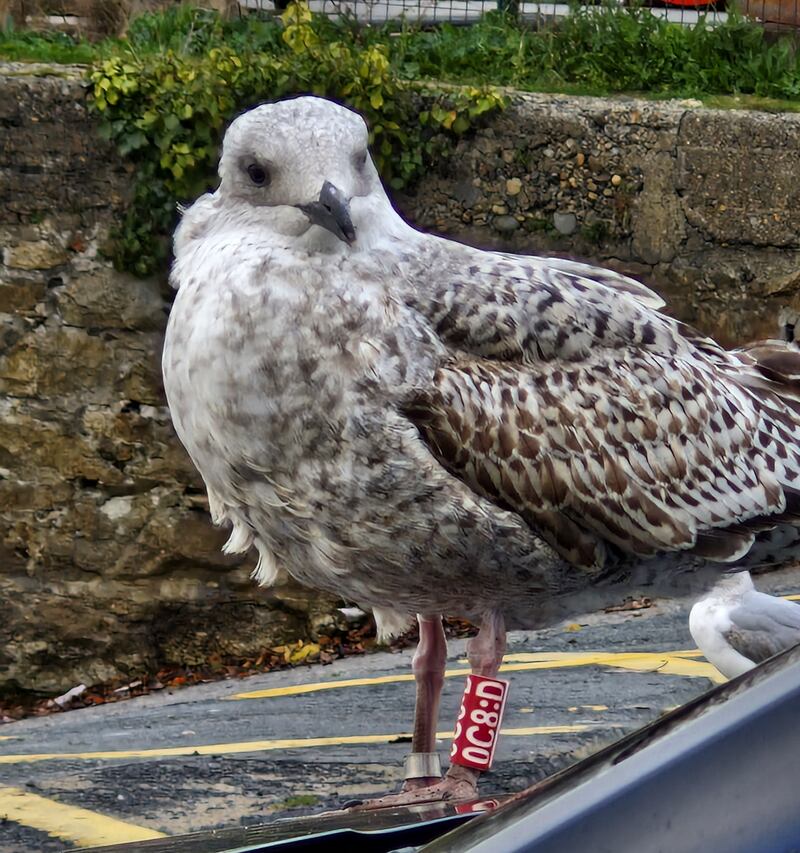
I noticed this herring gull among the swans at Bray harbour, Co Wicklow. It has a ring on each foot. Why is this and where was it ringed? Ruairi Megannety, Churchtown, Dublin
Birds are ringed with metal rings under licence from the National Parks and Wildlife Service as part of the British Trust for Ornithology Bird Ringing Scheme of Britain and Ireland. The larger ring on the other leg shows that this gull was also ringed by Graham Prole for the Irish Midland Ringing Group Dublin Gull Study project. This one came from a roof in Dún Laoghaire as a flightless chick. It was ringed and returned there. BirdWatch Ireland welcomes photos of ring numbers and colours at info@birdwatchireland.ie.
Please submit your nature query or observation, ideally with a photo (NOT a video) and location, via irishtimes.com/eyeonnature or by email to weekend@irishtimes.com


