There was only one Christian and he died on the cross: thus spake Friedrich Nietzsche. And he was right. The churches we have today that go under the rubric Christian should properly be known as Pauline, since it was Paul, formerly Saul, a Jew from Tarsus, who successfully, nay triumphantly, promoted the cult of Jesus, warning his fundamentalist followers, in Corinthians I, “if Christ be not risen, then is our preaching vain, and your faith is also vain”. So it all began, as it was to continue, with a threat.
And yet how persuasive is the Christian doctrine of grace against sin, the eternal against the temporal, the transcendent against the merely mundane. The Roman Catholic faith exerts an almost mesmeric hold on its adherents and haunts the darker corners of the minds of its apostates. And no member of the Church is so fierce in its defence as the convert.
An anecdote is told of the novelist Evelyn Waugh, a famous not to say notorious convert, in a private audience with Pope John XXIII, inveighing so passionately against the reforms of the Second Vatican Council that the pontiff was driven gently to protest: “But Mr Waugh, I too am a Catholic.”
It is startling to learn, from Melanie McDonagh’s authoritative and, yes, entertaining book, just how many cultural figures in these islands opted for Rome in the period from the 1890s – the aesthetes fairly flocked to the font – to the 1960s. McDonagh’s subtitle is From Oscar Wilde to Muriel Spark, Why So Many Became Catholic in the 20th Century.
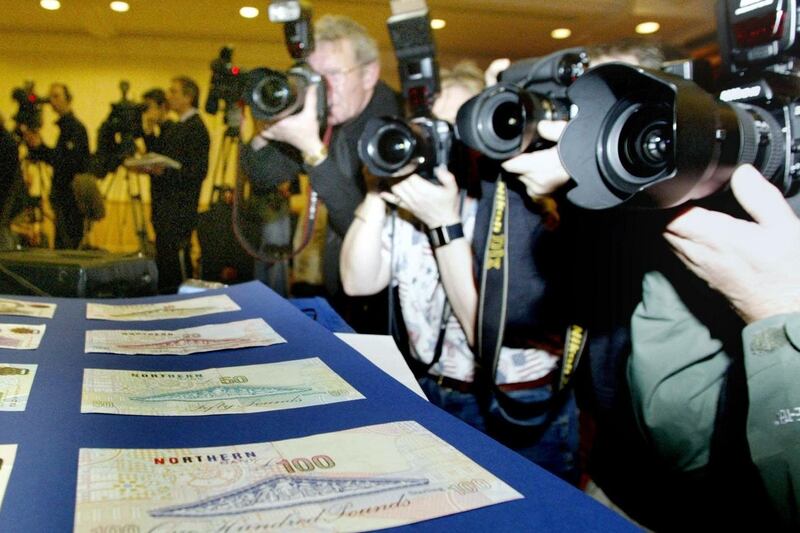
The Northern Bank Job by Glenn Patterson: a startling tale of audacious criminality
‘Badly done, Emma!’ Jane Austen needed only a picnic to torment her readers

How Canada coped with an influx of destitute and diseased Irish people during the Famine

The Eleventh Hour by Salman Rushdie: A new collection rich with pathos and reflection

GK Chesterton and Graham Greene we all knew about, but Siegfried Sassoon? The painters Gwen John and Graham Sutherland? Elizabeth Anscombe, one of Ludwig Wittgenstein’s philosopher friends? Bosie’s father, the unspeakable Marquess of Queensberry, Wilde’s nemesis? And what about Ronald Knox, son of the bishop of Manchester, and RH Benson, novelist son of – wait for it – the archbishop of Canterbury. It is as if a wholly outlandish conspiracy theory had turned out to be true after all.
There are surprises, at least for this reader, on every other page of Converts. Take the case of Lord Alfred Douglas, the ‘Bosie’ whom Wilde loved well but decidedly unwisely. When Wilde was dying in a Paris hotel room, his friend Robert Ross brought a priest along to receive him into the Church. Bosie was appalled: “I suppose Bobbie [Ross] . . . is consoled by the Roman Catholic tomfoolery . . . I did so loathe the idea of [Wilde’s] ‘being received’ on his death-bed à la Aubrey Beardsley. It was so utterly unlike him.” But wait. Elven years later, McDonagh writes, “Alfred Douglas was himself received into the Catholic Church and remained a devoted Catholic until his death”.
He was one among astonishingly many. “In the five decades between 1910 and 1960, well over half a million people in England and Wales became Catholics. There were nearly three thousand converts in 1910; in 1959, there were some 16,000.” Most of those who “submitted to Rome” had been brought up as Anglicans and some of them were lured in by the exotic whiff of candles and incense and the rolling thunder of the Latin Mass. However, many conversions were spurred by genuine spiritual convictions.
Those convictions were often expressed in colourful terms. The typographer Stanley Morison was a fierce critic of the Church of Rome, and when a friend asked him why, if it was so iniquitous, did he stay in it, he pounded the table and cried: ‘Stay in it? I wouldn’t stay with that bunch of macaroni merchants another minute if it wasn’t the only way of laying hold on Christ."
Compared to Catholicism, the Church of England was for many a decidedly wishy-washy institution. McDonagh relates how at the age of 16 the future philosopher E.I. Watkin met the archbishop of Canterbury one day and asked him how tenacious Anglicanism was of historic beliefs. He was advised that, as McDonagh writes, “if he wanted that kind of certainty, he must go to the Church of Rome”. Which is what he did, four years later.
The great exemplar for all these late arrivals at Rome was, of course, Cardinal John Henry Newman, who, to the consternation of a very great many of his flock, became a Catholic in 1845. The shock of Newman’s apostasy was to reverberate through British middle-class life for many decades. Where now was there sanctified ground on which to stand? What now of the “Sea of Faith” which once was “at the full”, as Matthew Arnold wrote in his 1867 poem Dover Beach? The answer was a sobering one: “But now I only hear / Its melancholy, long withdrawing roar.”
Throughout McDonagh’s book, there is a faint but persistent note of comedy, not sounded by the author but innate to her subject. The need, the earnestness, the spiritual longing of these well set up questers after the one, true faith at times will provoke the reader’s smile. Does not the mind boggle a bit at the notion of Bosie Douglas, who disdainfully referred to heterosexual men as “mulierasts”, kneeling at the altar rail to receive communion? Evelyn Waugh once remarked to Graham Greene that it was a good thing God existed, for otherwise the author of such faith-drenched novels as The Power and the Glory and The Heart of the Matter would be like Laurel without Hardy.
The terror and despair of two world wars drove many into the arms of the Church; some of them, less God-fearing, saw in Rome not only a rebuff to the smug certainties of science and a protest against unfettered industrialisation, but also the survival of paganism – yes, paganism – in a drably confessional world.
And then, of course, there was the prospect of redemption for even the most hardened sinners. Shortly before he died, Oscar Wilde told an English journalist plaintively that “much of my moral obliquity is due to the fact that my father” – the father, again! – “would not allow me to be a Catholic. The artistic side of the Church and the fragrance of its teaching would have cured my degeneracies.” Oh, come off it, Oscar.
John Banville’s latest novel is Venetian Vespers